
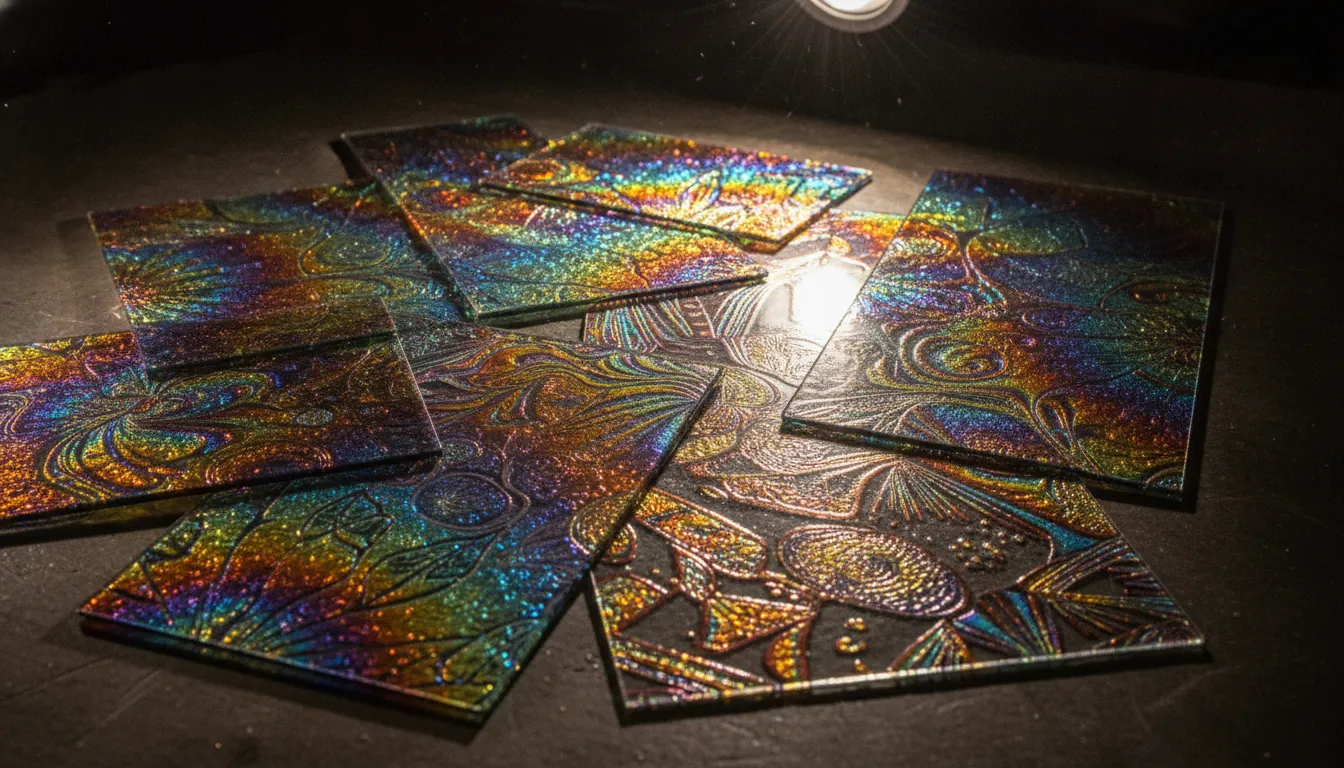
Thin layers of metal oxides permanently fused to glass create the vivid color play known as dichroic. Since 1996, Coatings by Sandberg has led the industry with their innovative vacuum-deposition process. This guide covers how to choose the right coatings and patterns for your next kiln project.
This cbs dichroic glass guide explains how thirty micro-thin layers of metal oxides create the vivid colors and light shifts found in modern fused glass art. These coatings act as interference filters bonded to the glass surface in a vacuum chamber using a process first built for the space and aerospace flight industry. You can choose from forty-five colors and eighteen patterns that reflect one hue while letting another pass through the solid clear or black base glass for a two-tone look. According to the maker CBS, these filters are fused to the glass so they can handle high kiln heat without losing their metallic shine or prismatic beauty.
Most artists know that dichroic glass looks great but they may not know how it behaves in the kiln. You need to understand vacuum thin-film deposition to get the best results. We will start by looking at How CBS Dichroic Coatings Are Made so you can see the magic. The path begins with
How CBS Dichroic Coatings Are Made
CBS dichroic glass is not a product of simple paints or glass stains. It is the result of a highly technical process called vacuum thin film deposition. This science began in the aerospace industry, where engineers used it for satellite parts and optical tools. In 1996, Jerry Sandberg founded Coatings by Sandberg (CBS) to adapt this tech for artists. Today, the family-owned company remains the leader in making these high-quality glass coatings. This tech is still vital for modern aerospace flight and space travel today.
The Vacuum Deposition Process
The journey of a piece of CBS glass starts inside a large vacuum chamber. This sealed space allows for the precise movement of atoms without interference from air. Inside the chamber, an electron beam gun focuses intense energy on specific parts. These items usually include quartz crystals and various metal oxides. The beam heats these solids until they turn into a vapor.
Once vaporized, the parts travel through the vacuum and condense on the surface of the glass. This creates a solid crystal structure that is bonded for good to the glass. Unlike a surface tint, this coating will not peel or fade over time. The process is extremely controlled. Each layer is measured to ensure the glass meets the high standards artists expect from the CBS brand. For more details on these products, you can see our complete CBS Dichroic 101 guide.
Building the Interference Filter
What makes dichroic glass unique is how it handles light. A single sheet can have as many as 30 micro-thin layers of metal oxides and quartz. Together, these layers form what scientists call an interference filter. This filter does not use pigments to create color. Instead, it causes light waves to interfere with each other. This is the same natural effect that creates the rainbow sheen on soap bubbles or oil on water.
These layers are made just for hotworking. This means they can withstand the high heat of a kiln or a torch. Whether you are fusing, slumping, or beadmaking, the coatings stay bright and stable. Because the layers are so thin, they do not change the thickness of the base glass. You can browse our complete collection of CBS COE90 dichroic glass to see the many ways these filters change your art.
Understanding Transmitted and Reflected Color
The most striking feature of a CBS coating is its dual-color shift. This effect depends on how you view the glass. Reflected color is the light that bounces off the surface toward your eyes. Transmitted color is the light that passes through the glass when held up to a light source. For instance, a piece might show a bright blue reflection but transmit a warm gold color.
This dual nature allows artists to create pieces that change as the viewer moves. CBS offers over 45 different colors and 18 patterns to help you reach your goals. Using these coatings gives your fused glass work an expert look that other items cannot match. By choosing the right base and coating, you can create art that sparkles with life and depth in every light.
Solid vs Patterned Coatings: What Is the Difference?
Choosing the right dichroic coating depends on the goal of your glass art. CBS offers two main styles that create very different looks. Solid coatings give a smooth, metallic sheen across the whole surface. In contrast, patterned coatings add geometric shapes and complex light play. Knowing how each one works helps you pick the best glass for your next project.
Uniformity of solid color coatings
Solid coatings are the classic choice for glass artists. CBS provides over 45 different dichroic coating colors to choose from. These coatings create a clean look with one reflected color and a second transmitted color. Because the layers are even, they work well for large focal points. You get a steady glow that changes as the viewer moves.
The science behind these colors is quite complex. Each coating is an interference filter with up to 30 micro-thin layers. These layers are added using a vacuum thin film deposition process. This method uses an electron beam gun to vaporize metal oxides and quartz crystals. The result is a permanent bond that can handle high heat in a kiln.
Intricate details in patterned coatings
Patterned coatings add a new layer of detail to your work. CBS offers more than 18 patterns like Squares, Dots, and Honeycomb. Unlike other methods, these patterns are not made by etching. Instead, CBS integrates the shapes during the coating process. This means the dichroic effect is part of the pattern itself. Each small shape has its own colorful rainbow around the edges.
Artists use these patterns to add texture and interest. Popular options like Aurora Borealis or Corkscrews create a sense of motion. You can find these patterns on many types of glass at ArtGlassSupplies.com, including clear and black bases. They are perfect for jewelry or small accent pieces where you want a lot of detail in a tight space.
Choosing the right style for your work
Both types of coatings are durable and made for kiln work. You can fuse, slump, or bead with them without losing the bright colors. Your choice often comes down to the scale of your piece. Large bowls often look best with solid colors that show off the shape. Small pendants benefit from patterns that catch the eye with tiny details.
| Feature | Solid Coatings | Patterned Coatings |
|---|---|---|
| Variety | Over 45 colors | Over 18 pattern types |
| Visual Look | Smooth, metallic sheen | Shapes with rainbows |
| Best Use | Large focal pieces | Jewelry and small accents |
| Process | Even vacuum deposition | Integrated during coating |
| Light Play | Uniform color shifts | Bright effects near shapes |
How Does Base Glass Selection Change Your Final Result?
The glass base you choose is just as vital as the dichroic coating. Because CBS coatings act as filters, they work with light in two ways: reflection and transmission. Your choice of base glass decides which of these colors the eye sees. Picking the right base helps you control the look and light play of your finished fused glass art.
Clear vs Black Glass Bases
A clear glass base lets light pass through the thin metal oxide layers. This creates a clear effect where the light seen through the glass is visible. If you use a clear base, the glass will show one color when you look through it and a different color when light bounces off the surface. You can learn more about these shifts in our full guide to CBS dichroic colors and patterns which covers common color pairs.
Black glass bases change the look by blocking light. When light cannot pass through the base, the eye only sees the reflected color. This makes the coating look much more solid and rich. Using a black base is the best way to get a deep, metal glow that does not change based on what is behind the glass. Modern dichroic optical effects use these small layers to create unique bright qualities.
Textured Bases and Prismatic Light
Textured bases add a new look to your work by breaking up the flat surface of the coating. Bases like Wissmach Thin Black Florentine or Oceanside Clear Cord Texture create many small angles for light to hit. This creates a prism effect where the color shifts fast as you move the piece. These textures are common for jewelry because they catch the light from every side.
Special textures like Clear Ripple or Black Ripple offer even more bold light play. The deep grooves in Ripple glass cause the coating to pool and stretch. This creates a wide range of hues from a single sheet. You can browse our complete collection of CBS COE90 dichroic glass to find textures like Florentine or Ripple for your next project. Many of these textured types, such as CBS Rainbow 2 on Wissmach Thin Black Florentine, are on sale for about $7.47 per piece.
Understanding COE Compatibility for Fusing
The most vital rule in glass fusing is to match the Coefficient of Expansion (COE) of all materials. COE measures how much glass grows when hot and shrinks as it cools. If you fuse glasses with different COEs, they will pull against each other. This stress leads to “thermal cracking” or “shattering,” often days after the work leaves the kiln. For good results, you must ensure your coating and base glass match. The National Institute of Standards and Technology (NIST) provides data on how heat affects material expansion for many industries.
Matching COE90 and COE96 Systems
Coatings by Sandberg (CBS) makes dichroic glass for the two most common fusing types. COE90 glass works with Bullseye glass. If you use Oceanside or System 96 glass, you must use COE96. You can buy COE90 dichroic glass or browse COE96 dichroic glass to match your base glass. Mixing these two types in one piece leads to failure due to stress. Proper geological standards for minerals and glass help artists understand these physical traits.
Managing Color Shifts After Firing
Dichroic glass often looks different after it goes through a kiln. High heat can cause small “color shifts” in the metal oxides. This is common with coatings like “Cyan/Copper,” where the color may change after a full fuse. To avoid surprises, always fire small test tiles of new colors. This step helps you see the final colors clearly before you start a big project. Checking these changes is a key part of detailed dichroic glass fusing instructions and best practices.
Protecting the Coating with Clear Caps
While CBS coatings are tough, many artists “cap” their glass with a clear layer. This helps in two ways. First, it protects the thin metal layers from wear. Second, the clear glass acts like a lens. It adds depth and makes the sparkle of the coating stand out. When you cap your glass, the clear top layer must also match the COE of the rest of the work. This method keeps the art safe and bright for a long time.
- Check your labels: Always verify the COE of your base glass and your dichroic pieces before you cut.
- Clean all parts: Remove dust from both the coating and the clear cap to prevent bubbles in the kiln.
- Stack your layers: Place your dichroic glass on the base, then add a clear cap on top for more shine.
- Run a test fire: Use small scrap pieces to check for color shifts before you start a major piece.
- Follow fusing steps: Use the right kiln schedule for your glass thickness to get the best bond.
How to Choose the Right CBS Dichroic for Your Project
Choosing the right CBS dichroic glass is based mostly on the size and style of your art. Whether you are making a large platter or small earrings, the type you pick will change how you work. We keep the world’s largest stock of these supplies to make sure you always have the best tools for your studio. We also offer next-day shipping. This helps you get your tools fast and keeps your projects moving. You can browse our full range in the CBS dichroic glass sale collection today.
Full sheets for large focal points
If you want to create a bold focal point, a full sheet is the best choice. A standard round CBS sheet gives you about 283 square inches of space to work with. This large size shows off the deep color-shifting looks of the coating across a wide area. It lets you cut custom shapes with ease and avoids the messy look of piecing small scraps together. Artists often use these for plates, bowls, or large wall hangings. Read our beginner’s guide to dichroic glass sheets for more advice on how to use these large types.
Frit, flakes, and detail work
For smaller pieces or added sparkle, frit and flakes are great options. Dichroic frit comes in small grains that you can sprinkle over your base glass. You can put it over a project to add light-shifting spots without the need for precise cutting. This is much easier and faster than cutting small glass shards by hand. Frit is perfect for making jewelry or adding a starry look to a sky. Stringers, noodles, and firestrips are also good for adding detail. They let you add straight lines to your plans without adding too much weight or bulk to the glass stack.
Dichroic Extract and specialty uses
Dichroic Extract lets you use coatings almost like a paint. You can apply it with a brush to create fine lines, small dots, or broad washes of color on your glass. This new idea gives you full control over the look and lets you sign your work with a shimmer. These coating tools were first made for the flight industry. They help create fine light filters used in high-tech sensors and cameras. You can learn more about how these filters work on the NASA website. Using extract is a great way to add a custom touch that standard glass sheets cannot provide.
Budget and pricing thoughts
Buying high-quality glass does not have to be high cost if you shop during a sale. CBS dichroic glass is now on sale for $6.68 to $8.22 per piece at our shop. This 25% off discount means you can buy many kinds of patterns and colors for your next project. For example, a piece of Blue/Gold on Wissmach Florentine glass is now only $6.68, down from its usual price. This low price lets you try many colors like Magenta or Green without breaking your budget. It is a great time to stock up on the world’s best dichroic glass.
Frequently Asked Questions
What exactly is CBS dichroic glass?
CBS dichroic glass is specialty glass with a micro-thin metallic coating that produces a color-shifting effect. The coating, applied through vacuum thin-film deposition, contains up to 30 layers of quartz and metal oxides that act as an interference filter, reflecting one color while transmitting another.
Why is dichroic glass so expensive?
Dichroic glass is expensive because it requires a complex vacuum deposition process originally developed for aerospace. Each sheet must be loaded into a vacuum chamber where quartz and metal oxides are vaporized by an electron beam gun and condensed into micro-thin layers. This high-tech manufacturing process limits production volume and drives up cost.
What are the different types of dichroic glass?
CBS offers over 18 dichroic pattern types including Squares, Dots, Marquis, Brick, Honeycomb, Balloons, and Boxes, plus solid coatings in over 45 colors. Dichroic glass is also categorized by base glass (clear, black, or textured), COE rating (90 or 96), and product form (full sheets, frit, stringers, noodles, firestrips, extract).
How does the dichroic coating process work?
The coating process uses vacuum thin-film deposition. Quartz crystal and metal oxides are vaporized with an electron beam gun inside a vacuum chamber. The vapor condenses onto the glass surface, forming a crystal structure of up to 30 micro-thin layers that create the interference filter effect.
Can you fuse dichroic glass?
Yes, CBS dichroic glass is specifically designed to be hotworked. It holds up beautifully in a kiln for fusing and slumping, and under a torch for flameworking and beadmaking. Artists typically stack four layers of dichroic (total 6mm) and full fuse in the kiln. Always match COE between dichroic and base glass.
What is the difference between transmitted and reflected color in dichroic glass?
Transmitted color is the color you see when light passes through clear dichroic glass. Reflected color is the color you see when light bounces off the coating surface. Because the interference filter layers interact differently with light at different angles, these two colors are often completely different, creating the signature color-shifting effect.
Does the base glass affect how dichroic looks?
Yes, base glass dramatically affects the final appearance. Clear base glass allows transmitted color to show through, creating a translucent effect. Black base glass blocks transmission so only the reflected color is visible. Textured bases like Florentine or Ripple add prismatic light play that shifts with every angle.
What COE should I choose for dichroic glass?
Choose COE90 if you work with Bullseye glass and COE96 for Oceanside or System 96 glass. CBS produces dichroic coatings in both COE ratings. The dichroic glass and your base glass must share the same COE to prevent cracking during firing from thermal stress incompatibility.