
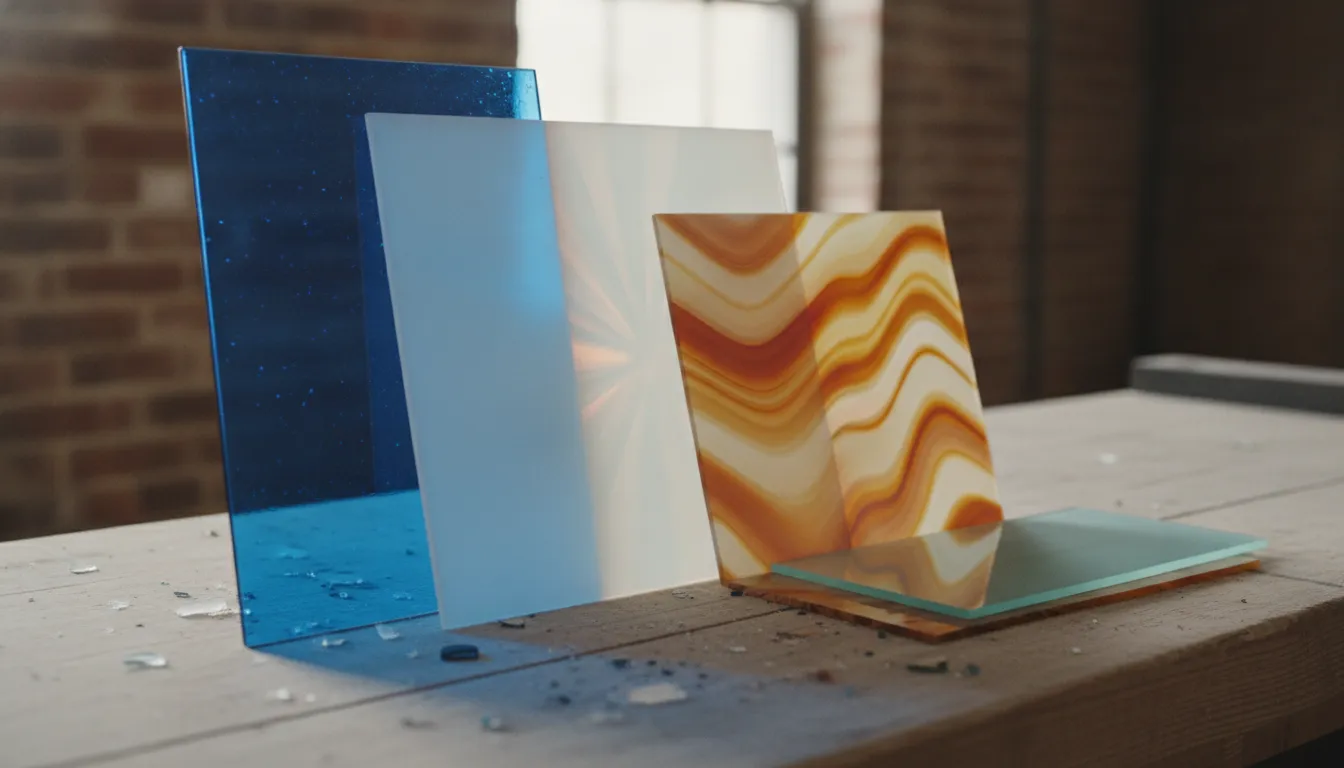
Sheets of colored glass are flat art-glass panels an artist cuts for stained glass or stacks and fires in a kiln. A sheet that looks right on a screen can still be the wrong sheet once you hold it to a window or set it on a second color. Light transmission, thickness, and expansion family decide whether the piece reads the way you planned and whether a fused stack survives cooling.
Shop COE90 colored glass sheets
Read each sheet in three passes before you buy.
- Hold it to the light and name the style by how much light passes through.
- Check the thickness against the job, not against the color you liked in the photo.
- Confirm one compatibility family for every glass in a fused piece, including viscosity as well as COE.
The notes below use Bullseye COE90 sheets as the worked example, because that is the line most studio artists start with. The same reading method applies to COE96.
What Sheets of Colored Glass Actually Are
A sheet of colored glass is a flat panel of art glass, colored in the melt, sold so you can cut it into the shapes a design needs. It is not window glass, and it is not a finished panel. Window float is formulated for buildings. Art glass is formulated for color, texture, and, in the fusible lines, for firing with other glasses from the same family.
Most studio sheets come in two everyday thicknesses. Bullseye sheets in this shop are sold as double-rolled 3 mm and thin-rolled 2 mm, and the glass is handmade, so a factory edge can be rolled rather than cut square. Dimensions are approximate. On the Art Glass Supplies COE90 sheet category, the same split shows up as opalescent and transparent glass in 3 mm and thin-rolled 2 mm, plus collage, streaky, iridescent, and special-production sheets.
Color is part of the glass, not a film you can peel off. That is why a photograph is only a starting point. Bullseye notes that colors can vary between production runs, and that some colors change with repeated firing or heavy heatwork. Glasses marked as strikers look pale, or even clear, until they reach the right temperature and mature into the catalog color. If you need a close match, test the new sheet on the same cycle you will use for the finished piece.
Read the Sheet by How Light Passes Through It
Those style names describe how light behaves, not which company made the glass. Warm Glass sorts sheet glass the same way: glass you can see through is transparent, also called cathedral, and glass that blocks the view is opalescent or opal.
Hold the sheet up. If you can see the room through the sheet, you are looking at a transparent. If the sheet glows and hides what is behind it, you are looking at an opalescent. If two or more colors run in bands, you are looking at a streaky. If the surface flashes rainbow as you tilt it, the sheet is iridescent.
| Style. | What you see. | Best first use. | Watch-out. |
|---|---|---|---|
| Transparent. | Clear color you can see through. | Suncatchers, windows, and light-through stacks. | Dark transparents can look nearly black in a thick stack. |
| Opalescent. | Glowing color that blocks the view behind it. | Solid color fields, jewelry bases, and mosaic. | A photo often looks flatter than the sheet in daylight. |
| Streaky. | Bands of two or more colors in one sheet. | Sky, water, leaves, and varied backgrounds. | The streak you want may sit on one side of the sheet. |
| Iridescent. | A metallic flash on the surface. | Accent pieces and cold glass that will not be buried. | Fusing can soften or change the coating. |
Transparent glass is the right call when light is the point. A pale blue transparent in a suncatcher stays luminous. The same blue stacked three layers deep in a fused tile can go much darker than the single sheet suggested. Opalescent glass does the opposite job. It holds a color even when the piece sits against a wall. If you want the longer treatment of that glow, the opalescent glass sheets guide covers it on its own.
Streaky and iridescent sheets are accents more often than they are the whole design. Cut the streaky so the band you care about lands inside the shape, not in the offcut. Keep iridescent glass on a face you will still see after firing. A coating trapped between two sheets rarely looks the way it did on the bench.
Match Thickness to the Job
Thickness changes three things at once: how the sheet cuts, how much volume it adds in the kiln, and how dense the color becomes. Use the order below when two versions of the same color are both available.
- Name the process first. Cold stained glass and fused glass do not want the same stack.
- Pick 3 mm for a standard single layer, a mosaic tile, or the base of a fused piece.
- Pick 2 mm when you need a thin cap, a delicate jewelry layer, or less volume in the kiln.
- Reach for 6 mm clear Tekta only when the design needs a thick clear base, not when you simply want more glass.
- Count layers before you buy. Two 3 mm sheets are already a full fuse thickness for many small pieces.
A double-rolled 3 mm sheet is the usual studio default. It is stiff enough to score cleanly for copper-foil and leaded work, and it is the usual base under frit, stringer, or a second sheet. Thin-rolled 2 mm glass bends more in the hand and adds less volume, which is why jewelers use it for small caps and why a full sheet of it feels surprisingly flexible. The guide to working with 2 mm glass goes further into that choice if the project is already heading thin.
Clear Tekta is the exception, not a third everyday color sheet. Art Glass Supplies lists Bullseye clear transparent Tekta as a double-rolled 6 mm COE90 sheet. Use it when a design needs a thick clear plinth or a single clear layer that would otherwise be two 3 mm clears. Do not assume every color exists at 6 mm. Most color styles stop at 2 mm and 3 mm.
Volume is the mistake that surprises new fusers. Glass does not disappear once the kiln reaches process temperature. It flows until the stack reaches a thickness the firing schedule and the mold will allow.
A 3 mm base plus a 3 mm color cap is a normal full-fuse sandwich. Add a third 3 mm layer and the piece can spread, thin at the edges, or overflow a small mold. If you are unsure how thick the finished piece should be, read the glass thickness for fusing guide before you cut the second sheet.
Keep One Expansion Family in the Kiln
Coefficient of expansion, usually shortened to COE, is the number studios use as a first label for which glasses can be fired together. It describes how much a glass grows as it heats and shrinks as it cools. Bullseye’s tested compatible line is sold as COE90. Oceanside and many other fusing glasses are sold as COE96. Fuse COE90 glass only with other COE90 glass, and keep COE96 glass with COE96. Window glass belongs to neither family.
COE is not the whole story, and the manufacturer says so. Warm Glass explains that matching COE numbers is not the whole compatibility test, because viscosity matters as well as expansion. Viscosity is how stiff the glass stays as it heats. The softening point is the temperature where that stiffness drops enough for the glass to sag under its own weight and start to flow.
Two sheets can share a published COE and still soften at different temperatures. The softer glass starts to move while the stiffer glass is still holding its shape. As the stack cools, those layers lock together at slightly different moments. The result is internal stress, even when the expansion numbers looked close on the label. That stress can show up later as a crack, a warp, or a piece that fails weeks after it left the kiln.
That is why a tested line, fired on a known schedule, is safer than mixing close numbers from different makers. A practical studio check fuses small squares on a clear base of known COE, then views the cooled stack between crossed polarized sheets. Stress shows up as a bright halo. The halo is the visible sign that expansion, viscosity, or both did not stay in step through the firing.
For a buying decision, you do not need to repeat that lab method. You need the compatibility label on every item in the stack. If the project will be fired, every sheet, frit, and stringer should carry the same COE as the base, and it should come from a line the maker has already tested to soften together. The COE 90 versus COE 96 comparison covers firing differences if you are still choosing a system. Once you have chosen, stay inside it.
Cold construction is more forgiving than kiln work. A stained-glass panel holds pieces with foil or came, so the glasses are not melted into one sheet. You can combine colors from different makers in a leaded window. You still should not later fuse those mixed scraps. A pretty offcut from a non-fusible stained-glass assortment can crack a kiln piece even when the color is perfect.
Choose a Sheet for the Project in Front of You
The same blue can be the right sheet for one object and the wrong sheet for another. Walk the choice in project order, then open the matching category.
A fused tile, plate, or jewelry stack
Start in one family. For Bullseye, that is the COE90 sheet glass category. Use a 3 mm transparent or opalescent as the base. Cap it with 2 mm or 3 mm from the same COE. If the color must stay solid against a table, choose opalescent. If you want light through a suncatcher-style tile, choose transparent and stop at two layers unless you have tested the darker stack. Keep iridescent glass on the top face.
A copper-foil or leaded panel
Cold glass cares more about texture and how the color looks at the window than about kiln volume. Transparent and streaky sheets at 3 mm are the usual panel glass. Opalescent sheets block light, which is useful for flesh, gowns, and areas that should not glow. Non-fusible stained glass from Oceanside, Wissmach, and Youghiogheny lives in the stained glass section. Do not buy that glass for a fusing project just because the color is hard to find in a fusible line.
A first COE96 project
If your kiln shelf, frit, and existing scrap are already COE96, do not switch families for one pretty COE90 color. Shop the COE96 glass collection and apply the same light-and-thickness reading. The style words match. The expansion number does not, and neither does the softening behavior. Mixing the two families is how a stack that looked compatible on the bench ends up stressed after cooling.
Cut the glass only after the sheet passes those checks. A clean score depends on a flat, correctly supported sheet and a sharp cutter, which the how to cut glass for fusing article covers. Selecting the sheet and cutting the sheet are separate jobs.
What to Check on the Product Page
A product title on this site already carries the facts you need, if you read it in order. Take Bullseye Glass Red Transparent, Double-rolled, 3 mm COE90. The color is red, the style is transparent, the thickness is 3 mm, and the family is COE90. The clear thin sheet is named the same way: Clear Transparent, Thin-rolled, 2 mm COE90. Tekta is named Clear Transparent Tekta, Double-rolled, 6 mm COE90.
Size is the next line on the page, and it changes what you pay more than the color name does. Ignore the dollar figure until the style, thickness, and COE already match the job. Then buy the smallest cut that contains your pattern plus a little practice glass.
A small piece or a 5 by 10 inch cut is enough for a test tile and a first jewelry stack. A 10 by 10 inch cut covers a small tile or a suncatcher with room to recut. Move up to a half sheet only when you already know you will use that color again. A full sheet is a studio staple, not a first experiment.
Three page checks prevent most bad orders:
- The COE in the title matches every other glass in a fused piece, and the glasses come from one tested line so they soften together.
- The thickness matches the layer you are filling, not just the color you liked.
- The style word matches the light you want: transparent, opalescent, streaky, or iridescent.
Handmade glass also has a rolled edge, and Bullseye says dimensions are approximate. Plan the pattern inside the sheet, not flush to a factory edge that may be thicker or curved. If a color is a striker, the cold sheet may not show the fired color. Read the product notes and test a scrap before you cut the whole design from it.
Compare COE90 sheet styles and thicknesses
FAQ: Sheets of Colored Glass
What are sheets of colored glass used for?
Artists cut them for stained-glass panels, mosaics, and fused pieces such as tiles, plates, and jewelry. The same color can serve any of those jobs only when the thickness and, for kiln work, the COE also fit the project.
What thickness should a beginner buy?
Start with double-rolled 3 mm. It is the standard single layer for cold glass and the usual base for a first fused stack. Add 2 mm later, when you need a thin cap or a small jewelry layer.
Can I mix different colored sheets in one fused piece?
Yes, if every sheet is tested compatible and labeled with the same COE. COE90 fires with COE90. COE96 fires with COE96. A matching color from window glass or from the other COE can crack as the piece cools, because the glasses expand and soften at different rates.
Why does the sheet look different from the photo?
Art glass is handmade, so color shifts between runs, and strikers develop their real color only after firing. Hold a transparent to the light, and judge an opalescent in daylight, before you trust the screen.
Do I need a full sheet?
Usually no. A 10 by 10 inch cut, or even a 5 by 10 inch cut, is enough for a first project and a test tile. Move up to a half sheet when you already know you will use that color more than once.
Pick the Sheet, Then Cut
Choose how the light should behave, then the thickness, then the compatibility family. A transparent 3 mm COE90 sheet, an opalescent 2 mm cap, and a 6 mm clear Tekta base are three different tools, even when the catalog calls all of them sheets of colored glass. Once those three facts match the project, the color choice is the fun part.
If you are ready to compare real cuts, start with COE90 colored glass sheets and filter by opalescent, transparent, streaky, or iridescent. For a cold panel, use the stained glass section instead. Questions about a specific sheet can go through the support form.