
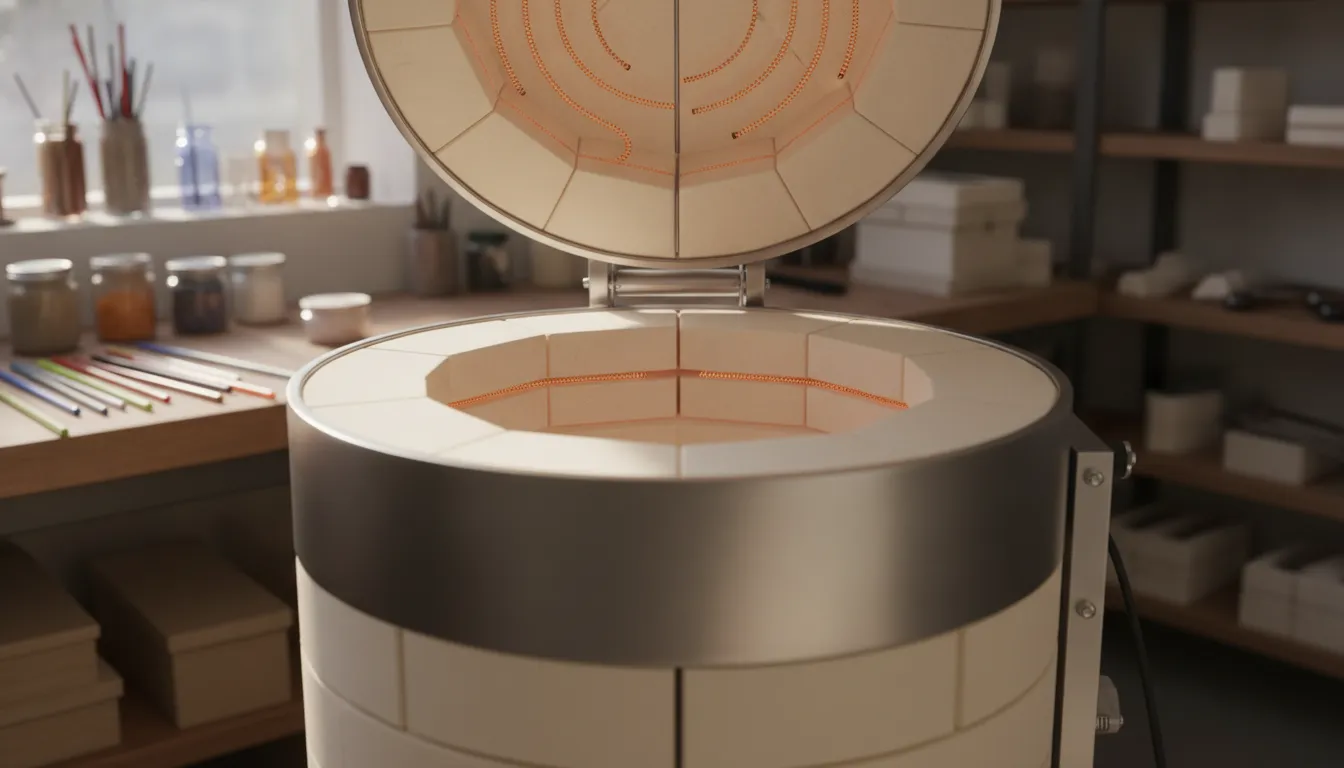
What is a kiln made of if it has to hold more than 2,000 degrees without falling apart? A studio electric kiln is not a metal box with a heater dropped inside. It is a stack of soft refractory brick, clamped by stainless bands. With heating elements seated in grooves, a thermocouple that measures the heat, and a controller that switches the power. Those five parts are the kiln. Everything else is hardware that lets you open, load, and vent it.
If you only need the job a kiln does, start with the beginner’s guide to glass fusing kilns. This page stays on the materials. The worked example is the Skutt KM1222-3, a sectional ceramic kiln sold by Art Glass Supplies with 3-inch energy-saving brick, a Type K thermocouple, and balanced elements.
What Is a Kiln Made Of in a Studio Model
Ask five glass artists what a kiln is made of and most will answer with brick. That answer is correct, and it is incomplete. The brick contains the heat. It does not generate the heat, measure it, or decide when the firing should stop.
On a top-loading electric kiln the wall is a ring of machined refractory brick. A stainless band clamps that ring. Coiled elements sit in grooves cut into the brick. A thermocouple pokes into the chamber. A low-voltage controller reads that probe and tells relays when to feed the elements. The lid, hinge, and lifter are hardware on top of that system.
The KM1222-3 lists those parts in plain language on its product page: lid lifter, sectional design, balanced elements, Type K thermocouple, and energy-saving 3-inch brick. Its chamber is 28 inches across and 22 inches deep, about 8.1 cubic feet, and it is rated to 2350°F on a 240-volt, single-phase circuit. That rating is a property of the brick and the elements together, not of the steel skin.
| Part | What it is made of | What it does | On the KM1222-3 |
|---|---|---|---|
| Wall and lid. | Soft refractory firebrick. | Holds heat in the chamber. | 3-inch energy-saving brick. |
| Bands. | Stainless steel. | Clamp the brick rings tight. | Sectional rings you can separate. |
| Elements. | Coiled resistance wire. | Turn electricity into heat. | Balanced elements in the brick. |
| Thermocouple. | Type K metal probe. | Reports chamber temperature. | Type K thermocouple. |
| Controller. | Low-voltage electronics and relays. | Switches power from the temperature reading. | Current-sensing control. Touchscreen upgrade sold separately. |
Kiln Arts, a kiln-education site, describes the same stack for home top-loaders: refractory brick, stainless bands, a thermocouple, and an automatic controller. Their kiln anatomy guide is a useful cross-check if you want the maintenance side of each part.
The Brick That Holds the Heat
Kiln brick is a refractory ceramic, fired so it survives the same temperatures you ask of the ware. It is not the dense brick used in a wall or a patio. Makers mix crushed refractory material with wood pulp, then fire the mix so the pulp burns out. The tiny air pockets left behind are the insulation. Air conducts heat poorly, so a light brick keeps heat in the chamber instead of dumping it into the room.
Three inches is the wall thickness called out on the KM1222-3. Thinner brick lets more heat into the room, and thicker brick adds weight and cost. This model ships at 330 pounds, and most of that weight is brick, not the steel jacket. Treat the surface like chalk rather than a patio paver, because a shelf corner or a dropped tool will gouge it.
Lid and floor bricks are mortared, then cut to shape. Sidewall bricks usually are not mortared. The stainless band is what keeps them in a circle. Grooves machined into the brick hold the elements. On many top-fired glass kilns those grooves are cut into the lid instead, so the heat comes from above the glass. A ceramic model like the KM1222-3 puts elements in the wall sections.
That difference matters when you move from clay to glass. A glass firing cares about even heat across a flat shelf, then a controlled cool so the sheet does not shock. The guide to choosing a glass fusing kiln covers element placement and fiber versus brick for that job. This page only needs the material: soft brick, with air trapped in it, cut to hold the wire.
Stainless Bands and the Hardware You Can See
The shiny jacket is not the hot face. It is only a clamp around the brick. Stainless bands wrap each brick ring and pull tight with worm screws. Stainless resists rust better than plain steel, but it still corrodes if it stays wet or sits in salt and sulfur fumes. Wipe the bands after a damp day, and do not store a wet kiln in a closed shed.
Because the side bricks are not mortared, a loose band lets the ring shift. A shifted ring pinches an element groove or opens a gap that leaks heat. On a sectional kiln you can unbolt the bands and separate the rings to move the kiln through a doorway. The KM1222-3 calls this out as sectional design. The 28-inch opening and 22-inch depth are chamber sizes, not the outside crate size, so measure the doorway against the banded rings, not against the shelf.
Hardware bolted to those bands includes the hinge, handles, latches, and the lid lifter. The lifter is the part that matters on a kiln this size. A brick lid over a 28-inch opening is heavy, and the lifter plus a lid brace hold it up while you load. Kiln Arts flags the lid brace on larger kilns because it is what keeps the lid off your head. Check those bolts a few times a year. Heat and vibration walk them loose.
Peep plugs are small brick stoppers in holes through the wall. Older firings used those holes so you could watch a pyrometric cone bend, and with an automatic controller the holes are mostly vents. You pull a plug to let fumes out or to speed a cool-down. They are the same refractory material as the wall, just small enough to handle with gloves.
Elements, the Thermocouple, and the Controller
The heat comes from resistance wire, because electricity pushed through a coiled element turns into heat the way a toaster does, only at a much higher temperature. The coils sit in the brick grooves so the brick supports them as they grow and shrink. Balanced elements on the KM1222-3 means the coils are laid out so one side of the chamber is not doing all the work. A tired element runs cooler in one zone, and glass shows that as an uneven fuse long before clay does.
The thermocouple is the thermometer. A Type K probe is two dissimilar metals joined at the tip, and heat at that joint creates a small voltage the controller turns into a temperature. The KM1222-3 uses a Type K thermocouple, the common hobby-kiln probe. It is inexpensive, and it does wear out. As it ages it tends to read low, so the kiln fires hotter than the display says. That drift is gradual. A cone placed on the shelf now and then tells you the probe still agrees with the heat the ware actually received.
The controller is the switch, not the furnace. Line power, 240 volts and 48 amps on this model, comes in through a 6-50 receptacle on 6-gauge wire. A transformer drops a small share of that power to about 24 volts for the electronics. The controller reads the thermocouple and tells the relays when to send full line power to the elements. It can ramp, hold, and cool on a schedule, but it cannot invent heat the elements and the brick cannot support. The 2350°F figure is the chamber limit those parts are built for.
Current-sensing technology, also listed on this kiln, watches whether the elements are actually drawing power. A dead element or a failed relay shows up as a current problem instead of as a mystery cool spot after the firing. A KilnMaster touchscreen controller is sold as a separate upgrade, not as a different pile of brick. You can change the brain without rebuilding the chamber.
None of this replaces a firing schedule. Once the parts are clear, the guide to using a glass fusing kiln walks through loading and the first firing, while the materials only explain why that schedule is possible.
How the KM1222-3 Uses Those Materials
Put the parts back together and the product page reads as a materials list with dimensions attached. Each line below is one material doing one job, not a second definition of what a kiln is for.
- A 3-inch brick chamber, 28 by 28 inches at the opening and 22 inches deep, gives 8.1 cubic feet rated to 2350°F.
- Stainless bands and a sectional build let the rings come apart for a move, then clamp tight again.
- Balanced elements in the brick turn a 240-volt, 48-amp, 11,520-watt supply into heat.
- A Type K thermocouple and a current-sensing controller decide when that power flows.
- A lid lifter holds the brick lid so the chamber can be loaded from the top.
Art Glass Supplies does not stock this kiln on a shelf. It is built to order and drop-shipped from the manufacturer. After the order is finalized, the shop contacts you with shipping, tax where it applies, and the lead time. A 208-volt version of the same model is also available. The brick, elements, and probe do not change. The supply they are built to meet does.
The product copy describes the chamber as a fit for a small pottery studio, including an easier load for people who struggle with a tall kiln. Glass artists use the same materials. What changes is the shelf, the schedule, and whether you need elements in the lid. For that choice, use the glass fusing kiln size guide rather than stretching this parts list into a buying ranking.
Shelf paper, kiln wash, and posts are not part of the kiln body, because they are consumables that protect the brick floor. The kiln shelf primer covers the first firing of that furniture. Skip them and you glaze the brick, which is a repair rather than a feature.
What to Check Before You Order
A materials check is short, and it is worth doing before the crate ships. You are confirming the kiln in the box matches the kiln in the spec, and that your room can feed the circuit those materials expect.
- Read the brick thickness and the max temperature together. On this model that pair is 3-inch brick and 2350°F.
- Match volts, amps, wire, and receptacle before you fall in love with the chamber. Here that is 240 volts, 48 amps, 6-gauge wire, and a 6-50 plug, unless you order the 208-volt build.
- Confirm the probe type. Type K is standard and replaceable. Ask who sells the spare before the first one drifts.
- Look for a lid lifter and a brace on any kiln with a wide brick lid. A 28-inch lid is not a jewelry-kiln door.
- Ask whether the rings separate. Sectional brick is how a 330-pound kiln gets down a stair.
If the circuit is the open question, stop there. A kiln made of the right brick still will not fire on a dryer outlet that uses the wrong plug or the wrong amperage. The ceramic kilns collection is the place to compare other Skutt chambers once the supply is settled. For a glass-only top-loader, browse kilns for glass work and keep this parts list as the checklist.
Review the KM1222-3 materials and price
Frequently Asked Questions
What is a kiln made of besides metal?
The hot face is soft refractory brick, not the steel you see outside. Stainless bands only clamp the brick, while heating elements, a Type K thermocouple, and a controller sit in or on that brick shell.
Why is kiln brick so light?
It is full of tiny air pockets left when wood pulp burns out during manufacture. Those pockets insulate, so a 3-inch wall can hold a 2350°F chamber without becoming solid masonry.
What does a Type K thermocouple do?
It is the temperature probe. Two metals at the tip make a small voltage as they heat, and the controller converts that voltage into the number on the display. When the probe ages, the kiln can fire hotter than that number.
Are the heating elements part of the brick?
No. They are coiled wire laid in grooves cut into the brick, or pinned in the lid on many glass kilns. The brick supports them, and the wire makes the heat.
Does a glass kiln use different materials than this ceramic kiln?
Often the lid elements and sometimes the insulation change. Many glass kilns fire from the lid and some use ceramic fiber instead of brick. The KM1222-3 is a brick, wall-element ceramic kiln. Read the fusing-kiln guide before you assume the same chamber is the right glass tool.
See the Materials on One Kiln
You now have the short list: refractory brick, stainless bands, resistance elements, a Type K thermocouple, and a controller. The KM1222-3 is one place those parts are written down with sizes and a real electrical spec. Art Glass Supplies builds that kiln to order and can quote shipping and lead time once the order is placed with the manufacturer.
Use the Art Glass Supplies contact page if you want help matching the 240-volt build, or the 208-volt option, to the circuit you actually have. Have the breaker size and the receptacle type ready before you write.