
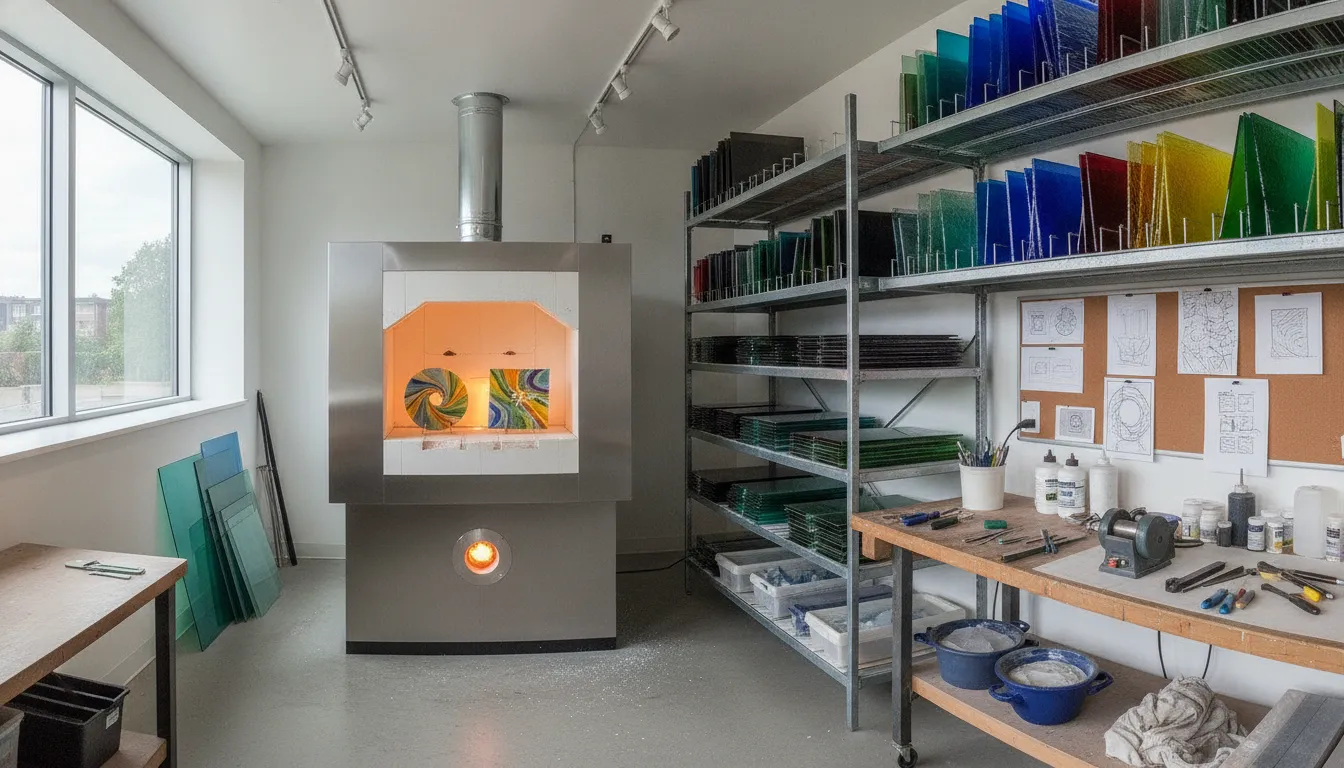
Selecting the wrong equipment can ruin hours of delicate prep work before the firing cycle even begins. A dedicated glass fusing kiln is the most critical investment in your studio, directly affecting how your glass slumps, fuses, and anneals.
A quality glass fusing kiln must deliver precise temperature control, even heating across the chamber, and programmable ramp-and-hold cycles to prevent thermal shock. Entry-level kilns like the Skutt FireBox series run on standard household outlets and are perfect for small jewelry and coasters. Mid-range studio kilns provide larger chambers for bowls and plates but often need dedicated 240-volt wiring. Production kilns from Olympic support heavy casting and large-format art.
Determining which tier fits your current space and future artistic goals is the first step toward successful firing. Before looking at specific models, you must understand the core technical features that separate glass equipment from traditional ceramic ovens.
What Makes a Kiln Suitable for Glass Fusing?
Glass is highly sensitive to heat and thermal shock. To work with this material safely, you need a kiln designed to meet its unique physical needs. While ceramic kilns apply heat from the sides to bake clay, a proper glass fusing kiln must distribute heat evenly across the flat surface of the glass. This even heat helps prevent cracking during the delicate stages of heating and cooling.
The Vital Temperature Range
A suitable kiln must easily reach and hold specific temperatures for different glass effects. Slumping and draping projects require temperatures around 1300 degrees Fahrenheit to shape glass over molds. For a tack fuse where pieces stick together but keep their textured edges, you need a range of 1350 to 1370 degrees Fahrenheit. A full fuse that melts glass into a smooth, glossy sheet requires hotter temperatures of 1460 to 1470 degrees Fahrenheit. The kiln must have the power to hit these targets without over-firing the glass.
The Need for Digital Controllers
You cannot fuse glass successfully by manual adjustment alone. Glass requires precise rate-of-rise and cooling cycles to relieve internal stress. Modern electric glass kilns use programmable digital controllers to automate these cycles. These devices let you set specific ramp rates, target temperatures, and soak times. You can slow the temperature drop during the annealing phase to keep the glass stable. This exact control protects your work from breaking as it cools down to room temperature.
Why Glass Kilns Differ from Ceramic Kilns
Ceramic kilns are built to reach much higher temperatures than glass kilns, often exceeding 2000 degrees Fahrenheit. They use side heating elements because pots and clay pieces sit tall inside the chamber. In contrast, glass kilns usually place heating elements in the lid. This top-fired design ensures that the flat surface of your glass sheets heats at the same rate. Additionally, specialized glass controllers are configured to prevent you from running high-heat ceramic programs. This built-in safety feature protects your glass from over-firing and melting into a puddle.
Explore our full selection of Skutt glass fusing kilns to find the right model for your studio.
Entry-Level Kilns: Skutt FireBox Series
When you start your journey in glass art, choosing your first glass fusing kiln is a major step. For beginners, hobbyists, and jewelry makers, a compact and reliable tabletop unit is often the best choice. Skutt beginner and test kilns offer a perfect balance of size, ease of use, and professional control without needing high-voltage studio power. They are designed to plug into standard household outlets, making them simple to set up in a spare room or home garage.
A Closer Look at the Skutt FireBox Models
The Skutt FireBox family is the industry standard for entry-level glass crafting. Each model is built with top-quality materials to ensure safe, even heating up to 1700°F. The base model is the FireBox 8, which features an eight-inch square interior and is available on sale for $976, down from its regular price of $1,220. If you want to fuse longer glass art items like bracelets or small plates, the FireBox 8×4 starter series is an excellent choice. This elongated model is priced at $1,004 on sale and provides extra length for rectangular projects. For those who need more height, the FireBox 8×6 is available for $1,104, while the larger FireBox 14 studio series is on sale for $1,412, down from $1,765.
Modern Controls for Consistent Results
A common worry for new glass artists is managing the complex heat cycles needed for glass work. Precise temperature control is critical to prevent thermal shock and devitrification. Thankfully, all new FireBox models now ship with a digital mini touchscreen controller. This advanced unit automates your firing steps, making it easy to program custom ramps and holds for a perfect tack fuse or full fuse. The touchscreen makes kiln programming simple, so you can focus on your art rather than technical details. It is also worth noting that the popular HotStart Pro model has been discontinued by Skutt, making the FireBox series the go-to line for modern entry-level glass artists.
Why Start with a Tabletop Kiln?
These compact units are highly efficient because they heat up and cool down much faster than large studio kilns. They use less power, which keeps your utility costs low as you learn and test new techniques. Whether you want to buy your first small kiln or need a secondary test kiln for your studio, you can find the Skutt glass fusing kiln lineup on our site. These models allow you to run small test firings with different glass types and COEs before committing your materials to a larger production run. For more information on educational glass processes and kiln operation, you can consult the guide from The Art of Education University to understand firing steps.
Mid-Range Studio Kilns: Skutt GM Series
For serious glass artists and small studios, a mid-range glass fusing kiln offers the perfect balance of chamber space and precise control. The Skutt GM series is a top choice in this category, delivering professional-grade performance without the footprint of industrial models. These electric kilns provide consistent temperature control through convenient digital firing, which is essential for managing the complex thermal cycles of glass art. You can learn more about digital heat controls on the University of Texas at Arlington resource site.
Skutt GM814 versus GM1014 Dimensions
Selecting the right model within the GM series depends on your production needs and the size of your projects. The Skutt GM814 measures 17.5 inches deep by 14 inches wide, making it a compact yet highly capable unit for standard studio work. If you need more space, the Skutt GM1014 offers a larger chamber that easily accommodates larger molds and multiple pieces in a single firing. Serious hobbyists can view the full Skutt kilns catalog to compare these dimensions and find the perfect match for their workspace.
The GlassMaster Touchscreen Advantage
A key differentiator for glass-only studios is the optional GlassMaster Touchscreen controller. Standard kiln controllers often include pre-set programs for firing clay, which can reach temperatures that will ruin glass. The GlassMaster Touchscreen ships with these ceramic programs turned off, acting as a built-in safeguard to protect your work from accidental over-firing. This specialized design ensures your projects never exceed the exact heat curves required for fusing. For more details on these custom safety settings, you can check the Skutt glass kilns documentation. This high level of control makes the GM series an ideal glass fusing kiln choice for artists who demand consistent, repeatable results.
Production Kilns: Olympic and Large-Format Options
High-volume studios and professional artists need a heavy-duty glass fusing kiln to handle large projects. Large-format kilns provide the space and power required for volume production, deep glass casting, and massive commissioned installations. These units are built to withstand daily firings and maintain stable temperatures across broad chambers.
Olympic Production Models
Olympic kilns are known for their strength and size. Art Glass Supplies carries 65 models of Olympic kilns to fit any commercial layout. Many of these units belong to the Olympic GF series, which are built specifically for glass work. These large electric chambers can fire up to 1700°F or higher, making them excellent choices for complex glass casting and large slumped pieces.
Skutt Large-Format Alternatives
Skutt also offers top-tier options for commercial glass artists. The Skutt GM818 is an 18-inch diameter model priced at $2,432 that works well for medium-sized production runs. For the largest projects, the GM1414 offers a massive 28-inch diameter chamber. These electric models use digital controllers to run complex firing schedules, ensuring your glass pieces cool down slowly and safely.
The Value of Side-Firing Elements
When firing deep molds or multiple shelves of glass, even heat is critical. According to operational guides from Skutt, side-fired production and annealing kilns are designed to spread heat evenly from top to bottom. These specialized heating configurations prevent cold spots in the chamber. Uniform heat is vital during the annealing phase to remove thermal stress from the glass and prevent cracking. Studies from the University of Texas at Arlington show that electric digital systems are the most reliable way to maintain consistent heat control throughout these long, delicate cooling segments.
Key Specifications to Compare
Selecting the right Skutt glass fusing kiln or Olympic model requires a close look at technical specifications. Key details like interior size, maximum temperature, and controller types directly impact what projects you can make. Understanding these elements helps you choose a machine that matches your workspace and artistic goals.
Firing Temperature and Heating Elements
Unlike ceramic units that heat from the sides, a glass fusing kiln typically uses heating elements in the lid to ensure even heat across the flat glass surface. This design prevents thermal shock during critical firing stages. Proper glass work relies on programmable ramps and holds to control the rate of temperature rise and cooling, which you can read about on The Art of Education. For example, a tack fuse at 1350 to 1370 degrees Fahrenheit lets glass pieces stick together while keeping their relief and edges. Raising the temperature to 1400 to 1450 degrees Fahrenheit produces a medium fuse with rounded, safe-to-touch edges. A full fuse at 1460 to 1470 degrees Fahrenheit results in completely smooth, glossy glass with no texture.
Kiln Controller Types
Precise temperature control is essential for successful firing cycles. Modern electric glass kilns feature digital firing systems that allow you to program multi-step heating segments. Manual controllers require constant monitoring, while digital and touchscreen controllers automate the ramp and soak stages. Some advanced controllers are specifically set up to protect your work. For instance, the GlassMaster touchscreen controller from Skutt ships with ceramic programs disabled to prevent accidental over-firing, which is explained on the Skutt official site. This safety feature ensures you do not overheat your glass projects by running a ceramic schedule by mistake.
Interior Size and Power Requirements
The interior dimensions of a kiln limit the size of your projects and the volume of work you can fire at one time. Smaller test kilns are perfect for jewelry and test tiles, while larger production models fit wide shelves for bowls or architectural glass. You must also check your studio power supply before buying. Small kilns often run on standard 120-volt household outlets, but mid-range and production models need a dedicated 240-volt circuit. Make sure your workspace can support the electrical needs of your chosen model.
| Kiln Line | Interior Size | Max Temp | Controller Type | Power Requirement | Best For |
|---|---|---|---|---|---|
| FireBox 8 | 8 in x 8 in | 1700 degrees F | Mini Touchscreen | 120V | Beginners, jewelry, test tiles |
| FireBox 14 | 14 in x 14 in | 1700 degrees F | Mini Touchscreen | 120V | Small plates, home hobbyists |
| GM814 | 17.5 in x 14 in | 1800 degrees F | GlassMaster / GMT | 240V | Serious hobbyists, small studios |
| GM1014 | 23.5 in x 14 in | 1800 degrees F | GlassMaster / GMT | 240V | Large slumping, professional studios |
| GM818 | 18 in x 18 in | 1800 degrees F | GlassMaster / GMT | 240V | Production artists, deep molds |
| Olympic GF Series | Varies by model | 1700 degrees F+ | Digital / 3-Key | 120V or 240V | Commercial studios, high volume |
How to Match a Kiln to Your Studio and Budget
Selecting the right glass fusing kiln requires a clear plan. You must balance your physical workspace, your artistic goals, and your financial limits. Following a structured process helps you find the best machine for your glass art without overspending.
A Step-by-Step Selection Guide
- Check your power and space. You must find where the kiln will sit and how much power you have. Small kilns run on standard 120-volt home outlets. Larger studio models require a dedicated 240-volt circuit. Make sure your workspace has proper ventilation and at least 12 inches of clearance from walls.
- Define your project size. Your kiln must fit the glass projects you want to make. Small test kilns are perfect for jewelry and small coasters. Medium models handle panels up to 12 inches. Large production units are needed for big commissioned glass art or multiple pieces at once.
- Match your firing needs. Different techniques require specific heat profiles. Tack fusing at 1350-1370 degrees Fahrenheit keeps texture, while full fusing at 1460-1470 degrees Fahrenheit creates smooth glass. Ensure your kiln can run precise schedules for slumping, casting, and annealing.
- Set your budget range. Entry-level kilns cost between $976 and $1,104. Mid-range studio models run from $2,188 to $2,800. Production-grade kilns start at $2,432 and go up. Always factor in the cost of kiln furniture, safety gear, and electrical work.
- Choose your controller type. Manual controllers require constant monitoring. Digital controllers automate the ramp and soak segments for consistent results. Advanced touchscreen controllers like the GlassMaster protect glass from over-firing by disabling standard ceramic programs.
- Plan for future growth. Many glass artists outgrow their first kiln within a year. If your budget and space allow, buy a kiln one size larger than your current need. This gives you room to expand your craft as your skills develop.
Kiln Recommendation Matrix
This table matches artist profiles with the best Skutt glass fusing kiln options and price ranges. Use this matrix to find your ideal tier based on your studio goals.
| Artist Profile | Ideal Project Type | Recommended Model | Price Range |
|---|---|---|---|
| Hobbyist | Jewelry, small coasters, test pieces | Skutt FireBox 8 | $976 – $1,104 |
| Studio Artist | Medium panels, bowls, slumping molds | Skutt GM814 / GM1014 | $2,188 – $2,800 |
| Production Artist | Large commissions, high volume casting | Skutt GM818 / GM1414 | $2,432+ |
Where to Buy Your Glass Fusing Kiln
Buying a glass fusing kiln is a major investment for your art studio. Purchasing your equipment from an authorized dealer ensures you get full warranty coverage, proper setup guidance, and access to the complete product catalog. At Art Glass Supplies Inc., we are a trusted, authorized dealer for leading brands, offering 38 Skutt models and 65 Olympic models in our active inventory.
Authorized Dealer Benefits and Support
When you buy from us, you get direct access to our expert support team from our Goffstown, New Hampshire warehouse. Our staff is available Monday through Friday from 9:00 AM to 5:00 PM EST at (888) 213-8588 to help you select, set up, and program your unit. Whether you need to learn about precise digital firing options or need advice on electrical setups, our team provides professional guidance to ensure your success.
Fast Shipping and Deep Inventory
We serve artists across the United States with next-day shipping on all non-custom orders. Our extensive warehouse stock means you do not have to wait weeks for your equipment to ship. By keeping a large inventory of both Skutt glass kilns and Olympic kilns on hand, we can get your studio up and running quickly with the exact model you need.
Shop our full selection of Skutt and Olympic glass fusing kilns today.
Frequently Asked Questions
Do I need a special kiln for glass fusing compared to pottery?
Yes, you need a kiln made for glass. Glass kilns heat from the top or sides to warm the surface of a flat piece evenly. Ceramic kilns heat from the sides and can reach much higher temperatures than glass requires. Heating glass from the side can cause large thermal differences across the piece, which often leads to cracking during the firing cycle.
Can you do glass fusing at home?
Yes, you can safely fuse glass at home. Many starter kilns like the Skutt FireBox series run on standard household electrical outlets. You must set up your kiln on a non-combustible surface. Keep it away from flammable items, and ensure your workspace has good ventilation to clear any fumes that rise from glass separator coatings.
How much does a glass fusing kiln cost?
A starter glass fusing kiln usually costs between $950 and $1,500. Mid-range studio kilns cost about $2,100 to $3,500, while large production units can cost up to $6,000 or more. According to Skutt, beginner test models are perfect for small projects, while production kilns feature advanced side-fired elements for professional annealing.
What is the difference between a ceramic kiln and a glass fusing kiln?
A ceramic kiln fires clay up to 2300 degrees Fahrenheit, while a glass fusing kiln operates at lower temperatures of about 1300 to 1700 degrees Fahrenheit. According to The Art of Education, glass fusing requires a programmable ramp-hold controller to carefully manage how fast the temperature rises and cools. Ceramic controllers often lack these precise, slow cooling programs.
Ready to Choose Your Glass Fusing Kiln?
Delaying your kiln upgrade means dealing with uneven heats, failed firings, and wasted glass. Investing in a reliable Skutt or Olympic model right now lets you expand your studio capacity and master advanced warm glass techniques without the stress of unpredictable results. With our fast shipping, you can start your next creative project sooner and make every firing a success.
Ready to get started? Browse and purchase from our full selection of Skutt and Olympic kilns to elevate your glass art today.