
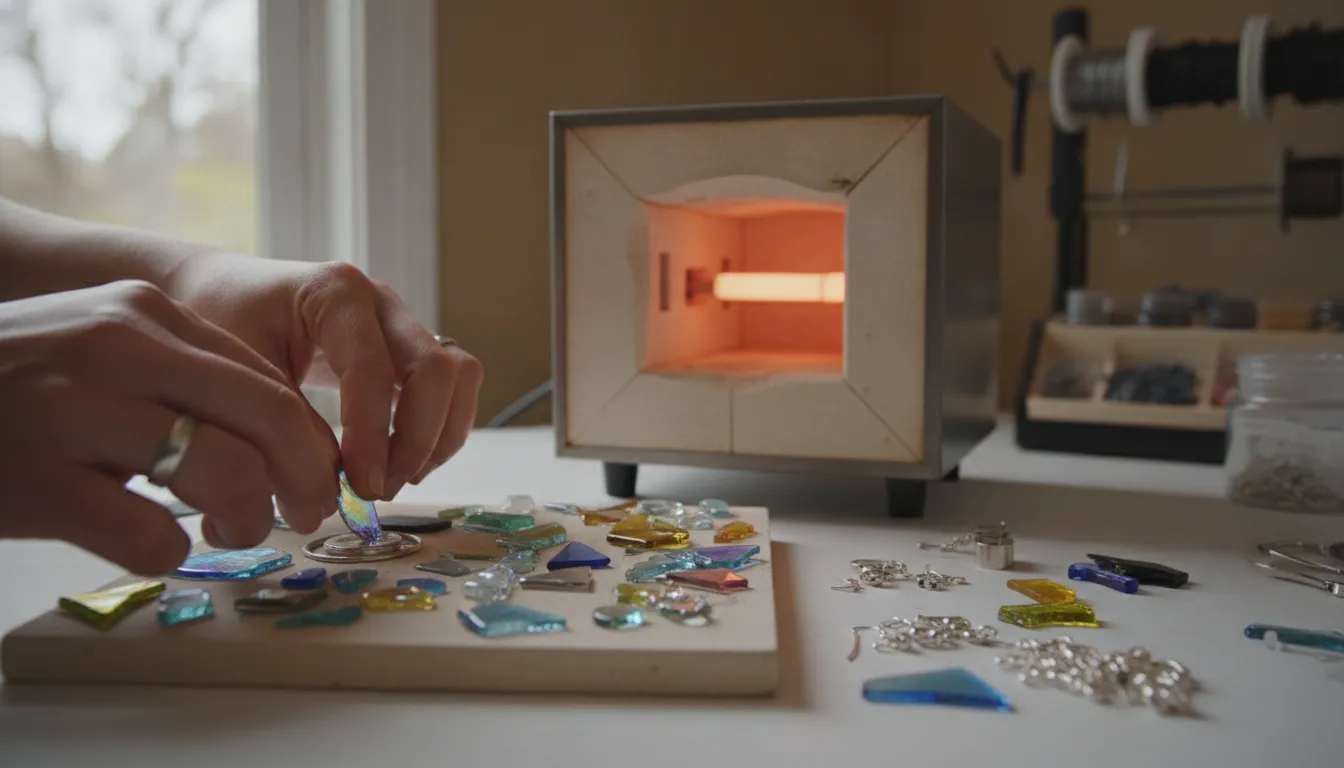
Small fused-glass jewelry projects reward careful material choices. The color and pattern may catch the eye first, but compatibility determines whether layered glass can cool without damaging stress.
For successful dichroic glass jewelry, start by identifying the glass system, then match the dichroic layer, base glass, frit, and other inclusions to that system. COE90 and COE96 are separate compatibility systems, and the COE label alone does not replace manufacturer guidance or small test pieces. Also consider viscosity and softening behavior, because materials must respond appropriately through heating and cooling.
Compare compatible dichroic glass for your project
Once the technical foundation is clear, you can choose sheets, scraps, frit, noodles, stringers, or textured surfaces based on the piece you want to make. That distinction matters because dichroic glass is more than a bright surface effect. Its coating, base glass, and viewing angle all influence the finished design.
What Makes Dichroic Glass Jewelry Different?
Dichroic glass creates visual movement that ordinary colored glass cannot provide. As a jewelry piece turns, its surface can flash one color in reflected light while showing another color through the glass. That changing appearance comes from the material’s optical coating, but the glass beneath the coating still determines how the finished piece behaves in the kiln.
The coating changes reflected and transmitted color
Dichroic glass begins with a transparent or translucent glass substrate and an engineered optical stack. The coating reflects selected wavelengths of light while allowing other wavelengths to pass through. Because the reflected and transmitted light are not the same, a pendant, cabochon, or earring can appear to change color as its angle to the light changes.
Modern dichroic coatings typically contain alternating layers of metal oxides. Their optical behavior depends on how light travels through those layers. Changing the viewing angle changes that path, which shifts the wavelengths reinforced by the coating. This is why a single piece may show blue, green, gold, or magenta flashes as it moves. The effect is not simply a color painted onto the surface. It is an interaction between light, the coating, the viewing angle, and the base glass.
Base color also affects the visual result. A black base generally absorbs more transmitted light, which can make reflected colors look deeper. A clear base allows more light to pass through the assembly and can create a brighter, more transparent appearance. Neither base is automatically better. Choose according to whether the design needs strong reflected color, visible depth, or light passing through layered elements.
Why the base glass matters in jewelry
For fused dichroic glass jewelry, the base is a compatibility decision as much as a design decision. COE means Coefficient of Expansion, or how much glass expands as it heats and contracts as it cools. Every layer in a fused project should belong to the same compatible COE system. COE90 and COE96 are separate systems, so a visually perfect combination can still be a poor technical choice.
Before combining dichroic glass with a base, cap, frit, stringer, or other inclusion, confirm the base system for the exact product. Do not rely on a shared color, pattern, or coating to establish compatibility. Even a small expansion mismatch can cause layers to pull against one another as the piece heats and cools. Compatibility also involves viscosity and softening behavior, which influence how materials respond and move through the annealing range.
Annealing helps relieve heat-related stress in properly matched glass, but it cannot make incompatible materials expand and contract at the same rate. Start by identifying the COE system already used in your studio or project, then choose dichroic material and supporting glass within that system. For additional background on the optical effect and material selection, see this complete dichroic glass guide.
How to Choose the Right COE for Dichroic Glass Jewelry
COE means Coefficient of Expansion. It describes how much glass expands as it heats and contracts as it cools. For a fused piece, that movement matters across every layer, including the base, dichroic sheet, frit, stringers, and any cap glass. A mismatch can create stress while the piece moves through the kiln, even when the colors and surfaces look like a natural visual match.
COE90 and COE96 are separate systems
COE90 and COE96 are not interchangeable labels. In practical terms, COE90 glass expands at about 90 millionths of an inch per degree Celsius. While COE96 glass expands at about 96 millionths of an inch per degree Celsius. That difference may sound small, but layers that expand and contract at different rates can pull against each other. The result may be visible cracking, immediate breakage, or a piece that fails later after it appears finished.
Choose the system before you choose the pattern. If your project starts with a COE90 base, select dichroic glass and inclusions identified for COE90. If it starts with a COE96 base, keep the other fusible components within the COE96 system. ArtGlassSupplies carries COE90 dichroic glass and COE96 dichroic glass collections, making the compatibility path easier to organize.
| Decision point | COE90 | COE96 |
|---|---|---|
| Expansion reference | Approximately 90 millionths of an inch per degree Celsius | Approximately 96 millionths of an inch per degree Celsius |
| Use with | A confirmed COE90 base, dichroic layer, frit, stringers, and other compatible components | A confirmed COE96 base, dichroic layer, frit, stringers, and other compatible components |
| Useful formats for jewelry | Sheets, scraps, patterned pieces, frit, noodles, stringers, and etched finishes | Solid or patterned pieces on clear, black, or textured bases, plus etched finishes and sample options |
| Best selection habit | Confirm the exact product base and keep the project within the COE90 system | Confirm the exact product base and keep the project within the COE96 system |
Check viscosity and manufacturer guidance
COE is an essential starting point, but it is not a complete compatibility guarantee. Glass also behaves differently as it softens. Viscosity describes resistance to flow, and differences in viscosity can create compatibility problems through the middle temperature range between the strain point and annealing point. The technical discussion in this glass compatibility reference explains why both expansion and viscosity matter.
For that reason, do not assume two products are compatible because they share a color, pattern, coating style, or brand category. Confirm the base listed for the exact sheet or component, then follow the manufacturer’s compatibility and firing guidance. This is especially important with dichroic products that use different base glasses. Keep notes about the manufacturer and system as you build a small jewelry design. Rather than relying on memory after scraps and decorative elements have been mixed on the workbench.
Annealing remains important because it relieves heat-related stress in properly matched glass. It cannot make COE90 and COE96 expand at the same rate, and a longer annealing hold or slower cooling cycle cannot correct an underlying mismatch. If a combination is uncertain, make a small test first. A controlled compatibility test gives you better information than risking a finished pendant or pair of earrings. Once the system is confirmed, you can choose color, texture, and format with much more confidence.
Which Dichroic Glass Formats Work Best for Jewelry?
The best format depends on the visual job the glass needs to perform. A small pendant may need one clean focal piece, while a pair of earrings may benefit from repeated scraps or a narrow line of color. Choose the format after you have a basic shape and surface effect in mind, then confirm that every layer belongs to the same compatible COE system.
Choose sheets and scraps for focal pieces
Sheet glass is the most flexible choice when you want to cut a pendant, cabochon, or other defined focal shape. It gives you room to plan the placement of the dichroic coating and can support designs that need a clean edge or a consistent visual field. Scraps are useful when the finished jewelry is small, when you are making accent pieces. Or when you want to test a layout without committing a larger piece of material. They can also introduce natural variation between earrings or create a mix-and-match collection.
Sample packs are another practical option when you are still learning which colors and patterns fit your style. They let you compare materials before building a larger project, but treat each piece as a material to identify, not as an anonymous assortment. Record its COE and follow the product guidance before combining it with base glass, frit, or other layers. You can browse COE90 dichroic glass or COE96 dichroic glass according to the system used in your project.
Use frit, noodles, and stringers for controlled detail
Dichroic frit works well when you want small particles of color, a sprinkled texture, or a more irregular surface arrangement. It can fill a selected area or add accents over a compatible base, making it useful for abstract pendants and small decorative elements. Because particle size and placement affect the finished appearance, begin with a restrained amount and plan how the pieces will sit during firing.
Noodles and stringers are better suited to lines, borders, veins, and other deliberate marks. Use them to draw a geometric pattern, separate color fields, or add a fine accent to an otherwise simple design. Their narrow form makes them helpful for repeating a visual detail across several jewelry pieces. They are not interchangeable with every other glass in the kiln, so confirm their COE and compatibility before layering them.
Let patterns, textures, and etched finishes set the mood
Patterned dichroic glass can supply visual movement without requiring you to build every detail from separate pieces. It is a strong choice for a focal pendant or coordinated earrings where the pattern itself should remain prominent. Textured base glass adds surface interest and changes how light interacts with the design. While etched finishes can create a softer or more dimensional contrast than a smooth surface.
These formats are design choices, not substitutes for compatibility checks. COE90 and COE96 are separate systems, and a textured or patterned appearance does not indicate that two materials can be fused together. Match the format to the design, identify the material system, and follow the manufacturer’s guidance for the complete stack.
How Should You Plan a Small Fused Jewelry Project?
A small pendant, cabochon, or pair of earrings becomes easier to manage when the design and compatibility decisions happen before the kiln is loaded. Plan the finished shape first, then work backward through the glass selection, preparation, firing, and assembly stages. This sequence helps keep a visually appealing idea grounded in materials that are meant to work together.
Start with the finished form and the glass system
Sketch the finished piece or make a simple paper template. Decide whether the design will be a flat tile, a rounded cabochon, a layered pendant, or another form. Note the approximate finished size, the hole or bail location, and whether the piece needs to remain relatively thin for jewelry findings. The design will help determine whether you need a focal sheet or scrap, small accents, frit, noodles, or stringers.
- Define the finished form. Choose the jewelry shape, approximate dimensions, and assembly method before cutting glass. Account for any shaping, drilling, or attachment step that will happen after firing. A simple template also makes it easier to repeat a design without cutting more material than necessary.
- Identify the base COE. COE, or Coefficient of Expansion, describes how glass expands when heated and contracts as it cools. Select one compatible system for the project, such as COE90 or COE96, and confirm the base listed for the exact dichroic sheet. Do not assume that two pieces belong together because their colors or coatings look similar. You can review the available COE90 dichroic glass or COE96 dichroic glass by system.
- Select compatible layers and accents. Confirm the same compatible glass system for the base, dichroic layer, cap, frit, stringers, or other inclusions. Keep the design simple enough that every added material can be identified and checked. Remember that compatibility involves more than a COE label. Differences in viscosity and softening behavior can affect how layers move and retain stress during heating and cooling, so follow the manufacturer guidance for the specific materials.
- Cut and clean carefully. Cut each piece to the template, keeping edges appropriate for the intended design. Remove dust, oils, and other residue before stacking. Clean surfaces support a more predictable fuse and reduce avoidable marks between layers. Handle coated dichroic surfaces according to the supplier’s instructions rather than treating them like ordinary uncoated glass.
- Fire by the manufacturer’s schedule. Use the firing schedule recommended for the compatible glass, kiln, project thickness, and desired result. Do not substitute a generic temperature or copy a schedule from a different glass system. Record the schedule and any observations so you can make controlled adjustments on a later test piece instead of changing several variables at once.
- Anneal the fused piece. Annealing is an essential part of cooling properly matched glass because it relieves heat-related stress. It cannot make incompatible materials expand and contract at the same rate. Follow the manufacturer’s annealing guidance, including the appropriate hold and controlled cooling instructions for the project.
- Finish and assemble. Inspect the cooled piece for cracks, sharp edges, and unwanted distortion before attaching findings. Finish edges or drill only with the appropriate tools and protective practices. Then add the bail, ear wire, cord, or other finding in a way that suits the piece’s thickness and intended use. Keep the project notes with the finished design, especially the glass system and firing schedule, for future pairs or variations.
Keep a small test in the plan
If a material combination is unfamiliar, make a small test before committing a favorite pattern or a full set of jewelry. A test can reveal how the layers respond together without turning a compatibility question into a finished-piece failure. Record the exact products and bases, not just the color names. That record is more useful than appearance alone when you repeat the project or change one component.
What Common Compatibility Mistakes Should You Avoid?
Compatibility problems are usually easier to prevent than to diagnose after a finished pendant cracks. A color that looks right, a familiar brand name, or a careful kiln schedule does not replace checking the glass system and the manufacturer guidance for every component. Keep the following mistakes out of your dichroic glass jewelry workflow.
Do not mix COE90 and COE96 because the colors match
COE means Coefficient of Expansion, or how much glass expands as it heats and contracts as it cools. COE90 and COE96 are separate compatibility systems. Even though the difference in the numbers appears small, layers with different expansion behavior can pull against each other during the kiln cycle. The result may be internal stress, immediate shattering, or breakage that appears later.
Start by identifying the COE of the base glass already in your studio. Then choose the dichroic sheet, frit, stringer, cap, and other inclusions for that same compatible system. Do not rely on a color name or a shared pattern to make the decision. For a project built around COE90, shop within the COE90 dichroic glass collection. For a COE96 project, use the corresponding COE96 dichroic glass options. If a product description is unclear, pause and verify the exact base before cutting it.
Do not judge compatibility by appearance alone
Dichroic glass is selected for its optical effect, but appearance is not a compatibility specification. Two sheets can have nearly identical colors, patterns, or coatings while using different base glass. Even products from the same coating supplier may be offered on more than one COE base. Read the listing for the exact sheet, scrap, frit, or stringer rather than assuming that every item in a collection behaves the same way.
COE is important, but it is not the whole story. Compatibility depends on expansion and viscosity, the glass property that describes resistance to flow. Viscosity and softening behavior matter through the middle temperature range, including the strain-to-annealing range. Two materials with a similar label can still require manufacturer-specific guidance or testing. Treat the product specification as part of your design materials, not as optional shopping information. The technical background in this complete dichroic glass guide explains why the base matters as much as the visible coating.
Do not expect annealing or a slow schedule to fix a mismatch
Annealing is essential for relieving heat-related stress in properly matched glass. It cannot make incompatible materials expand and contract at the same rate. Extending an annealing hold, changing the ramp rate, or cooling more slowly does not correct the underlying mismatch. A slower schedule may change when a failure appears, but it does not turn unlike glass into a compatible assembly.
Finally, do not test an unverified combination first on a commission or an irreplaceable focal piece. Make a small representative sample using the same base, dichroic layer, and inclusions. A practical compatibility test needs to account for both expansion and viscosity, not just visual inspection. Follow the relevant manufacturer’s testing instructions, and examine the sample after firing and cooling before committing valuable material. If the combination is not documented as compatible and the test gives you reason for concern, choose a verified material within your established COE system instead.
Where Can You Find Dichroic Glass for Your Next Jewelry Project?
The best source for a jewelry project is one that makes the material’s compatibility and format clear before you buy. Start by identifying the COE system used by your base glass, then choose dichroic material labeled for that same system. COE90 and COE96 are separate compatibility systems, so do not treat one as a substitute for the other simply because the colors or surface effects look similar.
Use this checklist before adding glass to your cart
- Confirm the COE. Match the dichroic glass to the base glass, frit, and other fusible components you plan to fire. If the product description or your existing material does not make the system clear, pause and verify the manufacturer’s guidance.
- Choose a format that suits the design. Sheets and scraps work well for focal pieces and small cabochons. Frit adds texture or concentrated color. Noodles and stringers create fine lines, borders, and linear accents. Patterned, textured, or etched options can provide visual interest without requiring a complicated construction.
- Buy for the finished scale. Small jewelry designs often need manageable pieces rather than a large sheet. Scrap packs or sample packs can help you explore color and pattern combinations while keeping the selection focused on the project.
- Check the full material list. A dichroic surface is only one part of a fused piece. Confirm that the base, decorative layers, and any inclusions belong to a compatible system, and follow the applicable firing and annealing guidance.
Shop by compatibility, then by color and effect
ArtGlassSupplies.com carries CBS dichroic products in both COE90 and COE96 collections. If your project is built around COE90 glass, browse the COE90 dichroic glass collection for options such as solid colors, patterns, frit, noodles, stringers, scraps, and etched finishes. For a COE96 project, compare the COE96 dichroic glass collection, which includes solid and patterned options on clear, black, and textured bases, along with sample and etched options.
When comparing pieces, consider how the coating, base color, pattern, and format will appear in the finished jewelry. Record the COE with your project notes, especially if you are building a repeatable design. That simple habit makes it easier to reorder compatible materials and prevents a visually appealing piece from becoming a compatibility gamble.
Find compatible dichroic glass supplies
Frequently Asked Questions
How do I choose between COE90 and COE96 for jewelry?
Start with the compatible system of your base glass, then choose dichroic glass, frit, stringers, and other inclusions labeled for that same system. COE90 and COE96 expand at different rates, so do not combine them casually. Check the exact product specifications before assembling a project.
Is sheet glass or scrap glass better for small jewelry projects?
Choose sheet or larger pieces when you need a planned focal shape or repeated designs. Scraps and sample packs are useful for testing color combinations and making one-of-a-kind pendants or earrings. Frit works well for texture, while noodles and stringers add narrow lines or details. Match every piece to the base glass system before firing.
Can annealing fix glass that is not compatible?
No. Annealing relieves heat-related stress in properly matched glass, but it cannot make incompatible materials expand and contract at the same rate. A slower cooling schedule or longer hold does not correct an underlying mismatch. Confirm compatibility first, then follow the manufacturer guidance for firing and annealing.
Should I test dichroic glass before making a finished piece?
Yes, especially when combining materials from different manufacturers or when the exact base is unclear. Make a small test using the same glass layers and inclusions planned for the finished piece. A compatibility test should account for both expansion and viscosity, or resistance to flow, not appearance alone. Browse COE90 dichroic options or COE96 dichroic options after confirming your system.
Get started with compatible dichroic glass
Choosing the right COE system and format gives your jewelry project a clearer starting point and helps you plan compatible layers with care. Compare options for your design, including materials suited to COE90 projects, on the COE90 dichroic glass collection. Review the product details, confirm compatibility with your base glass, and get started with the supplies that fit your project.