
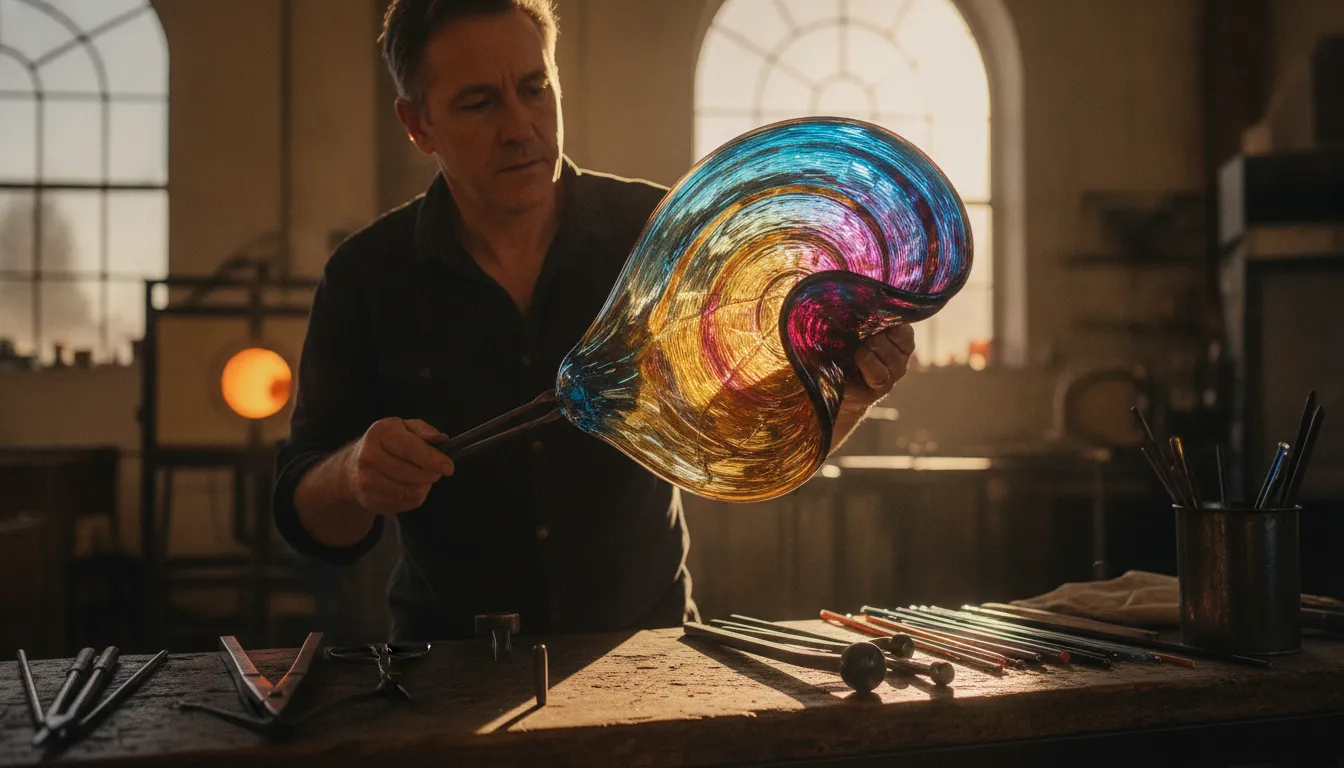
Color that shifts as a piece moves through the light is not a surface illusion. Dichroic glass gets this optical behavior from a precisely deposited coating of microscopic metal oxide layers, engineered to reflect selected wavelengths while transmitting others. Modern vacuum-deposition methods made the material practical for artists after related optical technology was developed for space applications. That same precision makes material selection and firing technique essential in the kiln.
A dichroic glass guide should begin with two principles: the coating creates the changing color effect, and every layer in a fused project must belong to the same compatible COE system. With the right base glass, careful handling, and a controlled firing schedule, dichroic material can produce durable depth in jewelry, fused panels, and larger sculptural work.
This guide examines the coating science, COE90 and COE96 compatibility, major product lines, cutting and firing considerations, and surface techniques that let you shape the final effect. Art Glass Supplies maintains the world’s largest dichroic glass inventory, giving artists access to specialty options for both experimentation and repeatable studio work.
Dichroic Glass Guide: What Is Dichroic Glass? The Science Behind the Color Shift
Dichroic glass is a transparent or translucent glass substrate coated with a precisely engineered optical stack. The coating reflects selected wavelengths of light while allowing other wavelengths to pass through. So the surface can appear one color in reflected light and another when viewed through the glass. The result is not ordinary iridescence caused by a single surface film. It is controlled thin-film interference, and the visible color changes with illumination, viewing angle, and the base glass beneath it.
How thin-film optics create two colors
Modern dichroic coatings typically contain 30 to 50 alternating layers of metal oxides. Each layer is extraordinarily thin, and the complete stack measures only about 760 to 890 nanometers, or roughly 30 to 35 millionths of an inch. At each boundary between layers, light is partially reflected and partially transmitted. The optical thickness of the layers determines which wavelengths reinforce one another through constructive interference and which cancel through destructive interference.
Changing the angle of incidence changes the distance light travels through the stack. That shifts the wavelengths meeting the reinforcement condition, which is why a sheet can flash blue, gold, green, or magenta as it moves. A black base generally absorbs transmitted light and makes reflected colors appear deeper, while a clear base allows more light to pass through the assembly.
From ancient dichroism to vacuum deposition
The optical principle has an ancient precedent. The Lycurgus Cup, made in fourth-century Rome, is the best-known early example of glass that changes color in transmitted and reflected light. Its effect came from metallic particles dispersed in the glass, rather than from the modern layered coating used by contemporary artists.
Today, manufacturers use physical vapor deposition inside a vacuum chamber. Metal oxide materials are vaporized and deposited onto prepared glass in controlled, sequential layers. This vacuum-deposition method produces the thin, precise coating described in dichroic glass fusing instructions. Once properly fused, the coating is extremely durable, although abrasive scratches made before firing can remain visible in the finished piece.
NASA helped advance modern dichroic technology for optical filters and space-related applications, where selective reflection and transmission are useful for managing intense light and radiation. The technology later became available to artists, turning a space-age optical coating into a practical material for fused glass jewelry, sculpture, and architectural work. Understanding that construction matters: the color is engineered into the coating, not simply painted onto the surface.
Why COE Compatibility Matters in Dichroic Glass Fusing
COE, or Coefficient of Expansion, describes how much glass expands when heated and contracts as it cools. That expansion rate is one of the most important compatibility factors in a fused project. When dichroic glass is layered with a compatible base, the pieces move through the kiln cycle at closely matched rates. When they do not, the finished piece can retain damaging internal stress.
COE90 and COE96 are different glass systems
COE90 glass expands at 90 millionths of an inch per degree Celsius, while COE96 glass expands at 96 millionths. That difference may appear small, but fused glass is a rigid material. During heating and cooling, even a mismatch of a few expansion units can make one layer pull against another. For a practical explanation of the measurement and its effect on glass, see our guide to what COE means in glass.
Bullseye dichroic is made for the Bullseye COE90 system. Oceanside and Spectrum materials use the COE96 system. Do not assume that two sheets are compatible because they share a color, pattern, or dichroic coating. Confirm the base glass system before combining layers, caps, frit, stringers, or other inclusions. Art Glass Supplies stocks dichroic materials in both COE systems, making it possible to choose the correct material for the rest of your project.
Why annealing cannot correct a COE mismatch
Using different COE systems can produce immediate shattering, but failure is not always visible when the piece leaves the kiln. Internal stress may remain hidden for days, weeks, or even months before the piece cracks. This delayed breakage is why a project that looks sound at first is not proof of compatibility.
Annealing is still essential because it relieves heat-related stress in properly matched glass. It cannot make incompatible materials expand and contract at the same rate, however. Changing the ramp rate, extending the annealing hold, or cooling more slowly will not correct the underlying mismatch. Use one compatible COE system throughout the project, as explained in this guide to fusible glass sheets.
For an additional check, view the cooled piece through a polarizing filter. Internal stress appears as colorful fringes or areas of distortion. The test can help reveal stress, but it should supplement, not replace, careful material selection. Verify the COE of every component before firing, and test unfamiliar combinations on a small scale rather than risking a finished design.
CBS vs. Bullseye vs. Youghiogheny: Dichroic Brands Compared
Choosing a dichroic line is not only a color decision. The coating sits on a specific base glass, so the base COE must match the rest of your project. A pattern that looks ideal can still create stress, cracking, or delayed breakage if it is fused with an incompatible system. Compare the manufacturer, base glass, visual range, and intended use before cutting your first piece.
| Manufacturer | Base COE | Pattern Range | Best For | Price Tier |
|---|---|---|---|---|
| CBS, Coatings by Sandberg | COE90 and COE96 bases available | Broadest range of colors, patterns, and effects | Artists who need maximum design choice across COE systems | Mid to premium |
| Bullseye Glass | COE90 | Coordinated dichroic colors and patterns for the Bullseye system | COE90 fusing projects built around Bullseye compatible glass | Premium |
| Youghiogheny Glass | Verify the product specification | Specialty colors and textures | Artists seeking a distinct surface character or less conventional look | Mid to premium |
When CBS offers the most flexibility
CBS, or Coatings by Sandberg, is a leading dichroic coating provider with an extensive selection of patterns and effects. Its coatings can be applied to different COE glass bases, including both COE90 and COE96 options. That breadth makes CBS a practical starting point when your project requires a particular color shift. Geometric pattern, or texture but your studio already works in a defined COE system. Confirm the base listed for the exact sheet, rather than assuming that every CBS product has the same compatibility.
For a closer look at CBS coatings, patterns, and base-glass choices, see our CBS dichroic float glass guide.
When Bullseye is the safer COE90 choice
Bullseye dichroic materials are engineered for compatibility with the Bullseye COE90 glass line. This makes them a logical choice when your project already uses Bullseye sheet, frit, or stringer and you want the dichroic layer to integrate into that same system. The narrower base-COE focus is not a disadvantage. It can simplify material selection and reduce the risk of accidentally combining incompatible glass.
Where Youghiogheny fits
Youghiogheny appeals to artists who are shopping for specialty colors and textures rather than the broadest possible coating catalog. Its positioning is different from CBS’s extensive pattern range and Bullseye’s tightly coordinated COE90 ecosystem. Treat each Youghiogheny product as an individual compatibility decision: read the product specification, identify the base glass, and keep the entire fused assembly within that COE system.
The best brand depends on your project, not on a universal ranking. Match the base COE first, then choose the visual effect that supports the design. If you are unsure which line belongs with your fusible glass, verify the product details before firing.
Solid Color vs. Patterned Dichroic: Choosing the Right Type
Solid and patterned dichroic glass use the same light-shifting principle, but they produce very different design results. Your choice affects how much visual movement a piece has, how easily you can control a small composition, and how prominently the glass reads after firing. Match the surface to the project rather than treating one style as universally better.
| Type | Visual effect | Best applications | Sale price range |
|---|---|---|---|
| Solid color | Uniform color shift with a clean, controlled appearance | Beginner projects, jewelry cabochons, and small accents | $6.68-$9.96 |
| Patterned | Directional or repeating movement from the surface pattern | Statement pendants, focal tiles, and larger showpiece elements | $7.47-$10.96 |
| Etched | Matte surface that scatters light for a softer, diffused effect | Subtle contrast, layered compositions, and designs needing less glare | Varies by style |
When solid color is the better choice
Solid-color dichroic is the most predictable option when you are learning to cut, layer, and fire this material. Its uniform shift lets the shape and surrounding glass carry the composition without competing lines. That control is useful for jewelry cabochons, where a small piece needs color without a busy pattern. It also makes solid sheets easier to combine with an intentional border, clean geometric layout, or transparent overlay.
When patterned dichroic makes a statement
Patterned sheets add visual direction before you make the first cut. Aurora Borealis, Corkscrew, Stripes, Pixie Stix, and Herringbone create distinctive movement that can become the focal point of a pendant, tile, or larger fused element. Because the pattern itself is part of the design, plan the cut around its scale and direction. Patterned options typically cost more, with sale prices from $7.47 to $10.96, but a small piece can deliver substantial visual impact.
How the base changes the result
Base glass matters as much as the coating style. A black base often deepens the reflected colors and produces a more saturated, dramatic appearance. A clear base allows more light transmission, which can make the result feel brighter, more transparent, or visually layered. Base color and texture can significantly influence the final appearance, so test an unfamiliar combination before committing it to a finished project. See the dichroic glass collection to compare available surfaces and bases.
Etched dichroic offers a third direction. Its matte surface scatters light instead of reflecting it as sharply, creating a quieter, diffused effect. It can balance a glossy solid or patterned piece, especially when the design needs contrast without another high-intensity focal point.
How to Cut and Handle Dichroic Glass: Essential Techniques
Dichroic glass rewards careful handling because its optical coating is thin, reflective, and easy to mark before it enters the kiln. Scratches, fingerprints, dust, and incorrect shelf preparation can remain visible after firing. Work deliberately from the first score through the final kiln inspection, and test an unfamiliar color or pattern before using it in an important piece.
-
Confirm the coated and uncoated sides
Inspect the sheet under angled light before cutting. The coated face usually has the stronger reflective appearance, while the back is the side you should score. Marking the uncoated back protects the delicate surface from direct contact with the cutter wheel. Do not drag abrasive tools across the coating, because scratches made before firing typically remain visible in the finished piece. Handle the sheet by its edges whenever possible.
-
Score the back in one controlled pass
Place the dichroic sheet coated side down on a clean, stable cutting surface. Use a glass cutter to make one firm, continuous score on the uncoated back. Avoid repeated scoring over the same line, which can create chips and unnecessary stress along the cut. Support the sheet close to the score and gently run the break. Wear properly rated eye protection during cutting, and inspect the edge for loose shards before moving the pieces.
-
Clean the pieces without touching the coating
After cutting, remove fine debris with mild soap and water or rubbing alcohol, then allow the glass to dry completely. Skin oils and other contaminants can burn onto the surface during firing, leaving spots or clouding. Hold each piece by its edges, or use clean gloves or tweezers when the shape makes edge handling difficult. Avoid abrasive cleaners and rough cloths that could scratch the coating.
-
Prepare the kiln shelf and load coated side up
Apply kiln wash to the shelf, or use ThinFire paper as a convenient alternative that can provide easier cleanup and a smooth underside. Place the prepared pieces with the coated side up. This orientation helps prevent the coating from contacting and sticking to the shelf during firing. If you cap the dichroic with compatible clear glass, use the same COE system. A clear cap can protect the coating and increase the perceived depth of its color. See our dichroic glass fusing instructions for additional loading and firing guidance.
-
Test fire before committing to a large project
Fire a small sample of the exact dichroic color, base glass, cap glass, and shelf setup first. Patterns and coatings can respond differently to heat, and a test reveals unexpected color changes, sticking, bubbles, or surface damage before those problems affect a larger design. Record the materials and kiln results so you can repeat a successful combination with confidence.
Dichroic Glass Firing Schedules: Full Fuse, Tack Fuse, and Annealing
Dichroic glass responds best to a controlled, gradual firing schedule. The correct peak temperature depends on whether you want the layers to flatten completely or retain dimensional texture. While the annealing segment relieves internal stress as the piece cools. These schedules are starting points, not universal presets. Adjust them for glass thickness, kiln accuracy, project size, and the compatible COE system used throughout the assembly.
Full fuse schedule for a smooth, glossy surface
For a full fuse, heat gradually to approximately 1450-1480 degrees F. A 10-minute hold at the top temperature is a practical starting point for a high-gloss finish, because the soak gives the surface time to fire polish. Some published Bullseye 90 schedules use 805 degrees C, or 1481 degrees F, with a 5-minute hold. Treat that shorter hold as a reference, then test a small sample before applying the schedule to a valuable design.
Place the dichroic coating face up when possible, and cap it with clear glass from the same COE system when the design allows. The clear cap protects the coating and can intensify the apparent depth and color. Do not extend the top-temperature hold simply to make the surface glossier. Some patterns lose definition or color intensity during prolonged soaking, and dichroic coatings can devitrify when over-fired, leaving a cloudy surface. See our guide to glass fusing techniques for broader kiln-program principles.
Tack fuse and bubble squeeze
A tack fuse generally peaks around 1350-1400 degrees F. This lower temperature bonds layers while preserving raised edges, texture, and more of the original pattern. For stacked or uneven pieces, include a bubble squeeze before the main fuse. A useful reference point is 670 degrees C, or 1238 degrees F, with a 30-minute hold. The gradual approach reduces thermal shock and gives trapped air time to move out between layers.
Annealing and controlled cool-down
After the top-temperature hold, cool to approximately 900 degrees F, or 482 degrees C, and hold for 60 minutes as a starting annealing segment. Then continue cooling in controlled stages until the kiln and glass are safely near room temperature. Annealing relieves stress created during heating, but it cannot correct incompatible COE glass. Confirm compatibility before firing, rather than trying to solve a mismatch with a longer cool-down.
| Stage | Temperature | Hold | Purpose |
|---|---|---|---|
| Initial heat | 995 degrees F / 535 degrees C | 30 minutes | Warm the assembly gradually |
| Bubble squeeze | 1238 degrees F / 670 degrees C | 30 minutes | Release air between layers |
| Full fuse peak | 1450-1480 degrees F | 5-10 minutes | Fuse and fire-polish the surface |
| Anneal | 900 degrees F / 482 degrees C | 60 minutes | Reduce internal stress |
Record the schedule and inspect the test piece under consistent lighting. If the result is cloudy, bubbled, cracked, or visibly faded, change one variable at a time rather than increasing heat or hold time indiscriminately.
Surface Techniques: Combining Dichroic with Decals, Paints, and Enamels
Dichroic supplies the reflective color shift, but surface treatments let you add line, texture, opacity, and imagery. The most controlled results come from treating each material as part of a compatible fused-glass assembly. Confirm the COE of every base, overlay, and supporting layer before firing. Then test a small sample because dichroic coatings can occasionally react with glass colors containing sulfur or lead, changing the finished color or surface.
Build imagery with decals and glass paints
Glass fusing decals are fired-on artwork that can add precise marks over or beside a dichroic accent. Apply the decal according to its product directions and keep the design intentional. A narrow line or simple silhouette can frame the color shift without obscuring it.
Reusche Glass Paint and Glassline Paints provide different ways to draw, shade, or add opaque detail. Use them to create a visual layer over a solid dichroic field, or place painted elements on adjacent compatible glass so the dichroic remains the focal point. For repeated designs, work from a test tile first. Surface materials can change in appearance after firing, and the coating itself is sensitive to over-firing and devitrification.
Use enamels for color and contrast
Glass enamel paints are useful when a project needs a more defined color block, border, or graphic accent. A practical buying guide should compare the enamel’s intended firing range, opacity, application method, and compatibility with the glass system you are using. Avoid selecting paint by color alone. The final result depends on the base glass, the dichroic pattern, the thickness of the applied material, and the firing schedule.
For a layered composition, place dichroic beneath compatible clear glass, then reserve paint or enamel for an adjacent surface or a carefully planned top detail. Capping with compatible clear glass can protect the coating and intensify its perceived depth and color. Keep the assembly clean, since oils and debris can burn onto the surface and create spots or clouding.
Combine iridescence with selective removal
Iridescent glass adds a broad, atmospheric sheen that can soften the sharper color shift of dichroic. Explore using iridescent glass when you want to compare iridescent surfaces with reflective coatings. You can also selectively remove dichroic with sandblasting or grinding to reveal the base glass beneath, creating negative space, softened edges, or controlled patterns. Work carefully: abrasions made before firing remain visible in the finished piece. Sandblast in a well-ventilated area with appropriate respiratory protection, and review additional glass fusing techniques before combining multiple surface processes.
Layering works best when each treatment has a defined role. Let dichroic establish movement, use decal or paint for drawing, add enamel for contrast, and use iridescent glass or selective coating removal to control the surrounding light. Record the materials and test results so successful combinations can be repeated.
Dichroic Glass Projects: From Cabochons to Art Panels
Dichroic glass rewards designs that let its color shift remain visible. The same coated piece can look dramatically different as it catches sunlight, studio lighting. Or movement, which makes it especially effective in small, wearable work and larger architectural compositions. Begin by confirming that every layer uses a compatible COE system, then choose a project that gives the coating enough visual space to perform.
Jewelry that captures attention
Cabochons are an efficient starting point because a small offcut can become the focal point of a finished piece. Stack compatible dichroic layers for depth, or combine a patterned surface with a clear cap for a more dimensional effect. Pendants and rings are similarly well suited to geometric cuts, while thin strips and fragments can create mosaic-like patterns inside a cabochon. At art fairs and craft shows, the light-catching surface gives these pieces strong visual appeal from a distance.
For shape planning, explore our guide to the best dichroic glass jewelry. It can help you compare jewelry formats before committing valuable patterned material to a design.
Fused bowls with controlled flashes of color
A fused glass bowl does not need a full dichroic surface to make an impression. Add narrow accents around the rim, place a few geometric pieces in a repeating pattern, or build a central motif beneath a clear layer. These restrained applications preserve the bowl’s form while adding color that changes as the vessel is viewed from different angles. Plan the placement carefully, because stretching or slumping can alter how the coating is seen across the finished curve.
Stained glass panels and light-driven compositions
Dichroic elements can serve as visual punctuation in stained glass panels. Use them sparingly among transparent, opalescent, or textured glass so that daylight illuminates the color shift rather than overwhelming the composition. Small squares, diamonds, and narrow inserts work well in borders, stars, botanical centers, and abstract patterns. The result changes throughout the day as the angle and intensity of incoming light change.
Kiln-cast details with dichroic frit
Dichroic frit opens another route for kiln-casting, from inlaid accents to concentrated color fields. Consistent frit grain size matters for even fusing. Mixed particle sizes can melt and settle at different rates, producing uneven coverage or an unpredictable surface. Sort the frit for the visual effect you want, keep the layer thickness controlled, and test a small sample before using it in a mold or larger casting. This is where a broad, carefully organized selection matters. ArtGlassSupplies offers the world’s largest dichroic glass inventory, giving artists more options for matching color, pattern, and compatible base glass to the intended project.
Browse the dichroic glass collection to compare materials for jewelry, fused vessels, panels, and kiln-cast work. A well-planned project lets the coating provide the color movement while the glass form provides the structure.
Frequently Asked Questions
Can COE90 and COE96 dichroic glass be fused together?
No. Keep every glass component in the same COE system for a stable project. COE90 and COE96 expand at different rates, so combining them can create internal stress, immediate shattering, or delayed breakage. Annealing relieves stress from the firing process, but it cannot correct incompatible glass. Learn more about COE compatibility.
Which side of dichroic glass should face up during firing?
Fire dichroic glass with the coated side facing up. This positioning helps keep the coating from sticking to the kiln shelf. Score and cut from the uncoated back, then handle the piece by its edges to reduce the chance of scratching or contaminating the coating before firing.
Should dichroic glass be capped with clear glass?
Capping it with compatible clear glass is often useful. A same-COE clear layer can protect the coating from handling and firing damage while adding visual depth and intensifying the perceived color. Test the combination first, because some glass colors or ingredients can react with dichroic coatings and change the final appearance.
Can dichroic glass be sandblasted or ground?
Yes. Sandblasting or grinding can selectively remove or alter the coating, revealing the base glass and creating matte areas or custom patterns. Work carefully, because scratches and abrasions made before firing generally remain visible in the finished piece. A sandblasted back can also make the uncoated side easier to identify.
How can I prevent dichroic glass from losing its color in the kiln?
Use a tested firing schedule and avoid over-firing, which can cause devitrification and cloud the surface. A controlled soak at the top temperature supports a complete fire polish, while a slower heat-up can reduce trapped air between layers. Test-fire a small sample before committing valuable dichroic glass to a larger project. Review dichroic fusing instructions.
Ready to Choose Your Dichroic Glass?
The right coating, pattern, and COE system can help you move from surface experimentation to a controlled, repeatable fusing project. Review the collection to compare specialty options for jewelry, decorative work, and larger fused pieces. When you need guidance on compatibility or technique, contact our glass experts or shop the dichroic glass selection for your next project.