
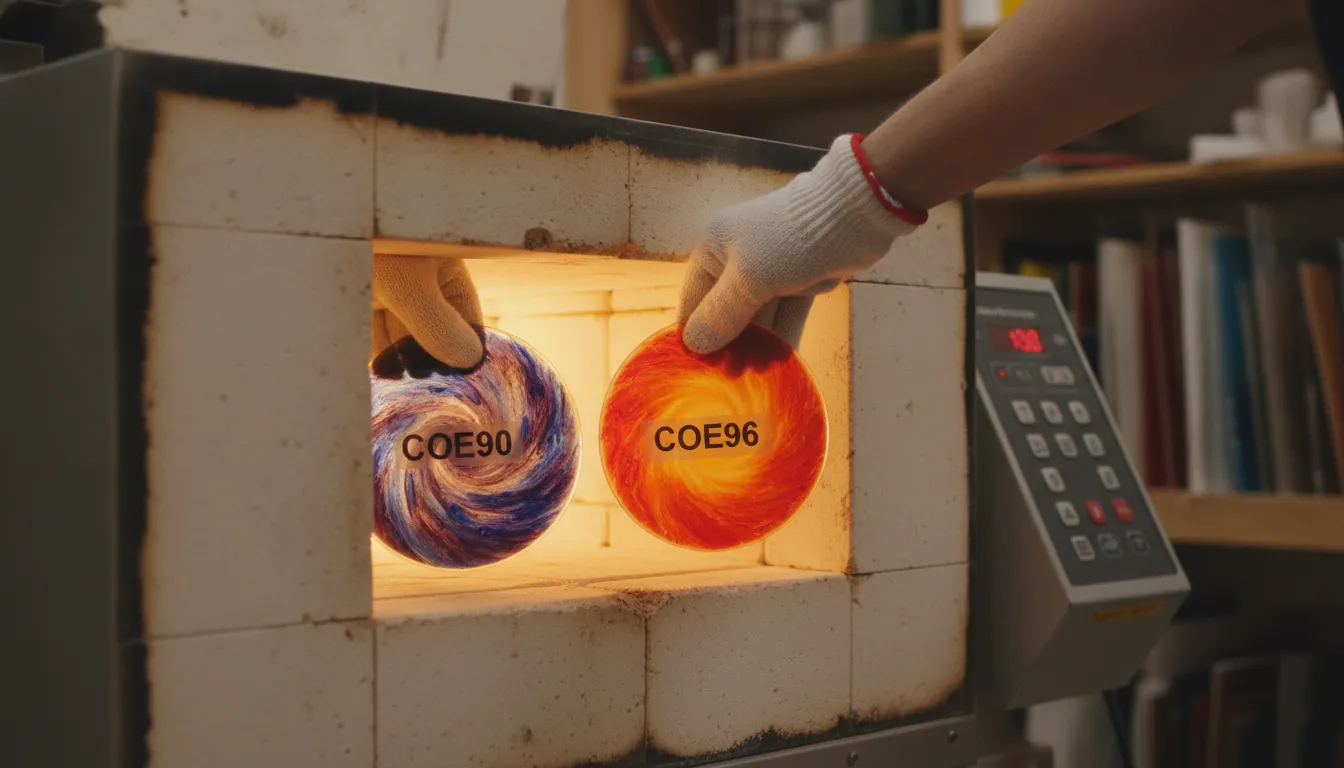
Mixing glass types with different expansion rates is the most common cause of shattered fusing projects. Before you load your kiln, make sure you have compatible materials. Shop our COE90 glass collection and COE96 glass collection to find compatible materials for your next project.
The answer to can you mix coe90 and coe96 is no, because these two glass types expand and contract at different rates during heating and cooling. COE90 glass expands at 90 millionths of an inch per degree Celsius, while COE96 glass expands at 96 millionths. When fused together, they pull against each other during cooling, creating internal stress that leads to cracks, shattering, or delayed breakage days or weeks later. Using glass from the same coefficient of expansion system is the only way to ensure a stable, long-lasting project.
Can You Mix Coe90 And Coe96: What Happens When You Mix COE90 and COE96 Glass?
The short answer is that the glass will almost always crack or shatter. Mixing glass types with different expansion rates is the primary cause of project failure. When you fuse mismatched materials, you create stress that the glass cannot handle. For a safe result, understanding glass compatibility is the first step for any artist.
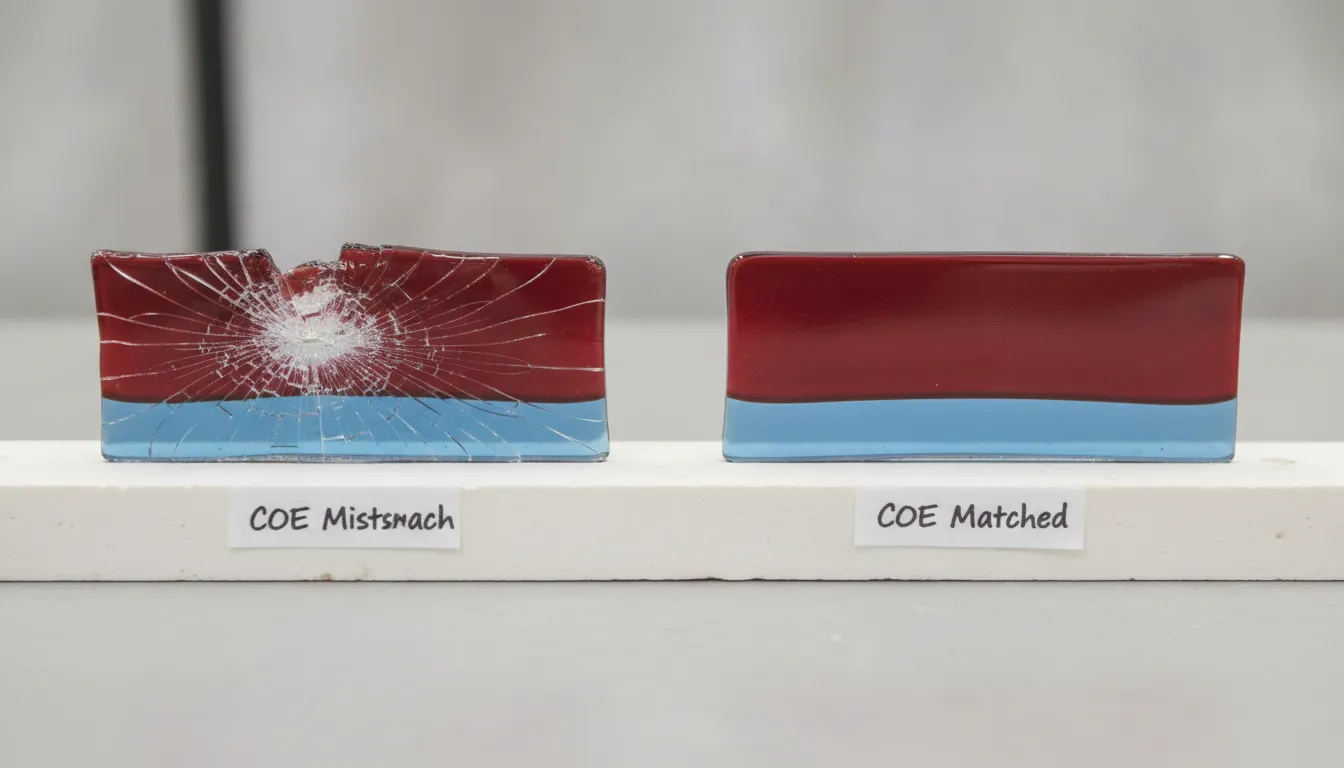
When COE90 and COE96 glass are fused together, the COE96 layer shrinks more during cooling, creating tension that cracks or shatters the piece. The stress may not appear immediately, delayed breakage can happen days or months later from a simple temperature change. You cannot fix this mismatch by adjusting your kiln schedule.
How expansion rates cause stress
Every glass type has a specific Coefficient of Expansion (COE) that measures how much it expands when heated and shrinks when cooled. COE90 glass moves at 90 millionths of an inch per degree Celsius, while COE96 moves at 96 millionths. This small difference becomes a serious problem when the glasses are fused together.
As the kiln cools, the two glass types shrink at different speeds. The COE96 glass tries to shrink more than the COE90 glass. Since they are fused together, they pull against each other with considerable force. This tension builds up inside the piece until the glass can no longer hold its shape. The result is often a break called dunting that ruins the project.
Immediate and delayed cracking
In many cases, the stress is high enough that the piece shatters before you open the kiln. You might hear a sharp ping as the glass pulls apart during cooling. This quick failure confirms the expansion rates were too far apart for a stable bond.
Sometimes a mixed piece looks fine when it first comes out of the kiln. This is known as delayed breakage. The stress stays hidden inside the glass for days, weeks, or even months. A small change in room temperature or a slight bump can trigger a sudden crack. Because this tension is a physical property of the glass, you cannot fix it by changing your kiln settings.
The Science of Thermal Stress in Fused Glass
The success of a glass project depends on how the material handles heat. Glass expands when heated and shrinks as it cools. This rate of change is the coefficient of thermal expansion, or COE. In the art glass world, COE90 and COE96 are the two most common systems. These numbers represent how much the glass moves per degree of change. Expansion is a fixed trait based on the chemical composition of the glass.
COE is a fixed physical property determined by the glass formula. COE90 glass expands at 90 millionths per degree; COE96 expands at 96 millionths. That six-millionth gap creates a tug-of-war between layers during cooling that causes stress fractures and dunting.
Understanding expansion and contraction
When you heat glass, its atoms shift and the piece grows in size. This growth is predictable when you use glass from the same system. Problems start when COE90 and COE96 glass are combined. The COE96 glass grows more during firing and shrinks faster during cooling. This mismatch creates a tug-of-war between the layers. Even small gaps in expansion rates can cause significant breakage in your work.
Stress fractures and dunting
The internal pull from mixed glass leads to stress fractures. In the fusing world, these breaks are often called dunting. Dunting can happen while the piece is still in the kiln. But the real danger is delayed breakage where hidden stress causes the piece to snap days or weeks later. Read more about why COE matters for fusing to understand how critical this is for long-lasting art.
Viscosity and firing behaviors
Heat stress is not the only issue when mixing brands. Different glass types also have unique viscosity levels, how thick or fluid the glass becomes when molten. Wissmach 96 glass is often more fluid than Oceanside 96 glass, even though both share the same COE. When you mix glass with different flow rates, they move at different speeds during firing, which can cause edges to pull or layers to shift unpredictably. Keeping your glass within the same system gives you the most consistent results.
How Can You Test Glass Compatibility in Your Studio?
You can test glass to see if two pieces are safe to use together. This is helpful when you have scrap glass with an unknown expansion rate. However, testing should only supplement your work , always use glass from the same system for best results.
The most reliable test is a small-scale fusing test: cut strips from each glass type, stack them, fuse them, and inspect for curvature or cracks. A polariscope can also reveal hidden stress as a milky white halo. Testing confirms compatibility but does not replace using glass from the same COE system.
The fusing test
The first step is a simple physical test in your kiln to see how the glass reacts when it melts and cools. Follow these steps:
- Cut two small strips from each type of glass you want to check.
- Clean the glass well and stack the strips on top of each other.
- Place the stack in your kiln and fuse them fully.
- Let the kiln cool slowly to room temperature using your standard annealing cycle.
- Examine the fused piece for any curvature, cracks, or separation between layers.
Check for hidden stress with a polariscope
Some stress does not show up as a visible crack. A polariscope uses polarized filters to reveal internal tension in clear glass. When you look through it at the fused test piece, a milky white halo indicates the glass is under stress and may break later. You can learn more about fusible glass sheet basics to pick the right materials for your kiln.
Why testing has limits
Glass types have different rates of expansion based on their chemical makeup. Even small differences can cause structural problems. While testing is useful for small crafts, it does not replace using known glass systems. Using the right glass from the start keeps your work safe and strong. Shop our COE90 collection or COE96 collection for verified compatible materials.
COE90 vs COE96: Two Separate Glass Systems
When you start fusing glass, you will encounter two main systems in the market. COE90 and COE96 are separate systems with different physical properties. Because of this, you must keep them apart in your studio.
COE90 (Bullseye, Uroboros) and COE96 (Oceanside, Wissmach) are incompatible glass systems. COE90 makes up 40.5% of Art Glass Supplies inventory; COE96 makes up 27%. They must never be fused together.
How glass expansion works
COE stands for coefficient of expansion , a measure of how much glass grows when heated and shrinks when cooled. This thermal expansion is a fixed physical property based on the glass recipe. COE90 glass expands at 90 millionths of an inch per degree. COE96 glass expands at 96 millionths. This six-millionth gap causes significant stress if you try to fuse them together.
The main brand ecosystems
Each system has its own set of brands and tools. COE90 is the largest group in our store, making up 40.5% of our inventory, led by the Bullseye Glass line. COE96 makes up 27% of our catalog and includes brands like Oceanside and Wissmach. Mixing brands within the same COE system is generally fine, but mixing across systems leads to cracks. Read our why COE matters for fusing guide to learn more.
| Feature | COE90 System | COE96 System |
|---|---|---|
| Expansion Rate | 90 millionths per degree | 96 millionths per degree |
| Key Brands | Bullseye, Uroboros | Oceanside, Wissmach, Youghiogheny |
| Catalog Share | 40.5% of inventory | 27% of inventory |
| Artistic Focus | High color consistency | Beginner-friendly and smooth |
| Common Use | Fine art and kiln casting | General fusing and jewelry |
What Are Common Beginner Mistakes and How Do You Avoid Them?
Fusing glass requires care, and new artists often encounter the same challenges. Knowing what to watch for helps you create pieces that last.
The three most common beginner mistakes are mixing COE systems, ignoring brand-specific viscosity differences, and failing to label scrap glass. All are preventable with good studio habits: keep COE90 and COE96 in separate labeled bins. Use a firing log, and never rely on annealing to fix a COE mismatch.
Mixing COE90 and COE96 glass
The most frequent error is trying to combine glass systems. People often ask can you mix coe90 and coe96 in a single project , the answer is no. These systems expand and contract at different rates. This mismatch creates internal stress as the glass cools, and the stress does not always cause an immediate break. Cracks can appear days or even months later.
Ignoring viscosity and brand differences
Another mistake is assuming all glass with the same COE behaves identically. Different brands have small variations in viscosity , how fluid the glass becomes when molten. Wissmach 96 glass has a lower viscosity than Oceanside 96 glass, meaning it flows more easily at lower temperatures. Mixing brands within the same COE system is generally acceptable. But you need to account for their different behaviors by adjusting your firing schedule and keeping a detailed firing log.
Better studio habits for success
Storing scrap glass without labels is a common pitfall. Many glass types look the same to the naked eye. If COE90 and COE96 scraps end up in the same bin, you will lose track of which is which. A single piece of the wrong glass can ruin an entire project. Mark every piece as soon as it enters your studio and keep systems in separate bins or shelves.
Be careful with frit and stringers as well. Even a small amount of wrong-COE frit can cause a project to shatter. Always verify the label before adding anything to your work. And do not rely on miracle annealing to fix a mismatch , annealing removes cooling stress but cannot fix stress from incompatible expansion rates.
Frequently Asked Questions
Can you mix COE 90 and COE 96 glass in the same project?
No, you should not mix these glass types. Each has a different expansion and contraction rate. Fusing them creates internal stress that leads to cracks or shattering. Use only glass from the same COE system to keep your work intact.
What happens if you fuse COE 90 and COE 96 together?
The fused piece may look fine at first, but the different cooling rates cause internal tension that creates stress fractures. These can break the piece immediately or months later. Mixing systems is never worth the risk.
How can you tell if glass is COE 90 or COE 96?
Check the manufacturer label , most brands clearly mark their products as COE90 or COE96. If you have unlabeled scrap, treat it as unknown and test it before combining with known glass.
Can annealing fix a project with mixed COE glass?
No. Annealing removes normal cooling stress but cannot change the physical expansion rate of the glass. The bond between two different COE systems remains unstable regardless of your kiln schedule.
Ready To Start Your Next Glass Fusing Project?
Mixing incompatible glass types can ruin weeks of work when your art cracks or shatters. The stress may not appear immediately, but it stays in the glass until it fails. Using matched materials from the start saves time, money, and creative energy. When you pick the right glass now, your pieces stay beautiful for years. Shop our COE90 glass collection or COE96 glass collection for next-day shipping on compatible materials.