
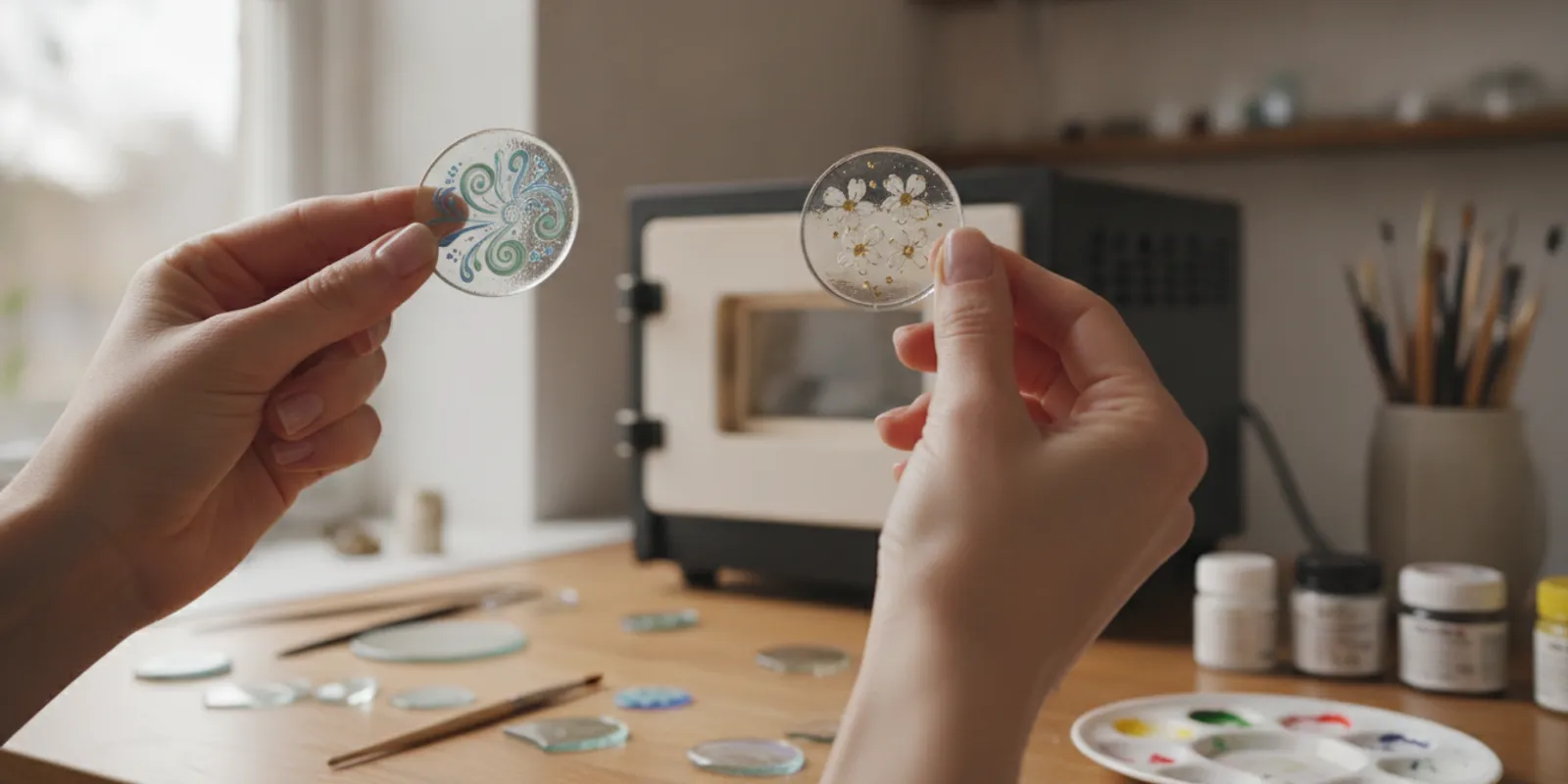
A useful Glassline paints review should help you decide whether this kind of glass paint suits your project, not promise a result that depends on your surface, application, and firing process. If you are choosing paint for fused glass, compare the project requirements first, then test the exact glass and finish you plan to use.
Browse glass fusing and stained glass supplies
What does this review evaluate?
This is a product-selection guide, not a claim of controlled, hands-on testing. A paint can be a good fit for one maker and the wrong fit for another. The practical questions are whether it suits your intended design, can be applied at the detail level you need, fits your firing workflow, and produces a finish you can repeat.
Glassline is discussed in the context of glass art and fusing. The outcome of any glass paint depends on the specific product instructions and how it is used. Check current manufacturer directions for application, drying, firing, and handling. Do not treat a review or a sample image as a substitute for those directions, or as a guarantee that two different glass and paint combinations will behave alike.
Who may want to consider Glassline paints?
Glassline paints may be worth investigating if you want to add painted marks, details, or drawn elements to a glass project and are prepared to make a small test before committing the design. They may be less suitable if your project needs a finish that must be confirmed without testing, if you cannot follow the product’s firing directions, or if your design depends on a specific effect that you have not verified on the intended glass.
Before buying, name the job you want the paint to do. Are you adding a fine line, a small motif, or a larger painted area? Will the piece be fused, remain unfired, or be used in another process? Will you need the design to survive handling or later steps? These are not minor details: they shape what you need to learn from a test and what questions to ask before selecting a product.
Think about the project from the viewer’s distance, too. A delicate line that looks clear on a small sample held in your hand may read differently across a larger panel or from across a room. If the glass is transparent, the background behind it will affect how the mark appears. If the project is a gift or a set of matching pieces, repeatability may matter more than whether a single sample looks appealing. Write down the result you need in observable terms, such as a legible outline, an even field, or matching marks across a pair of pieces.
How to read a Glassline paints review for your project
Use the same standards for any product review of glass paint. Look for clear information about the intended surface, application method, drying and firing directions, and the reviewer’s actual project conditions. A review that only says a color looked good leaves out key factors. A result on one type of glass, applied at one thickness and fired in one kiln, does not establish what will happen in a different setup.
- Project fit: Does the paint suit the kind of glass work you plan to make?
- Application: Can you apply it in the detail, line weight, or coverage your design needs?
- Process clarity: Are the product’s preparation, drying, and firing instructions available and understandable?
- Testability: Can you spare a small sample of the same glass and fire it using your intended process?
- Repeatability: Can you record enough details to reproduce or adjust the result on a later piece?
Also separate observation from conclusion when reading an account. “The sample retained a fine line after this maker’s stated process” describes an observation. “The paint will work on any glass” is a much broader claim and needs evidence that covers those different surfaces and processes. Prefer reviews that identify what was used, what steps were followed, and what the reviewer did not test. If important conditions are missing, treat the review as inspiration rather than a reliable prediction for your own piece.
For an additional visual reference, academic work on Tiffany Favrile and Carnival Glass offers a historical look at two areas of decorative glass. It is not a test or product evaluation of Glassline paints, but it may interest readers thinking about the broader visual language of art glass. Read the academic study, “Useful Beauty: Tiffany Favrile, Carnival Glass, and …”
What should you check before ordering?
1. Match the product to the process
Start by confirming whether your planned process matches the product’s stated use. If you plan to fire the painted glass, rely on the current directions for the specific paint, rather than adapting a schedule from another project or assuming that all glass paints share the same process. If you are unsure whether the product is intended for your technique, resolve that question before purchasing or applying it to a finished piece.
Also consider what happens after the paint is applied. A project may include additional glass layers, kiln work, coldworking, or assembly. The order of those steps can affect what you need to test. Write down each step in sequence and check that the paint’s instructions cover the process you intend to use.
For example, a design painted on a surface that will be covered by another layer raises different process questions from a design that remains exposed. A piece that will be ground, drilled, or assembled after firing also has later handling steps to consider. Do not assume that success at one stage confirms performance through every later stage. Make a small sample that includes the relevant layers and finishing steps, or ask the manufacturer whether your planned sequence falls within the product’s directions.
2. Confirm the glass and its compatibility
When glass will be fused, compatibility is a physical property, not a label or a visual judgment. The coefficient of expansion (COE) describes how much a material expands or contracts as its temperature changes. Glasses with different COEs can respond differently during heating and cooling. The mismatch can leave stress in the finished piece and may contribute to cracking, even if the glass looked compatible while warm.
COE alone does not tell the whole story. Viscosity and softening points also matter because glass changes its shape and flow as it heats. A paint coating does not make otherwise incompatible glass compatible, and visual similarity is not proof of compatibility. Use compatible glass from a known system for a fused piece, and follow product instructions for the paint. For example, shop by the stated glass family when considering COE90 iridescent sheet glass or COE96 frit balls; do not combine materials from different systems on the assumption that a painted surface resolves the difference.
When planning a test, list every glass component, not only the base sheet. That includes frit, dots, stringers, or decorative pieces that will be fused with it. Check that each item belongs in the same compatible system for the intended project. If you are uncertain about the material identity or compatibility, pause rather than using the paint as a workaround. The paint is a design material; it does not change how the underlying glass expands, contracts, softens, or flows in the kiln.
3. Decide how much coverage and detail you need
Think about the scale of the design, the number of pieces, and the kind of mark you want. Fine lines and small details call for control and a stable work surface. A larger area raises different questions about even coverage and consistency. If a project needs several matching pieces, test more than one sample so you can see whether your technique is repeatable.
Do not assess a paint only from its appearance in the container or on a different material. The glass color, transparency, texture, paint application, and firing process can all affect the visual result. Make the test piece as close as practical to the intended project, and judge it under the lighting where the finished work will be seen.
Translate the design into a test you can evaluate. For a line drawing, practice a short line, a curve, and an intersection; these show whether your hand can control the mark at the scale you need. For an area of color, test a small field with a defined boundary and inspect whether the coverage looks consistent after the prescribed process. For a repeated motif, make several copies at the same size and compare them side by side. This is more useful than a single sample with several unrelated techniques on it, because you can identify which aspect of the result needs adjustment.
4. Plan for a meaningful test
Choose a small piece of the same glass, prepare it as you plan to prepare the final work, and use the manufacturer’s application and firing instructions. Keep a simple record: glass type and COE, surface preparation, paint application, drying time, kiln and schedule details, and what the finished sample looks like. These notes help you distinguish a product issue from a change in process.
Change one variable at a time when a test does not meet your expectations. For instance, if coverage looks uneven, avoid simultaneously changing the glass, application, and firing approach. A controlled comparison is more informative and wastes fewer materials. Never rely on an improvised schedule when the product instructions specify a process.
A compact test log can be just a dated note beside a sketch or photograph. Include the glass type, which side was painted, the tool or method you used, and any direction details that could affect the result. After the test, record what you can actually see: whether the mark is clear, whether coverage is even, and whether the sample changed in a way that matters to your design. Avoid recording only “good” or “bad.” A specific note such as “the thin outline is readable, but the larger area looks uneven” gives you a useful next experiment.
For a project with several variables, make a small comparison grid rather than changing everything at once. Keep the glass and process constant while comparing two application approaches, for example, if the product directions allow them. Or keep application constant and test different intended glass colors. Label samples before firing so you can connect each result to its notes. If you cannot tell which test is which afterward, the experiment cannot guide the final piece.
How do the main buying approaches compare?
The right decision depends on what you know and what you need to verify. This comparison separates reasonable next steps; it does not claim that one approach produces a particular paint result.
| Your situation | Best next step | What to confirm |
|---|---|---|
| You are new to glass paint | Read the current product directions and plan a small sample | Intended surface, application steps, drying, firing, and handling instructions |
| You already have a defined fusing project | Check glass compatibility and test the exact glass combination | COE system, material compatibility, and how the paint fits the process |
| You need fine drawn details | Practice the line or motif on a sample before making the final piece | Whether your tools and technique can make the marks consistently |
| You need several matching pieces | Make repeat samples and keep a process record | Consistency across application and firing conditions |
| You cannot test before a deadline | Pause and resolve the process questions before using the paint | Whether the current instructions support the intended use without guesswork |
Use the table as a decision aid, not as a product rating. If you are new to the material, prioritize reading directions and learning the process before buying for a large project. If the design is already set, verify each material and sequence that the finished piece depends on. If you need matching results, build in time for repeat tests rather than assuming one successful sample automatically transfers to a batch. A deadline does not make uncertainty disappear; it changes whether the sensible choice is to delay, simplify the design, or choose a method you have already verified.
What are the trade-offs to keep in mind?
Paint can offer a way to add drawn or painted design elements to glass, but it introduces another material and process to manage. You will need to understand how it is applied and whether it is meant to be fired or used in another way. That makes a test and careful record keeping part of a sensible purchase decision, especially for work that must be repeated.
Paint is not a substitute for choosing compatible glass, and it cannot guarantee a particular color or finish. Nor does a product name alone tell you how a paint will behave in every studio. Work from the specific directions and your own representative sample, rather than relying on blanket claims such as “works on all glass” unless the manufacturer explicitly supports the intended combination.
There is also a practical trade-off between painted detail and alternatives built into the glass design. If you want a motif or surface pattern, compare the time needed to test and apply paint with the look of decorative glass, decals, or pre-shaped elements that fit your design. These options are not interchangeable in every project: they have different appearances and may involve different steps. The relevant question is which method meets your visual goal and fits the materials and process you can verify.
If you are still building your materials list, browse glass fusing and stained glass supplies alongside the materials you already use. Consider how additions such as COE90 glass dots or COE90 glass ribbons fit the glass system and design of your project; these are decorative glass components, not a substitute for a paint test. The etched butterfly pattern glass is another example of a patterned glass option to compare when deciding whether a design calls for painted marks or a patterned material.
Before ordering, consider the cost of a test in materials and time as part of the project plan. A small sample can help avoid committing a full-size piece to an unverified process. For a one-off experiment, a modest learning sample may be enough to decide whether to continue. For a commissioned or repeated design, allow time for more than one trial and keep the notes with the project. The more the finished work depends on a precise mark or repeatable appearance, the more valuable that preparation becomes.
How can you make the purchase decision?
Use this short checklist before placing an order:
- Write down the surface and process you plan to use, including whether the piece will be fired.
- Read the current instructions for the particular paint and confirm the application and firing details.
- Confirm the COE and compatibility of every glass component that will be fused together.
- Decide what a successful result should look like: detail, coverage, finish, or repeatability.
- Set aside sample glass and record your test conditions before working on the finished piece.
- If a key instruction or compatibility question remains unanswered, get clarification before committing the final design.
This approach helps you compare the product with your real needs rather than relying on a generic rating. It is also useful if you already own paint: a small, documented test may answer a project-specific question more clearly than a broad review.
One way to make the decision concrete is to write a short project brief for yourself: “I need this paint to make [mark or coverage] on [glass type], followed by [the planned process], and the result must [observable goal].” Then check each part against the current directions and your test. If you cannot complete that sentence because the process or desired result is still vague, clarify it before buying for the final work. This simple step keeps the purchase tied to a real need rather than to a general impression of the product.
Explore supplies for your next glass project
Frequently asked questions
Is this a hands-on test of Glassline paints?
No. This is a buying and evaluation guide, not a report of controlled product testing. Check the product’s current directions and test it on the glass and in the process you plan to use.
Can paint make two different COE glasses compatible?
No. A paint coating does not change the coefficient of expansion of the glass beneath it. When fusing, use compatible glass and follow the relevant material guidance. COE is important, but viscosity and softening behavior also affect how glass responds to heat.
Should I use a firing schedule from another glass paint?
Do not assume that instructions for another product apply. Follow the current directions for the specific paint and kiln process. If the instructions do not address your intended use, seek clarification rather than guessing.
What is the most useful first test?
Use a small sample of the same glass, apply the paint as directed, and reproduce the planned process as closely as possible. Record materials and steps so you can interpret the result and repeat it.
Choose based on your project, then test
A sensible Glassline paints review is a starting point, not a promise of a finished result. Check the intended use, verify glass compatibility, and test the exact combination before relying on it for an important piece.
Find supplies for your glass art project
Careful planning makes it easier to decide whether this paint belongs in your studio and how to use it responsibly.