
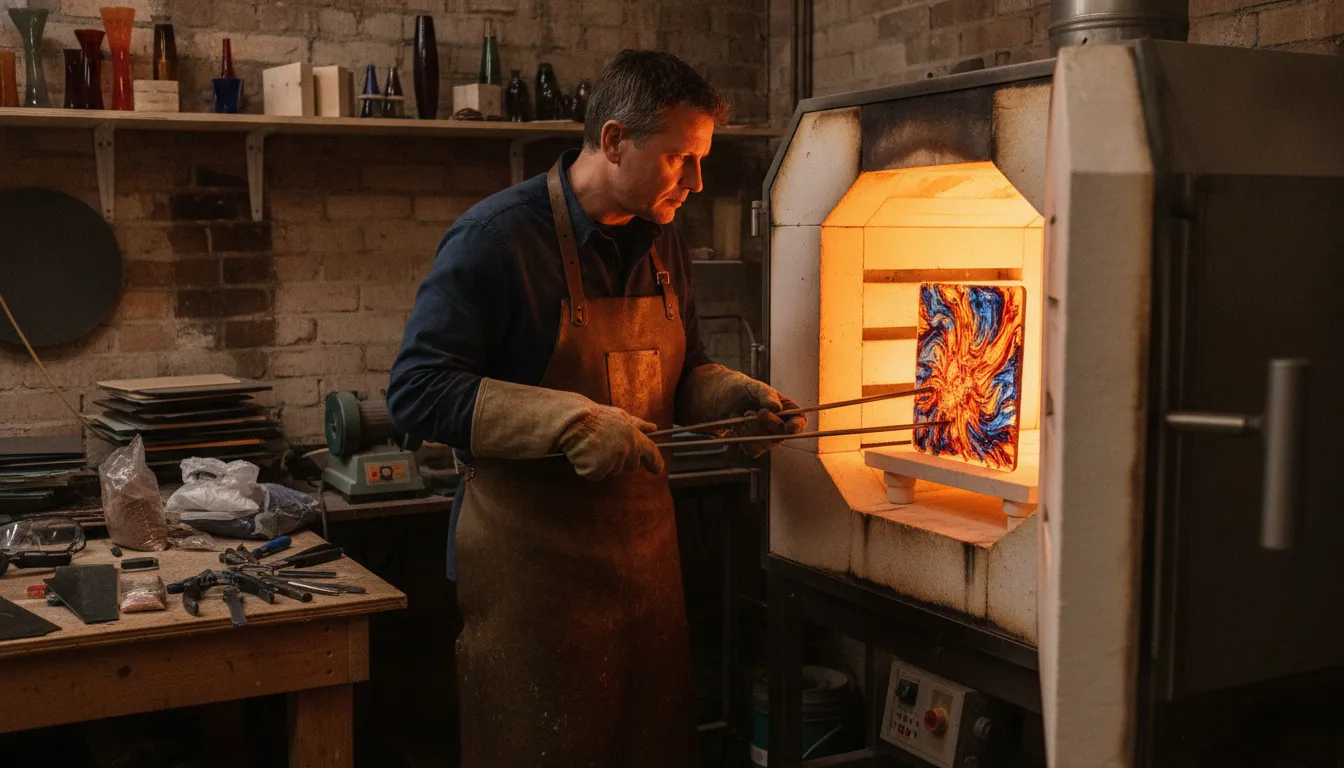
Successful kiln firing depends on more than choosing a number on the controller. The target temperature, ramp rate, hold time, glass thickness, and total volume determine whether layers retain texture, flow into a smooth surface, or develop stress during cooling. Compatible glass fuses at roughly 1,490 degrees Fahrenheit, but the correct schedule varies with the intended result and the specific kiln.
A reliable glass fusing temperature guide starts with compatibility: choose either COE90 or COE96, never combine them, then adjust the schedule for the desired finish. Tack fusing uses less heat to preserve texture, full fusing uses more heat to join layers completely, and slumping shapes glass at a lower temperature.
COE90 and COE96 expand at different rates, so they must be treated as separate systems to reduce cracking risk. The temperature also controls viscosity, allowing glass to soften and move without eliminating every detail. Understanding that relationship makes the next step clear: temperature control is central to both the appearance and structural integrity of a fused piece. For broader process guidance, review our glass fusing techniques resource.
Why a Glass Fusing Temperature Guide Starts with Temperature Control
Temperature control determines whether compatible glass joins into a stable piece, preserves its intended shape, or develops defects that appear during cooling. Fusing is not simply a matter of making the kiln hot. The controller must deliver a controlled combination of ramp rate, peak temperature, hold time, and annealing so the glass changes state without accumulating avoidable stress.
COE compatibility comes before the firing schedule
Coefficient of Expansion, or COE, describes how glass responds to temperature changes. COE 90 and COE 96 are common fusible-glass systems, but their different expansion rates make them incompatible in the same fused project. They may appear identical before firing, yet they can contract at different rates as the kiln cools. That mismatch can create cracks or breakage, sometimes immediately and sometimes after the piece has been handled.
Choose one COE system for the entire project, including sheet glass, stringer, frit, powder, and inclusions. A glass compatibility check is essential before building a design, especially when materials come from different manufacturers. Do not use peak temperature to compensate for incompatible glass. A longer hold or hotter firing cannot correct a difference in expansion behavior.
Temperature changes glass viscosity
As glass heats, its viscosity decreases. In practical terms, the material moves from a rigid sheet toward a viscous mass that can soften, round over, and flow. Glass research places the softening point near 107.6 poise, but the useful working range depends on the glass formulation, thickness, kiln calibration, and desired result. That is why one temperature does not define every fuse. A tack fuse can preserve texture, while a higher or longer firing can flatten edges and merge layers more completely.
Under-firing and over-firing create different problems
Under-firing may leave layers incompletely joined, sharp edges, weak bonds, or visible gaps between components. Over-firing can flatten texture, distort relief, increase devitrification risk, and allow glass to spread beyond the intended profile. Glass fusing commonly joins compatible sheets at approximately 1,490 degrees Fahrenheit, but that figure is a starting reference rather than a universal setting. Test tiles, kiln calibration, and a controlled annealing segment should guide the final schedule.
Precise control protects both the design and the material. It lets the kiln produce the intended level of fusion instead of relying on heat alone.
Full Fuse: What Happens to Glass at Top Temperature
A full fuse takes compatible glass pieces beyond surface bonding until they merge into one continuous, smooth layer. As the kiln approaches the working range, heat lowers the glass viscosity enough for the edges and internal interfaces to flow together. The original cut lines become less distinct, and the finished piece generally has softened edges and a unified surface.
What changes as the glass reaches full-fuse temperature?
Temperature alone does not determine the result. Time at temperature, ramp speed, glass thickness, kiln calibration, and the specific COE formulation all affect how completely the layers merge. A full fuse is therefore a controlled balance between heat and duration, not a single universal controller setting.
- COE 96 full fuse: A typical working range is 1,441 to 1,459°F, depending on the kiln and the glass. See the COE 96 temperature range.
- General reference point: Many introductory glass-fusing references place complete joining near 1,490°F. This is a broad guide, not a substitute for the manufacturer’s schedule. Review the general fusing process.
- COE 90: COE 90 commonly fires slightly higher than COE 96, but use the schedule recommended for the exact glass system and kiln.
A practical COE 96 cabochon schedule
For a COE 96 jewelry cabochon, one published example ramps at 800°F per hour to 1,460°F and holds for 15 minutes. View the cabochon schedule source. Treat this as a starting point. Small kilns can read differently across the chamber, and a dense or unusually thick design may require a slower approach or a revised annealing segment.
Never combine COE 90 and COE 96 in one fused project simply because their full-fuse temperatures overlap. Their different expansion behavior can create stress and breakage after cooling. For reliable results, keep one compatible glass system together, verify the manufacturer’s firing guidance, and test a new combination before committing a finished design.
Tack Fuse: Preserving Texture and Dimension
A tack fuse heats compatible glass enough for separate pieces to soften and bond while retaining much of their original shape. For COE 96 glass, the tack-fuse range is approximately 1,350°F, well below the temperatures used for a full fuse. The result is a surface with visible relief, rounded edges, and deliberate variation in height rather than one uniformly merged layer. Temperature is only one part of the process, so use a tested schedule for your specific kiln and include an appropriate annealing segment.
What a tack fuse does to the glass
At tack-fuse temperatures, the glass reaches a workable viscosity but does not flow far enough to erase every boundary. Layered pieces can remain identifiable, and textured elements can keep their profile. This makes the technique useful when the visual character comes from depth, surface pattern, or the relationship between adjoining components. The exact outcome also depends on heatwork, including ramp rate and hold time, as well as the size and thickness of the project.
Common applications for tack fusing
- Jewelry cabochons: Keep dots, shards, and stacked accents visible while creating a bonded, wearable form.
- Textured wall art: Preserve ridges, inclusions, and raised details that would flatten during a full fuse.
- Dimensional pieces: Build relief in small sculptures, tiles, and decorative components without eliminating every layer boundary.
Hot Shot Ovens lists a general COE 96 jewelry-cabochon tack schedule that ramps at 800°F to a target of 1,360°F, followed by a 15-minute hold. Treat this as a starting reference, not a universal prescription. Kiln calibration, project geometry, and the manufacturer’s glass specifications can change the required heatwork. Review the referenced tack-fuse schedule before adapting it to your controller.
Tack fuse versus full fuse
A full fuse generally produces a smoother, flatter surface because greater heatwork allows the layers to flow together more completely. A tack fuse prioritizes texture and dimension, so the finished piece can show distinct components and a more sculptural profile. The best choice depends on the intended visual outcome: choose tack fusing for preserved relief, and full fusing when you want a unified sheet or smoothly rounded form.
Slumping: Shaping Glass Over Molds at Lower Temperatures
Slumping reshapes a previously fused sheet without fully melting it again. The glass is first full-fused flat, annealed, and cooled. It is then placed over or into a mold and fired at a lower temperature, typically about 1,200 to 1,350°F. The correct range depends on the glass COE, the kiln, the mold material, and the depth or complexity of the form.
How gravity shapes the project
As the glass reaches its softening range, viscosity decreases enough for gravity to pull it gradually against the mold. The glass conforms to the mold’s contours while retaining its fused surface, layered color, and overall thickness. Slumping is not a substitute for annealing. The shaped piece still needs a controlled annealing segment so internal stress can dissipate before cooling through the strain point.
A successful slump is gradual rather than forceful. Firing too quickly can create uneven temperature across the sheet, especially where the glass contacts the mold. That thermal difference can produce cracking or distortion. A controlled ramp rate gives the entire project time to heat evenly, while a suitable hold allows the glass to settle into the form without over-softening the edges.
Choosing a mold and firing approach
Ceramic molds are common because they tolerate kiln temperatures and provide a range of shapes and textures. Stainless steel molds are also useful for smooth, repeatable forms when they are properly prepared with a compatible kiln wash or release treatment. The mold must support the glass without sharp transitions that concentrate stress, and its surface should be clean and fully dry before loading.
For detailed mold selection, review this guide to slumping molds. Because each kiln and glass combination behaves differently, use the slumping temperature guide as a starting point, then run small test pieces before committing a larger project to a new schedule.
Sample Firing Schedules for COE90 and COE96 Glass
Use the schedules below as controlled starting points for compatible glass, not as universal recipes. Kiln calibration, project thickness, total glass mass, shelf position, and the desired surface finish all affect the result. The target temperature describes the heatwork needed for the fuse, while the ramp rate controls how quickly the kiln approaches that stage.
| Project and process | Glass | Ramp rate | Target temperature | Hold |
|---|---|---|---|---|
| Tack fuse | COE96 | 800°F per hour | Approximately 1,350°F | 15 minutes |
| Full fuse cabochon | COE96 | 800°F per hour | Approximately 1,460°F | 15 minutes |
| Full fuse small project, up to 8 inches | COE96 | 500°F per hour | Approximately 1,460°F | 15 minutes |
| Equivalent starting point | COE90 | Use the same profile as a baseline | Typically 25-50°F higher | Confirm through testing |
The COE96 cabochon schedule is documented as an 800°F ramp to 1,460°F with a 15-minute hold. A full fuse may also fall within an approximate 1,441-1,459°F range, depending on the kiln and project. The small-project profile uses a slower 500°F ramp, giving a smaller piece a more gradual approach to full-fuse heatwork. These figures are summarized from the source firing chart.
COE90 and COE96 are not interchangeable materials. Their different coefficients of expansion mean they should never be combined in one fused project, even when the schedule appears similar. For additional programming examples, review our firing schedules for glass fusing.
Every schedule is a starting point. Fire test tiles made with the same glass thickness, layers, inclusions, and shelf setup as the finished work. Examine the result for edge shape, surface texture, bubbles, devitrification, and stress after annealing. Adjust one variable at a time, then record the schedule that produces stable, repeatable results in your kiln.
How to Program Your Kiln Controller
Most modern glass kilns use a digital PID controller. Although button names and menus vary by manufacturer, the programming logic is consistent: every firing schedule moves through rate, target, hold, then the next segment. Understanding that sequence makes a controller easier to use and helps you adapt a glass fusing temperature guide to your project, kiln, and compatible glass.
-
Learn the controller interface
Identify the keys for selecting a program, entering values, advancing between segments, and starting or stopping a firing. Confirm whether the display shows degrees Fahrenheit or Celsius. Before programming, check that the kiln is empty or loaded according to your firing plan and that the thermocouple is unobstructed.
-
Enter the ramp rate
For the first segment, enter the rate in degrees per hour. This controls how quickly the kiln rises from its starting temperature. A slower ramp can provide more controlled heating, while the appropriate rate depends on the glass thickness, project design, and schedule. Do not treat a fast default as suitable for every firing.
-
Set the target temperature
Enter the temperature at which that segment ends. The target should match the intended result, such as a tack fuse, full fuse, or slump, and must be compatible with the glass manufacturer’s recommendations. The controller will heat at the programmed rate until it reaches this target.
-
Set the hold time
Enter how long the kiln should remain at the target temperature. A hold allows heat to work through the project and supports a more even result. Use the schedule’s specified hold rather than adding time automatically, since excessive heatwork can alter edges, texture, and shape.
-
Program the anneal segment
Add a separate segment for annealing. Many glass schedules place the anneal around 900-1,000°F and hold for 30-60 minutes, but the correct temperature and duration depend on the glass, thickness, and manufacturer guidance. Annealing reduces stress as the project passes through the strain point.
-
Program the controlled cool-down
Enter the next ramp rate and a lower target temperature when your schedule calls for controlled cooling. Continue the sequence until the program reaches its final cooling stage. Avoid opening the kiln while the glass is still hot, because sudden temperature changes can create thermal shock.
Save the completed program if your controller supports multiple stored schedules. Label each one clearly by glass type, thickness, and firing purpose so you can reproduce tested results. For compatible programming accessories and kiln supplies, select equipment that matches your kiln and firing workflow.
Frequently Asked Questions
What temperature should I use for fusing glass?
The correct temperature depends on the desired result, glass thickness, project size, kiln, and COE. For COE96, a full fuse commonly falls between 1,441 and 1,459 degrees Fahrenheit, while a tack fuse is approximately 1,350 degrees Fahrenheit. Use these values as starting points, then refine the schedule through controlled test firings. See the cited COE96 temperature range.
What is the difference between a tack fuse and a full fuse?
A tack fuse heats the glass enough to bond layers while preserving texture, edges, and some dimensional detail. A full fuse reaches a higher temperature and hold that allow the pieces to flow together into a smoother, more unified surface. The choice depends on whether the finished piece should retain relief or become largely flat.
How long should I hold the temperature in a glass kiln?
Hold time is schedule-specific rather than universal. One suggested COE96 cabochon full-fuse schedule ramps at 800 degrees Fahrenheit to 1,460 degrees Fahrenheit and holds for 15 minutes. Larger, thicker, or more complex projects may need different heating and annealing segments, so follow the kiln and glass manufacturer’s guidance and test before producing a final piece. Review the cited cabochon schedule.
What is COE and why is it important in glass fusing?
COE, or Coefficient of Expansion, describes how much glass expands and contracts as its temperature changes. COE90 and COE96 are different fusible-glass systems with different expansion rates. Compatible layers must belong to the same system because mismatched movement can create stress and cracking during cooling. Read the cited compatibility guidance.
Can I mix COE90 and COE96 glass in one project?
Do not fuse COE90 and COE96 together as though they were compatible. Their different expansion rates can leave the finished piece under stress, even when the project appears intact after firing. Choose one COE system for the entire fused assembly, verify product specifications, and anneal the piece properly to reduce thermal stress.
Ready to Set Up Your Next Firing
Choose kiln programs and materials that support controlled, repeatable work across full fuse, tack fuse, and slump projects. Shop Art Glass Supplies for kilns, glass, and fusing supplies to get started with equipment and materials suited to your studio practice.