
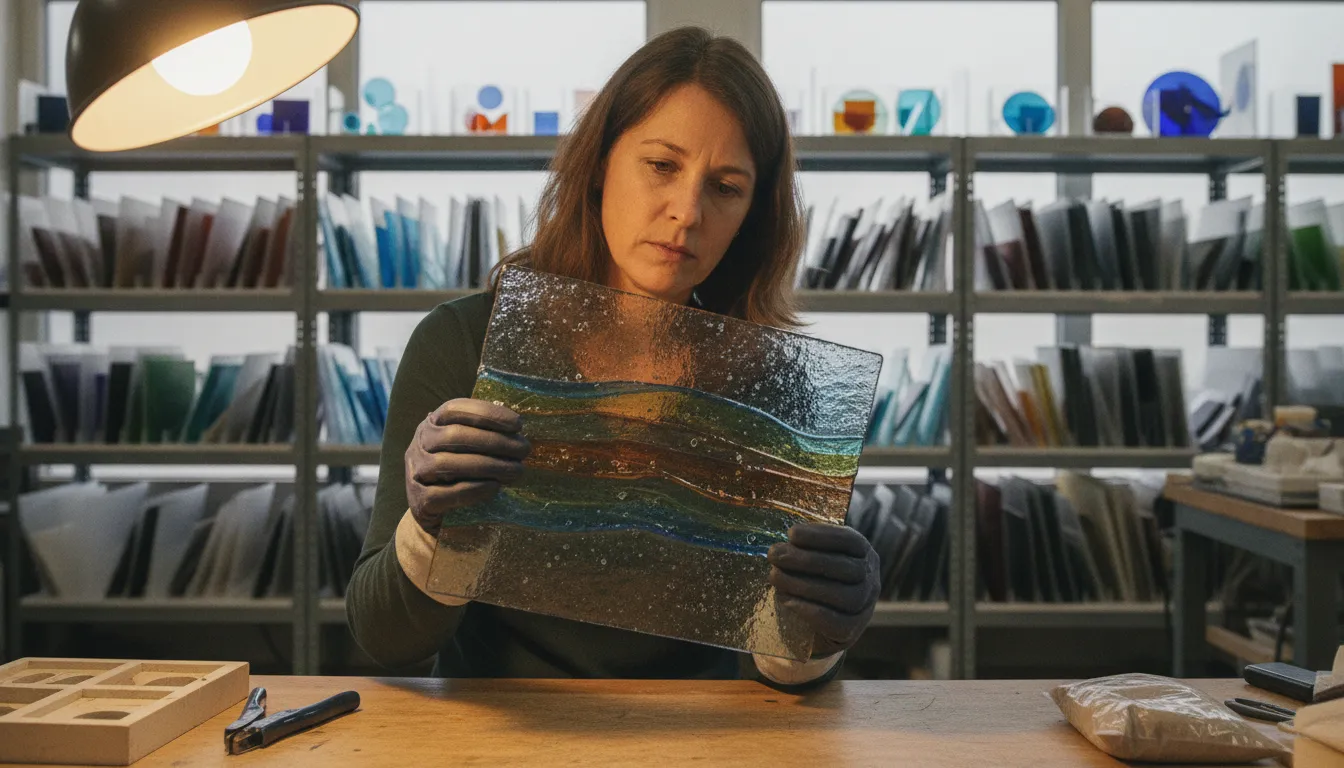
A smooth, glossy fuse can emerge from the kiln with a cloudy, dull, or chalky surface. That finish is not simply a cosmetic flaw. It signals that microscopic crystals formed at the glass surface during firing, often while the piece remained too long in a temperature range where crystallization can develop.
Devitrification in glass fusing is surface crystallization that replaces a clear, glossy finish with a hazy or chalky layer. The risk increases when glass is contaminated, overheated, or held too long between roughly 1300F and 1500F, although the exact range varies by glass composition.
Because devitrification may become visible only after the kiln cools, prevention depends on more than watching the peak temperature. Understanding how glass composition, surface cleanliness, viscosity, and the firing schedule interact makes it easier to identify the cause and choose an appropriate remedy. The first step is to examine what crystallization is and why this temperature-sensitive reaction occurs.
What Is Devitrification in Glass Fusing and Why Does It Happen
Devitrification is the formation of microscopic crystals on the surface of glass during kiln firing. Instead of cooling to a smooth, transparent, glossy finish, the affected area develops a cloudy, dull, or chalky appearance. The change is a surface crystallization problem, not simply residue left behind after firing.
For many fusing glasses, the critical devitrification range is approximately 1300F to 1500F. Prolonged heating within this zone gives crystal nuclei time to form and grow at the glass surface. A firing schedule that moves slowly through this range, or a hold that lasts longer than the project requires. Can therefore increase the risk even when the final peak temperature is otherwise appropriate. The exact response depends on the glass composition and the schedule. So these temperatures should be treated as a practical range rather than a universal rule for every product.
Why the kiln schedule matters
Glass remains structurally capable of changing as it is heated and cooled. When the surface spends too much time in a temperature zone that favors crystallization, a previously smooth surface can lose its optical clarity. This is why controlled ramp rates and purposeful hold times matter in both tack-fuse and full-fuse work. Correct scheduling is not only about reaching the target peak. It is also about limiting unnecessary exposure during vulnerable portions of the cycle.
The risk is significant enough that academic glass-science material describes devitrification as an “ever-present danger in all glass manufacture and working.” That warning applies to kilnforming as well as industrial glass production. Devitrification is a known behavior of glass, not proof that a project was assembled incorrectly.
Why devit can surprise you after firing
Devitrification may develop while the piece is inside the kiln, but it is often visible only after the kiln has cooled. A hot project can appear clear while firing, then reveal a hazy or chalk-like film when viewed at room temperature. Inspect the entire surface under strong, angled light after unloading, especially if the project remained in the 1300F to 1500F range for an extended period.
For a broader overview of firing methods and techniques to prevent devitrification in glass fusing, review the complete glass fusing guide.
Browse COE90 and COE96 glass for your next fusing project at Art Glass Supplies.
The Chemistry Behind Surface Crystallization
Glass is an amorphous solid, meaning its atoms do not occupy the orderly repeating arrangement found in a crystal. That structure is stable enough for practical use, but it is not the lowest-energy arrangement available to every glass composition. In materials science, glass is therefore described as metastable. It can remain noncrystalline for long periods, yet it retains a tendency to reorganize when temperature and time provide the opportunity.
That tendency is the physical basis of devitrification. As described in Lehigh’s glass science lecture, glass can crystallize during slow cooling or slow heating. In a kiln, a long dwell within a temperature interval can give atoms enough mobility to leave their disordered positions and begin forming an ordered crystal lattice. The resulting crystals scatter light at the surface, producing the cloudy or chalky appearance associated with devitrification.
How crystal formation begins in the base glass
Devitrification is not simply a layer of residue deposited on top of an otherwise unchanged project. Research published by NIST characterizes devitrification of the base glass as a single-step crystal-formation process. The glass itself supplies the material that reorganizes into a crystalline phase. Surface contamination can encourage nucleation, but the visible flaw reflects a change in the glass structure rather than ordinary dust trapped on the surface.
Why the temperature path matters
Three thermal landmarks help describe this behavior: the glass-transition temperature, the softening temperature, and the crystallization temperature. Near the glass transition, structural relaxation becomes possible as the rigid glass gains molecular mobility. At the softening point, viscosity falls enough for the material to deform under heat. Near the crystallization temperature, atoms can rearrange into a stable crystal structure. NIST identifies these temperatures as key variables in analyzing devitrification and glass-ceramic stability.
These are not interchangeable values, and they are not universal across every COE or glass formulation. A firing schedule that moves efficiently through a vulnerable range limits the time available for nucleation and crystal growth. Conversely, an unnecessary hold can keep the surface mobile long enough for the metastable glass to begin reorganizing. Understanding this temperature-dependent chemistry explains why precise ramp rates, peak temperatures, and annealing schedules matter when you are trying to preserve a clear, glossy fused surface.
Which Glass Types Are Most Prone to Devitrification
COE90 and COE96 are not simply two points on a devitrification scale. COE identifies a glass family by its approximate coefficient of expansion, while the complete composition determines how chemically stable its surface is during heating and cooling. Different formulas therefore have different propensities for surface crystallization. A glass that appears stable in one firing schedule may develop a cloudy surface when held too long in a vulnerable temperature range.
| Characteristic | COE90 | COE96 |
|---|---|---|
| What the designation means | A glass family identified by an approximate coefficient of expansion of 90. | A glass family identified by an approximate coefficient of expansion of 96. |
| Devitrification propensity | Varies by the specific formulation, surface condition, and firing schedule. COE90 alone does not predict devitrification. | Varies by the specific formulation, surface condition, and firing schedule. COE96 alone does not predict devitrification. |
| Compatibility concern | Use with compatible COE90 materials rather than assuming another COE family will behave the same way. | Use with compatible COE96 materials and follow the manufacturer’s compatibility guidance. |
This distinction matters when troubleshooting devitrification in glass fusing. If a project turns hazy, do not assume the COE number is the cause. Check the exact glass products, cleanliness, firing profile, and hold time. The guide to understanding compatibility and devitrification explains why materials from different families should not be mixed without testing.
Use a polarizing filter to investigate compatibility
A polarizing filter test can help reveal compatibility issues before you commit a larger project to the kiln. Place the sample between polarized filters and rotate it while observing for stress patterns. Unexpected or pronounced patterns can indicate strain from incompatible materials. The test does not rank COE90 or COE96 by devitrification risk, but it can separate a compatibility problem from a surface-crystallization problem.
For projects built around COE90 materials, browse COE90 glass for fusing and keep the glass family consistent unless controlled testing supports another choice.
How to Prevent Devitrification in Your Fusing Projects
Preventing devitrification requires controlling both the glass surface and the kiln environment. Surface contaminants can provide nucleation points for crystals, while excessive time or heat can destabilize the glass surface. Use this process before and during each firing:
- Clean the glass immediately before loading. Dust, fingerprints, oils, and cutting residue can trigger crystal formation when the glass reaches fusing temperatures. Wipe every exposed surface with 91% isopropyl alcohol or distilled white vinegar, then allow it to dry completely. Handle the piece by its edges afterward, and avoid touching the cleaned surface. This cleaning protocol is supported by glass fusing guidance on removing contaminants.
- Keep the firing schedule moving through the devitrification range. For many glasses, the higher-risk range is approximately 1300F to 1500F. Program the kiln to pass through this zone efficiently rather than holding there unnecessarily. Excessive hold times at peak temperature give surface crystals more time to grow, even when the peak temperature itself is appropriate. Review the guide to adjusting firing schedules to minimize devitrification when adapting a tack fuse or full fuse schedule.
- Use the lowest effective peak temperature. Avoid increasing the peak simply to speed up a firing or force a more fluid fuse. A temperature above the glass’s optimal firing range can create molecular instability at the surface, increasing the likelihood of crystallization. Base the schedule on the specific glass manufacturer’s recommendations, project thickness, and desired viscosity.
- Maintain a clean shelf and sound kiln wash. Remove loose kiln wash, dust, and debris from the shelf before every firing. Apply kiln wash correctly and repair or replace areas that are flaking or contaminated. Clean kiln surfaces and correct firing schedules work together to reduce surface flaws, so inspect the shelf as carefully as you inspect the glass.
- Use a devitrification spray when a glass repeatedly develops haze. A suitable spray can add another protective measure for problematic pieces, but it does not replace cleaning or accurate temperature control. Follow the product instructions and test it on a small sample first. Consistent results also depend on precise kiln control, so consider Skutt kilns for precise glass fusing if your current kiln struggles to hold a stable schedule.
Record the glass type, COE, schedule, peak temperature, hold time, and shelf condition after each firing. That record helps you identify whether contamination, excessive heat, or time in the devitrification range is driving a recurring surface problem.
How to Fix Devitrification After Firing
Prevention is more reliable than repair, because devitrification changes the glass surface during firing and may not become visible until the kiln has cooled. If the cloudy or crystalline area is mild, however, the piece may still be salvageable. Treatment depends on how deeply the crystals have formed and whether removing them would damage the design. Mild devitrification can sometimes be treated or removed, but methods vary with the severity of the crystal growth. Review established devitrification treatment methods before working on a valuable piece.
Grind and polish mild surface devit
For a light, superficial haze, use fine diamond hand pads to carefully abrade the affected surface. Work gradually with water as a lubricant, keep the surface evenly supported, and inspect often. The goal is to remove the thin crystalline layer without creating a visible low spot or cutting through an important color layer. After grinding, progress through finer pads and polish the surface if the project design and glass thickness allow it.
Consider a controlled second firing
A second firing can sometimes improve the finish, especially when the devitrification is shallow and the piece can tolerate additional heatwork. A faster ramp rate may reduce the time the glass spends in conditions that encourage crystal growth, but it is not a universal cure. Choose a schedule appropriate for the specific glass, thickness, and desired finish. Include a suitable annealing cycle, and avoid compensating with an unnecessarily high peak temperature or a long hold.
Some artists apply a devitrification spray before re-firing. When used according to the product directions, the coating can help create a cleaner surface and reduce recurrence. Test the spray and revised schedule on a small sample first, because coatings and firing responses vary.
When should you accept the surface as-is?
Heavy texture or deep crystallization may not be practical to grind away, and repeated firing can distort details, alter color, or introduce new stress. In those cases, accepting the finish may protect the structural integrity of the piece. The dependable solution for future work is prevention: clean the glass and shelf carefully, limit unnecessary holds, and use a controlled firing schedule from the initial firing.
Set up your kiln schedule with the full firing schedules guide from Art Glass Supplies.
Frequently Asked Questions
What causes devitrification in glass fusing?
Surface contamination, excessive hold times, and an overly high firing temperature can encourage crystal nucleation. Dust, fingerprints, oils, and cutting residue are especially important because they give crystals a starting point. Prolonged heating between about 1300F and 1500F also increases the risk for many glasses. Source.
How can I prevent a cloudy surface before firing?
Clean the glass thoroughly after cutting and handling, remove residue with isopropyl alcohol or distilled white vinegar, and keep kiln shelves free of contamination. Use a firing schedule appropriate for the glass, avoid unnecessary holds, and do not exceed the recommended peak temperature. These steps reduce the time and surface conditions that support crystal growth.
What does devitrification look like after a firing?
Instead of a smooth, glossy surface, the glass may appear cloudy, dull, hazy, or chalky. The crystals form during firing, but the defect is often easiest to identify only after the kiln and project have cooled. Inspect the surface under consistent lighting before deciding whether treatment is worthwhile. Source.
Can devitrified glass be fixed?
Mild surface devitrification can sometimes be treated or removed, but the suitable method depends on how extensive the crystal growth is and how the piece was fired. Evaluate the surface first, then choose a compatible corrective process rather than automatically increasing the temperature. Severe or deeply established devitrification may be more practical to accept or prevent in a replacement firing.
Does every type of fusing glass have the same devitrification risk?
No. Glass compositions have different propensities for surface crystallization, so one product may devitrify under a schedule that works well for another. Keep glass within its compatible COE system, test unfamiliar combinations, and use a polarizing filter test when evaluating compatibility-related concerns. Source.
Ready to refine your glass fusing results?
Consistent results depend on compatible glass, clean surfaces, and firing equipment you can control precisely. Browse Art Glass Supplies’ selection of COE90 and COE96 glass, kilns, and studio supplies to support careful testing and more predictable projects. Get started by browsing glass fusing materials and supplies.