
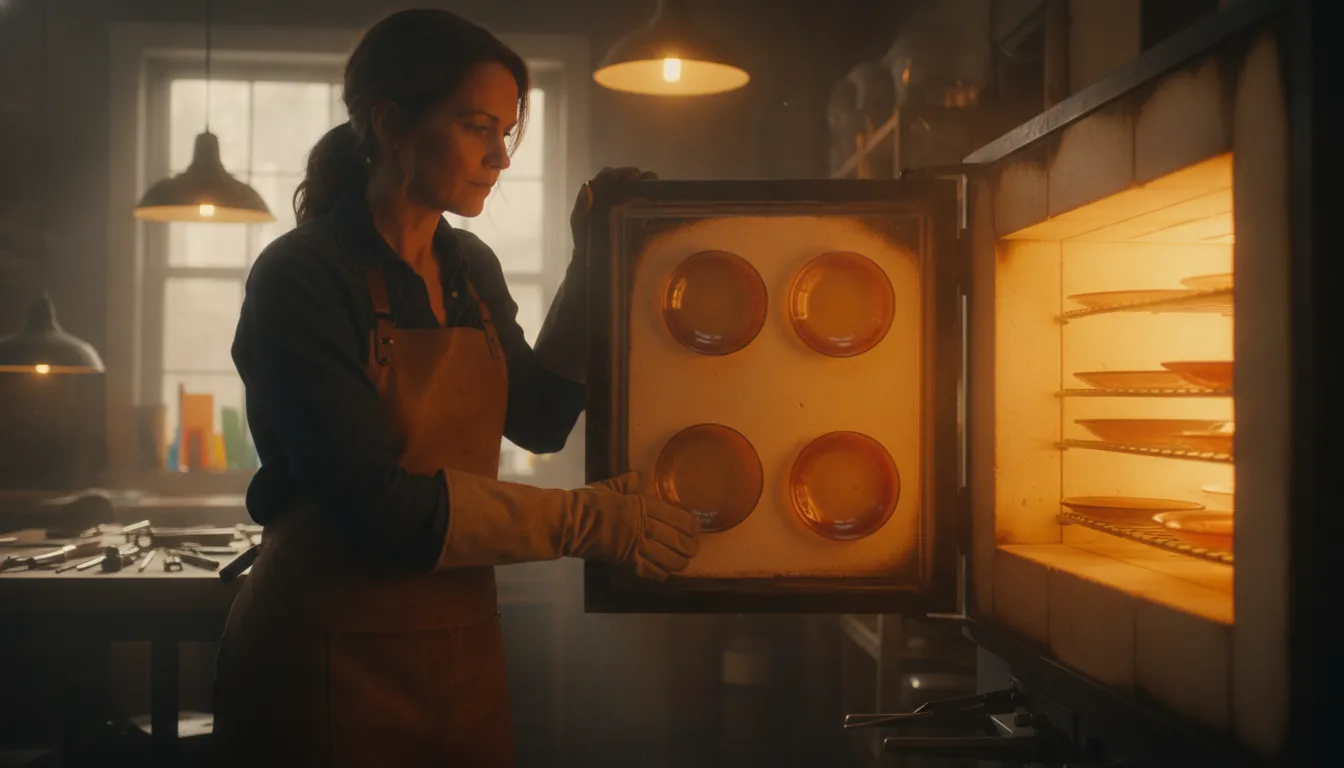
A fused glass project can look flawless when it leaves the kiln and still fail later if its internal stress was not relieved. Annealing is the controlled hold and cooling phase that lets the glass relax before it reaches room temperature.
To understand how to anneal glass fusing, hold compatible glass at the correct annealing temperature long enough for its interior to equalize, then cool it gradually through the strain range. The exact schedule depends on the glass system, thickness, and kiln’s ability to maintain an even temperature.
Annealing is not a single universal number. COE, viscosity, project thickness, and the difference between the center and surface all affect the schedule. The following explanation begins with the science behind the process, building on this glass fusing techniques guide before turning to practical kiln settings.
Browse glass fusing supplies and kiln tools for controlled firing schedules.
What Is Annealing in Glass Fusing and Why Does It Matter?
Annealing in glass fusing is the controlled cooling phase that relieves internal stress in a fused piece before it reaches room temperature. The kiln holds the glass within a specific temperature range, allowing structural constraints to relax, then cools it gradually through the critical range where new stress can form. This process is essential because poorly annealed glass has reduced resistance to cracks and failure from small thermal or mechanical shocks. Glass fusing for artists depends on this controlled thermal treatment as much as it depends on compatible materials and accurate firing.
Glass is an amorphous solid, so its atoms do not settle into the long-range ordered structure found in a crystal. As the fused project cools, different areas can contract at different rates. Annealing gives the material enough molecular mobility to approach equilibrium and reduce those residual stress differences. If the kiln cools too quickly, the outside may become rigid while the interior remains warmer, creating constraints that stay locked in the finished piece. Those stresses may produce a crack immediately, or cause spontaneous breakage later.
Annealing is more than holding one temperature
A reliable cycle has two connected stages: a soak and a controlled cool-down. During the soak, the glass is held long enough for heat to move through the entire project and for internal stress to relax. During the first cooling stage, the kiln must continue to reduce temperature at a controlled rate so the glass does not develop a damaging temperature gradient. Bullseye’s guidance identifies a difference of no more than 10 degrees Fahrenheit, or 5 degrees Celsius, throughout the glass during the first anneal cool as an important benchmark. The correct schedule depends on glass type, thickness, size, and kiln performance.
Annealing also requires the right viscosity range. The temperature must be high enough for stress relief but low enough that the project does not soften, slump, or deform. That is why an annealing schedule should match the glass manufacturer’s recommendations and its COE system rather than relying on a single universal setting.
The Physics of Thermal Stress in Fused Glass
Fused glass behaves differently from a crystalline material because it is an amorphous solid. Its atoms do not settle into a repeating long-range lattice, so the material responds to temperature through changes in molecular mobility and viscosity. During cooling, the outside of a project can become rigid while its hotter interior is still contracting. If that temperature difference is too large, the rigid outer glass constrains the interior and stores elastic stress.
How COE and viscosity influence stress
COE, or Coefficient of Expansion, describes how much a glass changes size as its temperature changes. Compatible glasses are selected within the same COE system because different expansion behavior can create stress where layers, inclusions, or components meet. COE does not replace annealing, however. Even a compatible project can crack if its temperature is uneven during cooling.
Viscosity is equally important. As glass cools, it becomes progressively more resistant to molecular movement. The annealing range is narrow: the glass must be fluid enough for its structure to relax, but not so soft that the project deforms. Below this range, the material may retain stress because its structure no longer has enough freedom to rearrange. The annealing soak therefore gives the glass time to approach equilibrium before controlled cooling continues.
Why the strain point matters
The strain point marks the lower part of the temperature range in which internal stress can still relax on a practical timescale. As the glass passes through this region, its viscosity rises sharply and molecular rearrangement becomes too slow to remove meaningful stress. A firing schedule must keep the project sufficiently uniform through this transition, rather than allowing the surface and center to cross it at widely different times.
Rapid cooling creates structural constraints inside the glass. Those constraints may not be visible immediately, but they reduce resistance to mechanical or thermal shock and can produce delayed, spontaneous cracks. This is why a piece can appear successful when removed from the kiln and fail hours or days later. During the first anneal cool, aim for a temperature difference of no more than 10 degrees F, or 5 degrees C, throughout the glass body. That uniformity is often more important than chasing one exact soak temperature. Review glass fusing firing schedules before adapting a cycle to your project size, thickness, and compatible COE system.
How to Choose Annealing Temperatures for COE90 and COE96 Glass Fusing
Anneal soak temperature is the controlled temperature at which fused glass can release internal stress without softening enough to deform. The correct setting depends on the glass manufacturer and compatible system, not simply on the number printed as its COE. COE90 and COE96 therefore require separate reference points. Even though both rely on the same physical process: hold the glass long enough for its temperature and viscosity to become uniform. Then cool it through the critical range in a controlled way.
| Glass System | Anneal Soak Reference | Notes |
|---|---|---|
| Bullseye COE90 | 900 F (482 C) | Bullseye lowered its recommendation from 960 F; verify the current schedule for your project. |
| Spectrum System 96 | 950 F | Some technical guidance still cites 960 F (516 C) as an effective soak for compatible work. |
COE90 and COE96 use different reference temperatures
For Bullseye-compatible COE90 glass, a commonly cited anneal soak is 900 degrees F (482 degrees C). Bullseye lowered its recommended soak from 960 degrees F to 900 degrees F, so older schedules may show a number that is no longer the manufacturer’s current recommendation. Use the schedule supplied for the exact glass system and project rather than combining values from unrelated charts. The Fused Glass Association annealing reference provides manufacturer context for compatible systems.
For Spectrum System96, a frequently specified anneal hold is 950 degrees F. Some schedules and technical guidance also identify 960 degrees F (516 degrees C) as an effective soak temperature for compatible work. That difference is why a firing schedule should identify the glass brand or system, COE, project thickness, and anneal temperature. COE compatibility reduces expansion mismatch between pieces, but it does not make an arbitrary anneal setting safe. The kiln must still bring the entire project to a stable, appropriate soak.
Uniform heat matters more than chasing one exact number
Annealing occurs within a relatively narrow viscosity range. If the temperature is too low, the glass cannot relax internal constraints efficiently. If it is too high, the glass may soften, distort, or change shape. Within the correct range, uniformity across the piece is often more important than choosing 950 degrees F instead of 960 degrees F. A thick slab can have a hotter exterior and cooler center, leaving permanent stress even when the controller displays the intended set point.
During the first anneal cool, aim to keep the temperature difference through the glass below about 10 degrees F (5 degrees C). Then follow a controlled ramp through the annealing range. Document the compatible COE system and the schedule that produced a sound result. For broader kiln programming guidance, compare these recommendations with our glass fusing firing schedules.
How Do You Build an Annealing Schedule for Different Project Thicknesses?
Project thickness determines how quickly heat can move through the glass. A thin, even layer usually equilibrates sooner than a thick slab or a piece with significant variation in thickness. Build the cycle around the slowest area, then adjust it through controlled test firings. The goal is not merely to reach an annealing temperature. The entire piece must reach a reasonably uniform temperature before it cools through the range where stress can develop.
- Identify the glass system and COE, then confirm the manufacturer’s recommended anneal soak temperature for your project thickness.
- Program a soak long enough for the entire piece to reach an even temperature before cooling begins.
- Cool at a controlled ramp through the annealing range so the interior and surfaces stay within about 10 F (5 C) of each other.
- Record the soak, ramp rates, thickness, and result so you can repeat or refine the cycle for the next firing.
Thin and evenly layered projects
For a small, thin project with consistent thickness, begin with a controlled soak appropriate for the glass system, then use a steady first cooling ramp. One documented example holds at 950 F for 45 minutes, ramps at 100 F per hour to 930 F, holds there for 45 minutes, and then ramps at 200 F per hour to 700 F. This gives the glass time to equalize before the faster portion of the cycle begins.
Do not treat this schedule as universal. Confirm the recommended annealing temperature for your COE and glass manufacturer. The glass fusing temperature guide can help you coordinate the anneal with the rest of your firing schedule.
Medium-thickness and uneven projects
When a piece includes layered areas, raised decoration, or moderate changes in thickness, extend the equalization time and cool more gradually. A useful model uses 60 F per hour to 940 F, holds for 120 minutes, continues at 60 F per hour to 920 F, holds another 120 minutes, then ramps at 60 F per hour to 880 F for a 60-minute hold. These staged ramps reduce the temperature difference between the interior and surfaces as the piece passes through the strain-point region.
Thick slabs and large projects
Thick or large work needs the most conservative schedule because its center may lag behind the surface. Uniformity during the soak matters more than chasing an exact number. One industry benchmark recommends keeping the temperature difference throughout the glass below 10 F, or 5 C, during the first anneal cool. If the kiln controller cannot provide that confidence, lengthen the soak and slow the first ramp rather than opening the kiln.
Record the glass type, COE, maximum thickness, soak, ramp rates, and result after every firing. A schedule that works for a thin tack fuse may fail on a thick full-fuse piece, even when both projects use compatible glass.
What Happens When You Skip the Annealing Step?
Skipping annealing leaves a fused glass project with internal structural constraints instead of allowing those stresses to relax while the glass still has enough molecular freedom to rearrange. The piece may look successful when the kiln opens, yet its resistance to later mechanical and temperature shock is greatly reduced. Annealing is not an optional finishing cycle. It is the controlled thermal treatment that determines whether the work remains stable after firing.
Thermal shock can create delayed cracks
During rapid cooling, the outside and interior of the glass do not necessarily contract at the same rate. Those temperature differences create stress within the material. If the glass passes through the critical annealing range without a proper soak and controlled cool, the stress can become locked into the piece. Academic glass-processing guidance notes that non-annealed or poorly annealed glass has low resistance to cracking under even small thermal or mechanical shocks. Read the technical explanation of annealing and thermal stress for the underlying glass science.
The heartbreak may happen after the firing
One of the most frustrating failures is a piece that appears intact after cooling, then develops a crack hours or days later. This delayed, spontaneous breakage is often described by glass artists as the heartbreak of annealing failure. A minor change in room temperature, handling, mounting, or impact can expose the weakness that the kiln cycle left behind. The problem is not necessarily visible until the stored stress finds a path through the piece.
Proper annealing improves thermal-shock resistance by removing those internal stress differences before the glass becomes too rigid to relax. The soak temperature must suit the glass system and remain within a narrow viscosity range: high enough for stress relief but below the point where the project softens or deforms. The cooling portion matters just as much as the hold. For a broader review of compatible materials, firing stages, and kiln practice, follow this guide to glass fusing techniques.
Get the glass and kiln tools you need for stress-free firing.
Frequently Asked Questions
What is the importance of annealing in glass fusing?
Annealing allows internal stresses to relax while the glass remains below its softening range. Without that controlled soak and cooldown, temperature differences can become locked into the piece and reduce its resistance to cracks, breakage, and later thermal shock.
How long should you anneal fused glass?
The soak length depends on the project’s thickness, size, shape, and glass system. A commonly cited example uses a 45-minute hold at 950 F, followed by a controlled ramp to 930 F and then 700 F. Treat that as a starting reference, not a universal recipe, and follow the compatible glass manufacturer’s schedule.
What temperature should I use for annealing fused glass?
Use the annealing temperature specified for your glass system and project. Bullseye-compatible COE90 glass is commonly soaked around 900 F (482 C), while some System 96 schedules specify 950 F. The correct range must be hot enough for stress relief but not so hot that the glass deforms. Source: Fused Glass Association annealing reference.
Should I change the schedule for a thick fused glass project?
Yes. Thick or large work needs more deliberate heating, a sufficiently long soak, and slower cooling because its interior and surface equalize at different rates. During the first anneal cool, aim to keep the temperature difference through the glass at no more than 10 F (5 C), a benchmark identified in Bullseye’s technical guidance.
Can fused glass crack after it comes out of the kiln?
Yes. Poorly annealed glass can contain residual stress that is not immediately visible. A later mechanical or thermal shock may expose that weakness, causing a delayed crack or spontaneous breakage. Review the glass compatibility, soak temperature, project thickness, and cooling ramps before firing the piece again.
Ready to Choose Your Fusing Supplies?
Consistent annealing starts with the right glass, kiln, and firing tools for your project. Browse the selection of materials and equipment for your next fused glass piece.
Shop kilns, glass, and fusing supplies at Art Glass Supplies.