
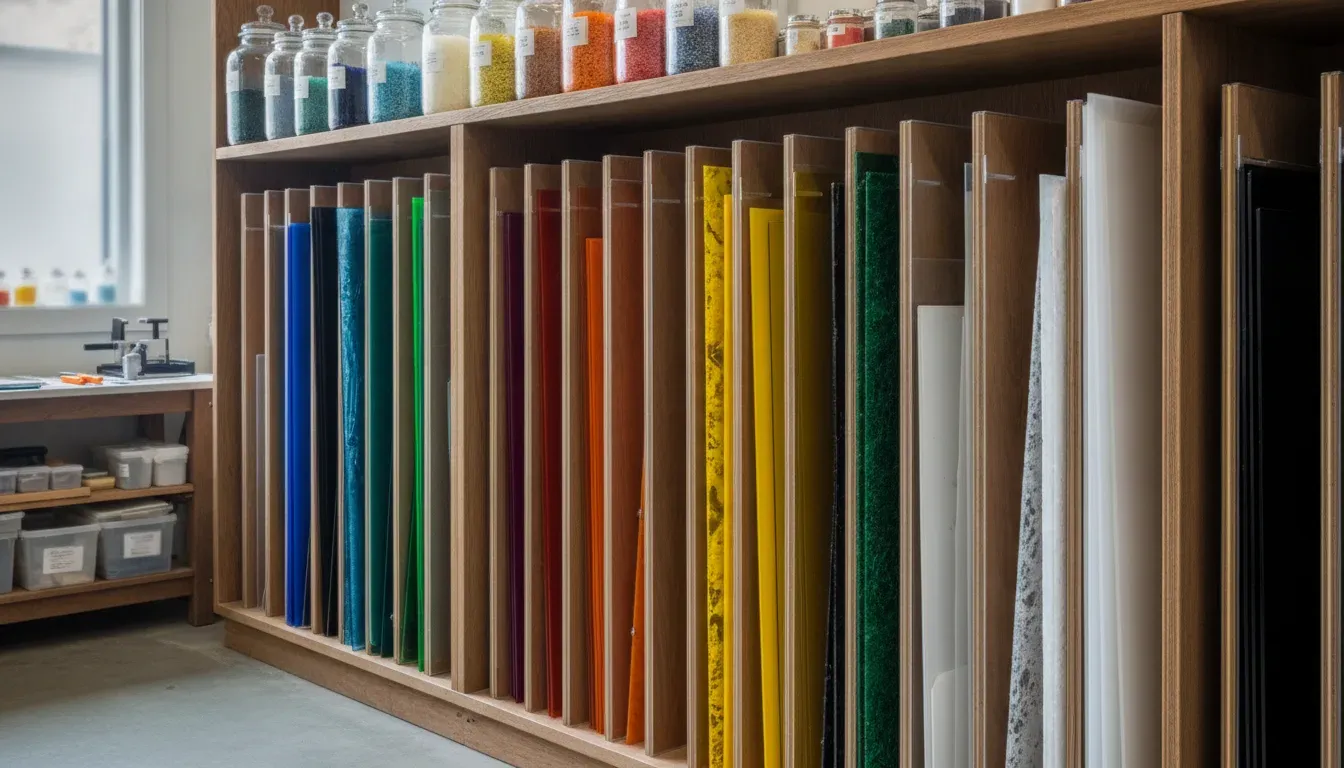
Good storage protects more than the appearance of your materials. It helps prevent broken sheet glass, keeps frit and powders free from avoidable contamination, and makes it much less likely that you will combine incompatible materials by mistake. The best system for storing fused glass supplies separates glass by compatibility, keeps small particles contained, and lets you identify every container before you begin a project.
Shop glass fusing supplies at Art Glass Supplies when you are ready to replenish compatible sheet glass, frit, stringers, and other studio materials.
What is the safest way to store fusible glass?
Store fusible glass in a clean, dry, stable area away from direct sunlight and heat sources. Keep sheets upright with support between colors or types, place frit and powders in closed containers, and label each material with its brand, color, size, and COE. A consistent system reduces breakage, dust, moisture, and compatibility errors.
Start with a clean, stable storage area
Choose a shelf, cabinet, or drawer that will not wobble when you remove one piece of glass. The storage surface should be strong enough for the material you keep there and positioned where sheets cannot slide into a walkway. Avoid placing glass beneath a leaking pipe, beside a kiln vent, or directly against a damp exterior wall.
Dust control matters even when materials are not being used. Fine particles can settle on shelves, container rims, and work surfaces, then transfer to glass during design or kiln loading. The Washington State Department of Health recommends keeping containers closed, wet-wiping surfaces, and using a HEPA-filtered vacuum instead of dry sweeping in glassworking areas. Its glassworking safety guidance also explains why cutting, grinding, dry powders, and colorants deserve careful handling.
How should you store fusible glass sheets?
Store fusible glass sheets vertically, supported along their long edges, rather than leaning loose sheets in a pile. Use dividers to prevent contact and sliding, keep large sheets in a rack designed for sheet material, and place heavier pieces lower than lighter ones. Never force a sheet into an overcrowded slot.
Use dividers and edge support
Separators make it easier to remove one sheet without scraping neighboring pieces. They also create a visual index for your inventory. A rack can be divided by:
- COE, such as COE90 and COE96
- Brand or glass family
- Color family
- Sheet thickness
- Texture, transparency, or opalescent finish
- Full sheets, partial sheets, and project remnants
Keep sheets close to vertical, with broad support along the bottom and enough spacing to grasp them safely. Do not allow a sheet to rest on a sharp corner, and do not stack glass where a single pull can start an avalanche. If a sheet is too large or heavy for your rack, store it flat on a fully supported surface with protective separation between pieces.
Keep project scraps in a separate section
Scraps can be useful, but mixed scrap bins create uncertainty. Keep remnants separate from identified inventory, and label them with whatever information remains available. If you do not know the COE or manufacturer, mark the piece as unknown and do not use it in a project that requires a confirmed compatibility group.
A small tray for current-project pieces can prevent repeated handling of your main inventory. Return unused pieces to their labeled location when the project is complete. That simple step reduces clutter and helps keep unidentified scraps from being mistaken for verified glass.
How should you store frit, powder, and small glass pieces?
Store frit, powder, confetti, stringers, noodles, and other small glass components in clean, tightly closed containers that are easy to identify. Choose containers that resist cracking and have secure lids. Keep fine particles especially well contained, because a spilled powder can contaminate nearby colors and create unnecessary airborne dust during cleanup.
Choose containers that fit the material
Clear glass jars or sturdy plastic containers can work well when they are clean, dry, and compatible with the material being stored. The important features are a secure closure, a stable base, enough room to scoop without spilling, and a shape that can be handled without knocking over neighboring containers.
Use a separate container for each color and particle size when possible. Mixing coarse, medium, and fine frit makes future design work less predictable and can make a useful inventory difficult to audit. Keep powders in containers that will not be opened next to a fan, kiln exhaust, or active grinding area.
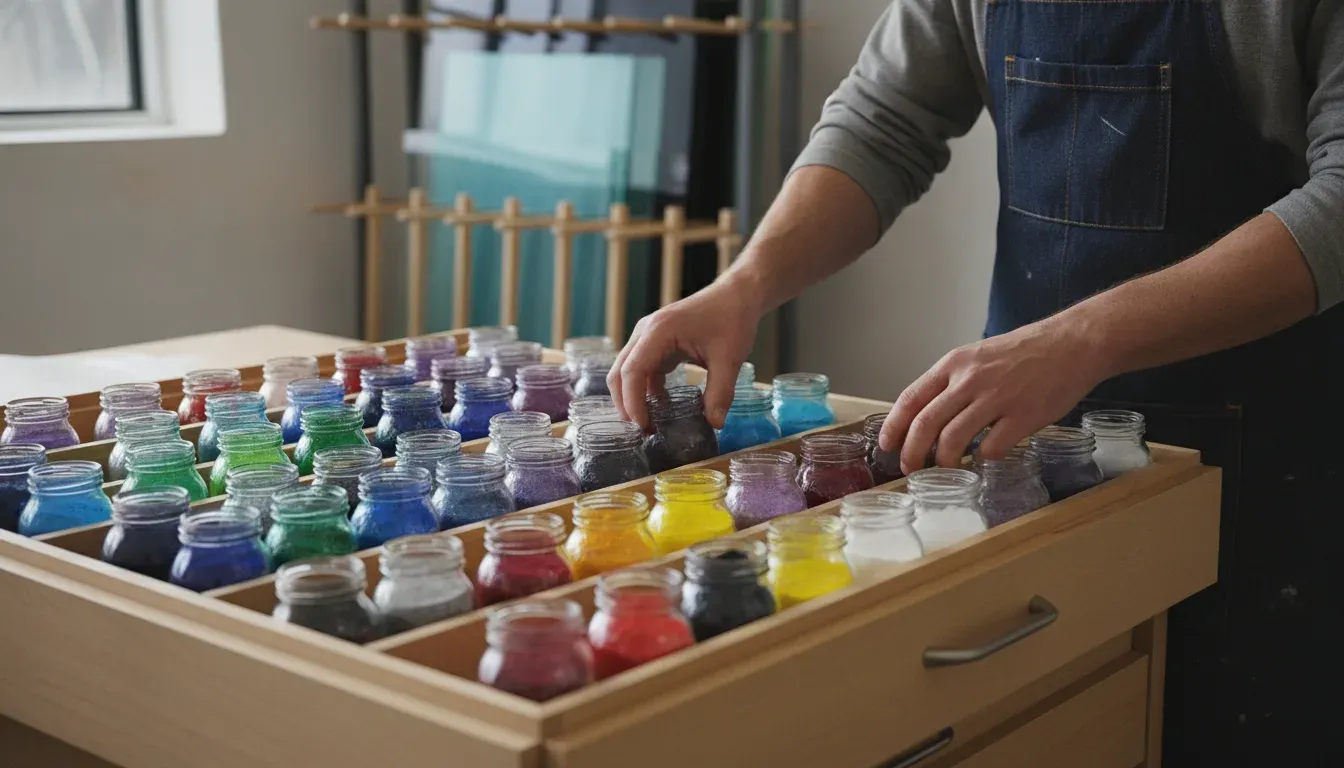
Label the lid and the container
A label on only the lid can become unreliable when lids are exchanged. Mark both the container and its lid when practical. At minimum, record:
- Glass brand or product line
- COE or compatibility family
- Color name or a useful color description
- Frit grade, powder, confetti, stringer, or other form
- Purchase date or batch note when helpful
Keep labels readable without making the container itself the only source of truth. A simple inventory list or spreadsheet can record the same information, along with an approximate quantity and storage location. This is especially useful when several colors look similar under studio lighting.
Why does COE matter when storing fused glass supplies?
COE, or coefficient of expansion, describes how glass changes size as temperature changes. Storage does not change a glass product’s COE, but poor labeling can lead you to combine materials that were never intended to be fired together. Keep each compatibility family physically separated and preserve the original product information whenever possible.
Separate COE90 and COE96 before you design
Use dedicated shelves, drawers, bins, or clearly divided rack sections for COE90 and COE96 materials. Do not rely on color alone. A red sheet, blue frit, or clear stringer can belong to a different compatibility family than a visually similar item.
Art Glass Supplies carries separate COE90 glass and COE96 glass collections. Those category paths can help you replace a damaged piece or rebuild a labeled inventory, but the product information for the specific glass you own should remain the final reference for your project.
Do not assume that storage can correct a compatibility mistake
Glass compatibility is not determined by storage conditions, color, thickness, or appearance. When materials are fired together, differences in expansion and contraction can leave stress in the finished piece. If a label is missing, set the material aside until its identity can be confirmed. An unknown piece is not a safe substitute for a verified piece.
How do temperature and moisture affect storage?
Keep glass and frit in a cool, dry area with stable conditions. Ordinary studio storage does not require extreme climate control, but it should protect materials from leaks, condensation, direct sun, and rapid temperature swings. Clean, dry containers help prevent moisture and residue from becoming part of the material you later fire.
Sheet glass can be damaged by impact and edge pressure, while frit and powders can pick up dust or clump when exposed to moisture. Do not store containers on a cold floor where condensation may form, and do not place them next to a sink unless the shelf is protected from splashes. If a container becomes wet or contaminated, isolate it and assess the material before returning it to active inventory.
Silica and other hazards are most relevant during handling, cutting, grinding, and dry material work, not because a closed jar is inherently dangerous. Still, closed storage is an important first control. The Washington State Department of Health specifically advises keeping containers closed and using wet methods or HEPA cleanup to reduce dust in glassworking spaces.
How can you organize a small studio without wasting space?
A small studio can store fused glass supplies safely when the system follows the way you work. Put frequently used materials between waist and shoulder height, reserve lower shelves for heavier items, and keep fragile sheets out of high-traffic areas. Use shallow drawers or divided bins for small components so the inventory stays visible without spreading across the work surface.
| Material | Useful storage method | Key control |
|---|---|---|
| Full sheet glass | Supported rack with dividers | Prevent sliding, edge impact, and overcrowding |
| Partial sheets and scraps | Flat tray or labeled vertical section | Keep COE and unknown pieces separate |
| Coarse, medium, and fine frit | Individual sealed jars or containers | Label particle size and compatibility family |
| Powder and fine colorants | Tightly closed containers in a low-draft area | Limit spills, dust, and cross-contamination |
| Stringers, noodles, and cane | Long divided box or protective tube | Prevent bending and breakage |
| Current project materials | One temporary, labeled project tray | Return unused material to its permanent location |
Leave enough clearance to remove one item without moving five others. Overfilled storage looks efficient until a search turns into repeated handling. A little empty space is useful protection for both materials and your hands.
Need to rebuild or expand your studio inventory? Browse compatible glass fusing supplies by material type and project need.
What should you check before using stored glass?
Before cutting or arranging stored glass, confirm its identity, condition, and intended use. A two-minute inspection can prevent a compatibility error or a preventable injury. Check the label, look for chips or cracks, and move questionable pieces to a clearly marked review area instead of returning them to general inventory.
- Read the label and confirm the brand, product, and COE.
- Check that the sheet or container belongs to the correct storage section.
- Inspect sheet edges for chips, cracks, sharp damage, or stress marks.
- Check frit and powder for visible contamination, moisture, or an incorrect label.
- Confirm that the particle size and material are suitable for the design.
- Clean the work area using a wet method or suitable HEPA equipment when dust is present.
- Return unused materials to their permanent location after the project.
Do not dry sweep spilled powder or frit into the air. Follow the safety instructions for the specific material and your studio equipment. If a product has a manufacturer handling or firing recommendation, keep that information with the material rather than relying on memory.
How often should a glass storage system be reviewed?
Review your storage system whenever you add a new material, finish a large project, or notice that labels and locations are becoming inconsistent. A monthly spot check is enough for many hobby studios. Professional studios may benefit from a more regular inventory routine, especially when several people share materials or projects move quickly.
During a review, remove empty containers, consolidate only when the identity and compatibility information will remain accurate, replace damaged labels, and separate unknown materials. Look at the shelf itself for moisture, dust, loose dividers, and signs of movement. Storage is working when you can find the right material without guessing and return it without creating a new pile.
Frequently asked questions about storing fusible glass and frit
Can I store COE90 and COE96 glass on the same shelf?
You can use the same sturdy shelving unit, but keep COE90 and COE96 in clearly separated, labeled sections. Physical separation lowers the chance of selecting the wrong material. Always confirm the specific product information before combining glass in a firing project.
Should glass frit be stored in airtight containers?
Frit should be kept in clean, closed containers with secure lids. This limits dust, moisture, and accidental mixing. Choose a stable container that can be opened without spilling, and label it with the frit color, particle size, brand, and compatibility information.
What should I do with glass if the COE is unknown?
Set unknown glass aside in a clearly marked review area and do not combine it with identified materials. Try to confirm its source or product information. If the compatibility cannot be verified, do not use it in a project that depends on a known COE group.
How do I keep glass powder and frit from spreading dust?
Keep powder and frit containers closed, open them away from drafts, and clean spills with wet methods or a suitable HEPA-filtered vacuum rather than dry sweeping. Wear the protective equipment required for the specific material and studio task.
Can I store fusible glass in a garage or basement?
A garage or basement may work if the area is dry, stable, protected from leaks and direct sun, and free from heavy traffic. Avoid locations with condensation, extreme temperature swings, or uncontrolled dust. Use covered containers and inspect materials before bringing them into your studio.
Find glass fusing supplies for your next organized studio project at Art Glass Supplies.