
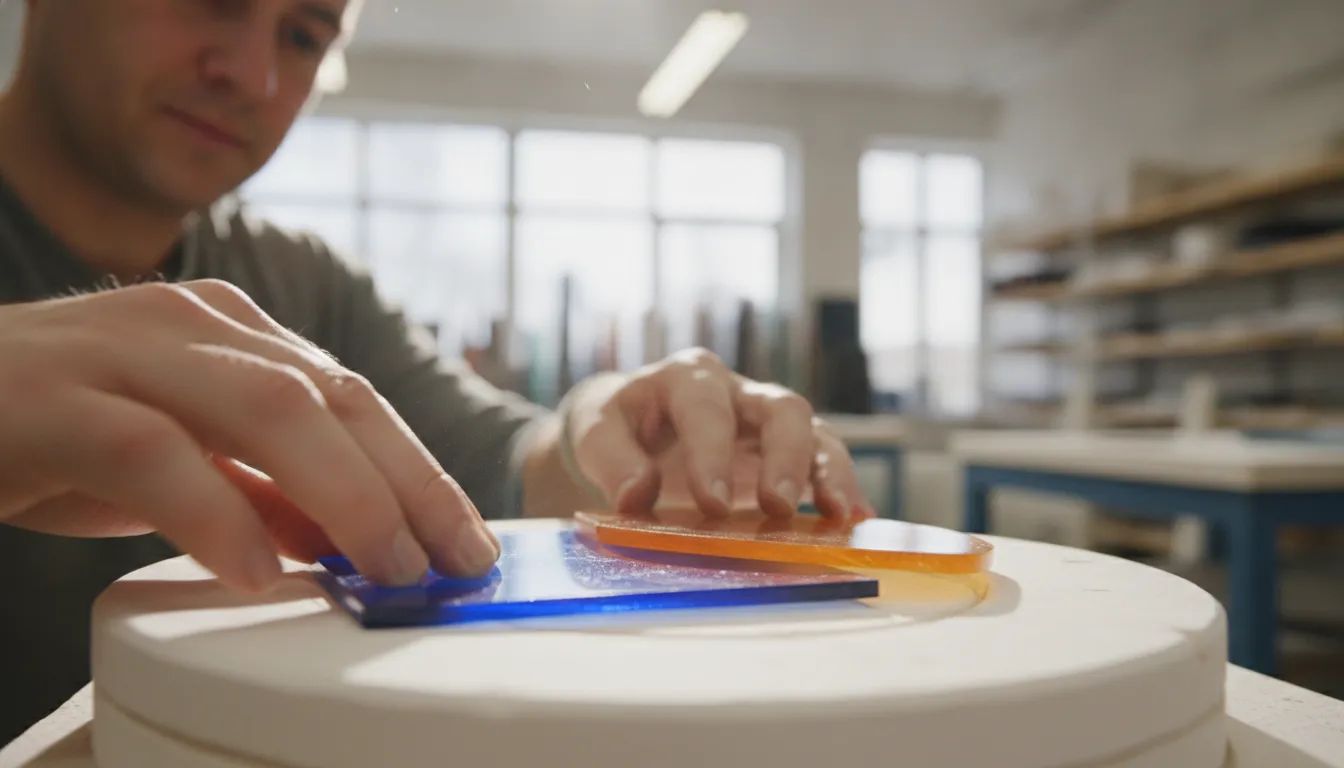
A fused piece can finish smaller or wider than its unfired outline, even when no glass is added or removed. The difference often starts with how much glass is stacked in the assembly, not just the shape you cut. Thinking about glass thickness for fusing helps you anticipate that movement before it changes the design. It also raises practical questions: will the piece keep its footprint? Should you allow more room around a mold? Is the final texture meant to remain distinct or settle into a smoother surface?
Use the 6 mm rule as a volume guide. During a full fuse, glass may move toward roughly 6 mm thick. A thinner assembly may draw inward, while a thicker one may spread outward. This is a planning principle, not a guaranteed result. Heatwork and the glass itself affect how far it moves, and thickness alone does not prove compatibility.
Read our broader glass thickness reference
It matters when a project needs to fit a mold or keep a planned edge. Thickness changes how much glass occupies the final area. Understand what the 6 mm benchmark can and cannot tell you about a fired piece’s footprint.
What the 6 mm Rule Means for Glass Thickness for Fusing
The 6 mm rule is a useful way to think about volume in a full-fuse assembly. In a sufficiently fluid full fuse, glass tends to move toward an even thickness of about 6 mm. It does not mean every project will finish at exactly that measurement. It describes a tendency that helps explain why the amount of glass in a design can change its footprint as it softens. It should be treated as a planning guide, not a guaranteed result.
| Stack | Effect | Tip |
|---|---|---|
| < 6 mm | Draws inward | Less area |
| ~ 6 mm | Changes less | Test |
| > 6 mm | Spreads | Leave space |
The rule applies to a full-fuse outcome, not every firing approach. Heatwork is the combined effect of time and temperature. It affects how much glass softens, and softening happens by degrees rather than as a sudden switch from rigid to liquid. The final surface and dimensions depend on the actual firing and material behavior, not just the starting thickness. A less-fluid fuse may retain more of its original contours than a full fuse. Do not use the 6 mm idea in place of firing guidance for your glass and kiln.
Use the rule to anticipate volume-related movement, then plan for uncertainty. It is not a kiln schedule. It cannot promise a particular finished thickness or test whether glasses are compatible. Nominal thickness alone cannot tell you if different pieces can fuse successfully. Before building a thickness-sensitive design, check the manufacturer’s product details. Keep the glass within a compatible system. If exact dimensions matter, make a small test with the same glass and construction. Then assess its footprint before committing the final design.
How Thickness Changes the Final Size and Shape
Think of a fused piece as a fixed amount of glass arranged in a footprint. How you stack that volume helps determine the finished dimensions and thickness. Layer count is a design decision, not just a way to add color or detail. One artist calls this relationship volume control: assembly choices affect the finished work’s size, shape, and thickness.
Her examples help visualize the effect. In one full-fuse project, a single layer of 1/8-inch glass may shrink. Two layers are likely to retain their original size and shape with more consistent thickness. Three layers may grow as the stack settles. These are illustrative outcomes from one artist’s explanation. They are not a formula or a guarantee for every glass, design, or firing.
The practical takeaway is to work backward from the shape you want. A broad, thin layout may finish with a smaller footprint than its unfired outline suggests; a taller stack may spread as it settles. That matters when the design needs to fit a specific opening, preserve a border, or keep space between elements. Consider the amount and placement of glass across the whole piece rather than relying on a single thickness measurement.
Use the examples to guide a test, not to calculate an exact finished size. Keep the glass system and construction consistent, then compare a small sample with the intended design. The existing guide to 2 mm and 3 mm glass options covers sheet sizing. It is a shopping reference; the layer examples here explain how assembled volume can affect the final geometry.
Should You Use One Layer or Stack Compatible Layers?
Start with the finished piece you want, then choose an assembly that can produce it. A single layer may suit a lighter, more open design if some footprint change is acceptable. Stacking compatible layers adds volume, which can help a project retain its dimensions during a full fuse. The right choice depends on the desired size, surface, and likely glass movement. There is no universal layer-count rule.
Construction affects the finished characteristics of a fused project. One artist’s examples illustrate the principle. In one full-fuse context, a single layer of 1/8-inch glass may shrink. Two layers may be more likely to retain their size and shape. Three may grow. Treat these outcomes as an artist’s example, not a guarantee for every glass, design, or firing. Shape, dimensions, glass behavior, and heatwork all affect the result.
Think about the surface as well as the footprint. A less-fluid result may suit a design with distinct elements or raised details. A fuller fuse may fit a smoother, more unified surface. Consider the total amount of glass and the degree of fuse your project requires. Layer count alone does not determine texture. Arrangement and firing outcome matter too. Make sure every layer is compatible. Use the glass maker’s guidance for the specific system.
For a piece that must fit a mold, check its dimensions before cutting or stacking. One artist suggests measuring the mold and allowing clearance. Glass resting on a mold rim can slump unevenly. Follow the mold maker’s instructions, since mold shapes and intended fit differ.
When the result matters, make a small test piece from the same glass and layer arrangement. Watch for edges that draw inward, a stack that spreads, or a surface that stays more textured than intended. This gives you evidence to adjust the design before committing a larger piece. Keep notes on the materials and firing approach. Change one variable at a time to see which choice affected the result.
How Do Tack Fuse and Full Fuse Affect Thickness?
The main difference is how much the glass softens and reshapes. In a tack fuse, pieces join while retaining more of their profile and texture. A full fuse smooths the joined pieces into a more unified surface. As a result, the stack can change thickness and footprint more noticeably.
That distinction matters when planning glass thickness for fusing. Raised edges, dimensional detail, or visible separation may suit a tack-fused finish. A flatter surface may call for a fuller fuse. That can redistribute the glass rather than preserve the assembled dimensions exactly.
A common full-fuse guideline describes glass moving toward roughly 6 mm thickness. A thinner piece may draw inward as it thickens, while a thicker stack may spread as it settles. These are tendencies, not guarantees. The outcome depends on the glass and the total heatwork. Heatwork is the combined effect of time and temperature on softening. The guideline does not establish compatibility or prescribe a firing schedule.
Choose a finish based on the shape you want to keep. Consider how the amount of glass may affect its footprint. If dimensions matter, test a small sample with the same glass system and design thickness. A tack/full-fuse label alone does not predict the result. For recipe details, see the firing schedules for glass fusing guide.
Why COE and Viscosity Matter Alongside Thickness
Two pieces can have the same measured thickness and still behave differently in the kiln. Thickness describes dimensions; compatibility depends on material behavior. Before stacking pieces, check that they are intended to be fused together. Follow the manufacturer’s compatibility guidance.
COE, or coefficient of expansion, describes how glass expands when heated. Pieces with dissimilar expansion behavior are not automatically suitable for fusing together. Compatibility guidance considers both COE and viscosity. Dissimilar behavior can prevent pieces from fusing together as intended.
Viscosity describes how readily a material flows. As glass heats, its viscosity changes. The glass softens by degrees, not in a sudden switch from rigid to liquid. This flow behavior affects how pieces come together and how the assembly moves under heatwork. A nominal thickness associated with a fusing rule cannot establish compatibility.
Keep glass within its specified system rather than assuming similar appearance, thickness, or firing makes products interchangeable. Art Glass Supplies carries distinct COE90 and COE96 ranges. These are separate product systems, not a claim that every item in either range can be mixed with every other item. Check each product’s stated compatibility before combining it with other glass. For background, see the guide to COE 90 glass compatibility.
Think of thickness as a way to plan volume and likely shape, not as a substitute for material selection. Choose glass that is confirmed compatible first, then use layer thickness and assembly design to pursue the finished form you want.
A Practical Check Before Firing a Thickness-Sensitive Project
Before loading the kiln, check the project as a whole. Do not treat nominal thickness as a firing recipe. Heatwork combines time and temperature. It affects how much glass softens. The right plan depends on the glass, construction, mold and intended finish. Use the maker’s guidance for your materials and kiln.
- Decide what surface you want. Choose whether the finished piece should retain distinct layers and texture or become more level. That goal helps define how much movement is acceptable; thickness alone does not specify a firing schedule.
- Count the layers and consider their total volume. Note how the layers stack and where pieces overlap. Heatwork affects softening. Full-fuse references describe thinner-than-about-6-mm work drawing inward and thicker stacks spreading as they settle. Treat this as a general principle, not a guaranteed outcome. Actual movement depends on the project and firing conditions.
- Anticipate footprint changes. Ask whether the piece can become smaller or wider without ruining its fit or design. Layer arrangement affects the fused work’s finished size, shape and thickness.
- Check the mold before placing glass. Measure the usable interior. Confirm the project sits inside the mold, not on its rim. Glass resting on a rim can slump unevenly. Leave room for movement. A sizing rule of thumb cannot replace checking the actual mold and shape.
- Verify the glass system. Confirm from the manufacturer’s product information that every piece is intended to be fired together and compatible. Similar thickness does not establish compatibility.
- Test a small representative piece. Build a sample from the same glass and layer arrangement. It can show how your materials behave before you commit a larger design. Record the result and adjust your plan. Do not assume it guarantees identical movement in every project.
- Use the maker’s firing and annealing guidance. A completed stack is one assembled piece, not unrelated single sheets. Follow the glass maker’s and kiln maker’s guidance for your load. Do not copy a schedule just because another project has a similar thickness.
For thickness-specific planning, read the broader glass thickness reference. It covers other glass applications, so pair it with product specifications for fusible glass.
Frequently Asked Questions
What does the 6 mm rule mean in glass fusing?
It is a volume-planning guideline for a full fuse, not a guaranteed finished measurement. Glass tends toward about 6 mm thick. Thinner assemblies may draw inward, while thicker stacks may spread as they soften. The result depends on the glass and heatwork. Test a sample when the final footprint matters.
Will adding layers change the finished size?
It can. Layer count changes the volume in the piece, and that volume affects its final dimensions after fusing. In one artist’s example using 1/8-inch glass, a single layer shrinks, two layers are likely to retain their footprint, and three layers can grow. Treat those outcomes as an illustration, not a rule for every glass, shape, or firing.
Does tack fusing keep glass from changing thickness?
A tack fuse leaves pieces more distinct than a full fuse, so it generally preserves more of their original relief. It does not mean the glass is motionless. Heatwork combines time and temperature and affects how much the glass softens. Use a firing schedule suited to your glass and desired result. Thickness alone does not determine the outcome.
Does matching thickness mean two glasses are compatible?
No. Thickness describes the piece’s dimensions, not whether two glasses can fuse together safely. Compatibility also depends on COE, or how glass expands as it is heated, and viscosity, which affects how it softens and moves. Check the manufacturer’s compatibility specifications and keep materials within a compatible glass system. Matching thickness by itself is not enough.
Plan Your Next Fusing Project
Thickness is one part of planning a fused-glass piece. For broader background, read our glass thickness reference. Then check the specifications for the fusible glass you plan to use.