
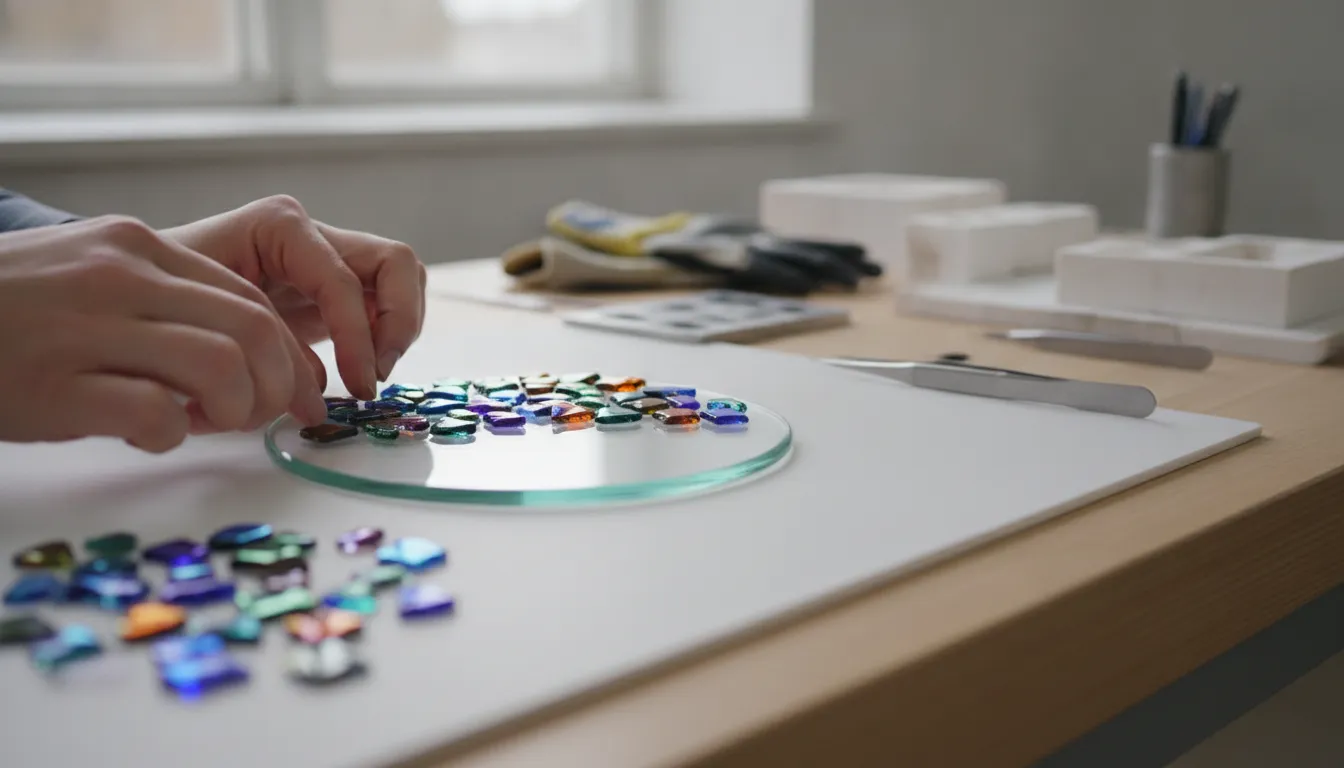
Small fused-glass designs leave little room for material mistakes. A pendant may depend on a precise cut, a clean layer, and a compatible base, so choosing the right sheet matters before the kiln is loaded.
For pendants and other compact projects, dichroic glass sheets work best when you match the glass to your base by COE. Plan the coating orientation before cutting, and choose a format that fits the design without forcing unnecessary layers. For COE90 projects, keep every added glass component within the manufacturer’s compatibility and firing guidance.
Shop COE90 dichroic glass for compact designs
The colorful surface is only part of the decision. Understanding how the coating creates its visual effect will make it easier to judge how a sheet behaves when a small design is cut, layered, and viewed from different angles.
What Makes Dichroic Glass Sheets Work for Small Designs?
Dichroic color comes from a very thin optical coating rather than from a single opaque pigment mixed through the glass. The coating contains multiple thin-film layers applied to an optically flat glass surface. Each layer interacts with light, allowing some wavelengths to pass while reflecting or suppressing others through interference. The result is the characteristic contrast between the color you see by reflection and the color that can appear when light passes through the piece. The basic filter behavior is described by Florida State University’s microscopy resource: thin-film interference transmits selected wavelengths and rejects others.
That optical behavior matters more in a pendant or other small design because a narrow strip, center dot, or angled shard can carry much of the visual identity. A small change in orientation or surrounding glass may make the color read differently, so plan the coating direction and the viewing angle before cutting a valuable area. Strong pattern and color shifts can be useful for a focal accent, while a calmer solid field may be easier to control when the design has several small parts.
For a practical starting point, choose a sheet format that matches the scale of the cut rather than treating every piece as a miniature version of a large panel. The COE90 dichroic collection includes sheets as well as smaller formats such as scraps, frit, noodles, and stringers. A small test piece can help you evaluate how a selected coating, backing, and layout work together before committing the final cut. Keep the material system consistent: COE90 identifies the coefficient-of-expansion family, but matching labels alone do not replace checking manufacturer compatibility and firing guidance.
How to Choose Dichroic Glass Sheets for Pendants
Start with compatibility, then choose the visual effect and format that fit the pendant. For kiln-fused work, COE90 means Coefficient of Expansion 90. Keeping the COE system consistent helps you narrow the field, but the label is not a substitute for checking the manufacturer’s compatibility information and firing guidance.
For a dependable starting point, browse COE90 dichroic glass and confirm that the sheet, backing glass, and any accent pieces are intended to work together. Do not combine COE90 and COE96 simply because both materials are described as fusing glass.
COE is only one part of compatibility. Viscosity describes how readily glass flows as it is heated, while the softening point is the temperature range where a piece loses much of its rigidity. Two glasses can share a COE family yet respond differently in the kiln if their viscosity or softening behavior differs. In a small layered pendant, that difference can let one component move or spread before another, changing the edge, thickness, or intended alignment. Use the exact manufacturer’s compatibility and firing guidance for the selected glass, rather than relying on the COE number alone.
Choose the surface effect for the pendant design
Transparent sheets are useful when you want the base glass or a lower layer to remain part of the visual effect. Light can pass through the design, so the color and texture underneath will influence the finished appearance. A more opaque or opalescent surface is useful when the dichroic area needs to read as a stronger focal shape against its backing. Consider the pendant’s silhouette, not just the sheet color. A small uninterrupted field can look intentional, while a busy pattern may lose definition after cutting.
For a clean color block, compare the available solid-color COE90 dichroic glass. Choose a patterned surface when the cut geometry benefits from visual movement, but make sure the pattern scale suits the small finished piece. On a pendant, a narrow cut may show only one part of a larger design.
Match the format to your cutting plan
Full dichroic glass sheets make sense when you need a specific shape, repeated pieces, or enough material to orient the coating deliberately. Smaller formats can be more efficient for one-off pendants, test cuts, and small accents. The COE90 range also includes specialty forms and smaller options such as scrap, frit, and other detail formats, so choose the form that matches the job rather than buying a large sheet by default.
Before ordering, sketch the finished dimensions and mark where the focal color should land. Then confirm the base glass, COE, product description, and manufacturer’s instructions. That short check is more valuable than choosing by appearance alone.
Worked example: a compact pendant layout
Imagine a round pendant planned at about 25 mm across. Start with a COE90 base sized to the finished silhouette, then place one small, simple dichroic shape near the center rather than trying to fit a full sheet pattern into the entire piece. A thin rolled 2 mm sheet can provide the focal accent, while a compatible backing or cap can frame it without crowding the profile. Before cutting, test whether the coating looks strongest facing the intended viewing direction, and leave enough margin around the shape for a clean edge.
For this layout, record the COE90 identity of the base, dichroic accent, and any cap or decorative addition. Then check the exact product guidance for viscosity and softening behavior as well as COE. If the cap softens and flows sooner than the focal piece, it may shift the accent or round the edge differently than expected. The goal is not to invent a universal schedule, but to choose a compatible stack and follow the manufacturer’s process for those specific materials. This example keeps the color decision, cut plan, orientation, and material check tied to the small finished design.
Which Size and Thickness Fit a Pendant or Small Design?
For a compact piece, choose the format that gives you enough surface for the design without creating unnecessary offcuts. The COE90 collection lists thin-rolled 2 mm and double-rolled 3 mm sheets, while the dichroic range also includes smaller formats such as scraps, noodles, and stringers. Use the table as a planning guide, not as a universal firing prescription.
COE90 dichroic formats for pendants and small designs
| Format | Useful when | What to consider |
|---|---|---|
| Thin-rolled 2 mm sheet | You need a relatively slim sheet for a small silhouette, a surface layer, or efficient cutting from a compact design. | Plan the finished thickness and layering before cutting. The catalog identifies this as a COE90 sheet format, but final suitability depends on the compatible materials and manufacturer guidance. |
| Double-rolled 3 mm sheet | You want a standard thicker sheet format for a design with broader areas of dichroic coverage. | Allow for the added material in your layout and verify the intended combination with the manufacturer instructions. Do not treat thickness alone as a firing rule. |
| COE90 dichroic scraps or packs | You are making a small pendant, testing color placement, or need varied pieces without committing to a full sheet. | Sort pieces by size, color, and usable edge before planning the design. See the COE90 dichroic glass scraps category for this catalog format. |
| Noodles, stix, or stringers | You need narrow lines, borders, or small accents rather than a broad reflective field. | Use them as deliberate detail elements and confirm the format is appropriate for the compatible base glass. Browse COE90 dichroic stringers and related accents. |
Before ordering or assembling, identify the COE of every glass component and compare the product description with the manufacturer’s compatibility and firing guidance. A matching COE label is an important starting point, not a substitute for those instructions. For a broad selection, review the available COE90 dichroic glass formats and select the sheet or accent that matches your actual pendant dimensions.
Can You Fuse Dichroic Glass Sheets With COE 90 Glass?
Yes, COE90 dichroic glass can be used with compatible COE90 fusing glass, but the label is a starting point, not a complete compatibility test. COE means Coefficient of Expansion, a way of describing how glass changes size as its temperature changes. When two pieces expand and contract differently during heating and cooling, built-in stress can develop. That stress may lead to cracking during firing or later, even when a finished piece initially looks sound.
For a pendant or other compact design, first identify the COE of both the dichroic sheet and the base glass. COE90 means Coefficient of Expansion 90. The customer catalog separates COE90 and COE96 dichroic and fusing categories, so do not treat those systems as interchangeable. COE96 dichroic glass belongs with a compatible COE96 project, while COE90 dichroic glass should be paired with materials specifically intended for COE90 work. A matching number does not mean that every product from every manufacturer will fuse reliably together.
What else should you verify?
Check the manufacturer’s compatibility information for the exact dichroic product, base glass, and any decorative additions. Products can differ in their glass composition, coating, thickness, and recommended use. Also review the manufacturer’s firing guidance and adapt it to your kiln, project size, and layer arrangement. Do not copy an exact schedule from an unrelated product or assume that a schedule suitable for one sheet applies to another.
For a dependable starting point, choose from the COE90-compatible fusing glass category, then confirm the specifications of each selected piece before cutting. This extra check is especially important when combining a dichroic sheet with transparent or opaque layers, scraps, frit, or other accents. If the product listing does not clearly identify its COE or compatibility guidance, pause and contact the manufacturer or supplier before firing. Careful verification protects both the visual result and the time invested in your small design.
How Should You Cut, Orient, and Layer Dichroic Sheets?
Small pieces reward a deliberate layout. Before cutting, decide which areas need a broad color field, which need a pattern, and which can be built from narrow accents. That keeps an attractive sheet from becoming a pile of unusable offcuts.
- Plan the geometry before scoring. Trace the finished outline and mark the cuts on the glass side, not across the coated surface. For a compact pendant or tile, favor simple shapes that use the sheet efficiently. Leave enough room for the final design rather than cutting directly on the finished boundary. If you need a directional motif, mark its orientation before separating the pieces. Patterned options can give a small design visual movement without requiring a large sheet; see the patterned COE90 dichroic glass category for that format.
- Protect the coating while handling. Keep the coated face free from unnecessary contact, rubbing, and loose grit. Handle pieces by their edges when practical, and keep the protective surface clean while you mark and arrange the design. Use suitable glass-cutting tools and avoid dragging a fragment across another piece, which can scratch or contaminate the finish.
- Choose the coating orientation intentionally. Test the direction under your studio lighting before committing to the layout. The coating can present a different visual effect depending on whether it faces upward or is placed beneath a compatible layer. Do not assume that one orientation is correct for every product. Follow the manufacturer’s product information and firing guidance, especially when using an etched finish. You can browse etched dichroic glass options as a surface choice, but this section is not a substitute for the product instructions.
- Clean the mating surfaces. Before layering, remove fingerprints, dust, and cutting residue from the surfaces that will meet. Clean gently and let the pieces dry fully. A tidy surface helps you inspect the stack and prevents a small particle from changing the intended fit. Confirm that every layer is compatible with the rest of the assembly; matching labels alone do not replace manufacturer compatibility and firing guidance.
- Layer with restraint. Arrange the base, dichroic piece, and any compatible cap or accent without crowding the design. Keep edges aligned where a clean silhouette matters, and avoid piling pieces where the finished work needs a slim profile. Check the layout from above and from the viewing angle before moving it to the kiln shelf. Do not invent a firing schedule from the number of layers; use the schedule appropriate to the materials and project.
- Reserve the small pieces for accents. Save narrow strips, triangles, and irregular offcuts for borders, dots, or short linear details instead of forcing them into the main sheet. The customer offers smaller forms such as COE90 dichroic glass scraps, and COE90 dichroic stringers can supply fine lines when the design needs a controlled accent. Confirm the format and compatibility before adding either to a layered piece.
What Backing and Accent Materials Complete a Small Piece?
A compact dichroic design usually needs more than a focal fragment. The backing establishes the piece’s visual field and finished thickness, while accents define edges, movement, or a small point of contrast. Start by identifying the compatible base glass for the project. If you are working in a COE90 system, select backing and additions labeled for that system, then confirm the manufacturer’s compatibility and firing guidance. A matching COE label is an important starting point, not a substitute for those checks.
For a quiet foundation, solid-color COE90 dichroic glass can provide a controlled field around a smaller focal piece. Choose a color that supports the coating rather than competing with it. Transparent or lightly colored backing can preserve visual depth, while a stronger solid color can make a small motif read more clearly. Keep the backing proportionate to the design so the accent remains intentional instead of becoming a crowded stack.
Pattern is another way to add interest without adding many separate pieces. A narrow section from patterned COE90 dichroic glass can act as a border, directional mark, or secondary focal area. Because a small cut may show only part of the pattern, preview the intended orientation before committing to the layout.
Use small accents with a defined job
Frit works well for restrained points of color or texture, provided the format and design are suitable for the project. Noodles and stringers are useful when the piece needs a line, curve, or fine visual separation. Browse COE90 dichroic stringers when a narrow accent will communicate more clearly than another sheet fragment. Scraps can fill small shapes or support testing, but sort them by COE and surface condition before including them. Treat each addition as a deliberate design element, and keep the total stack compatible with the base materials and documented process.
A Simple Workflow From Sheet Selection to Kiln-Ready Layout
A short pre-kiln check prevents avoidable compatibility, proportion, and handling problems. Use this sequence before loading a small pendant or design into the kiln.
- Measure the finished piece. Record the intended length, width, and any openings or margins. Then estimate the cut size of each layer, allowing for the design rather than choosing a sheet solely by its color or coating.
- Choose a workable glass format. The COE90 collection includes thin rolled 2 mm and double rolled 3 mm sheets, along with smaller formats such as frit, precut shapes, and scrap. Select the sheet thickness and format that suit the dimensions and construction of your piece.
- Verify the COE before cutting. COE90 means Coefficient of Expansion 90. Check the label of the dichroic sheet and every base, backing, or accent material you plan to combine with it. Do not assume that a similar appearance means compatibility, and do not treat a matching COE label as a replacement for the manufacturer’s compatibility guidance.
- Confirm firing guidance. Review the manufacturer’s instructions for the specific glass and kiln process. Product compatibility and firing behavior depend on more than a quick label comparison, so use the recommended schedule rather than copying an exact schedule from an unrelated project.
- Clean and handle the surfaces. Cut with the coated surface protected from unnecessary contact. Remove dust, fingerprints, and cutting residue using your normal glass-cleaning procedure, then let the pieces dry fully. Keep the coating side identified as you work.
- Make a dry layout. Arrange the base, dichroic layer, and accents on a clean surface before moving them to the kiln shelf. Check edges, corners, holes, overlaps, and the visual direction of any pattern. Small scraps, frit, noodles, and stringers can fill compact details when their format and compatibility fit the design.
- Document the load. Note the glass products, COE, coating orientation, dimensions, and the manufacturer’s firing guidance. Photograph the dry layout if helpful. This record makes a successful result easier to reproduce and gives you a clear starting point for troubleshooting.
Shop COE90 dichroic glass for your next layout
Frequently Asked Questions
How do I choose dichroic glass sheets for pendants?
Start with the finished pendant size, then choose a COE90 sheet format and a pattern that will remain legible after cutting. Transparent and opalescent options create different backing effects, so plan the base glass and coating orientation together. For a small design, a solid color can provide a clean focal area, while a patterned sheet can supply detail without many separate pieces.
What size dichroic glass sheet is best for small designs?
Use the smallest format that gives you enough room to cut safely and position the visual feature. COE90 sheets are available in thin rolled 2 mm and double rolled 3 mm formats, while scraps and packs can be practical for pendants, test pieces, and small accents. Choose by the layout you need, not by thickness alone.
Can dichroic glass sheets be fused with COE 90 glass?
Yes, COE90 dichroic sheets are intended for designs built with compatible COE90 glass. COE90 identifies a coefficient-of-expansion category, but a matching label does not replace checking the manufacturer’s compatibility information and firing guidance. Confirm the base glass, coating, and any accent materials before assembling the pendant.
Can you fuse 90 COE and 96 COE dichroic glass together?
Do not combine COE90 and COE96 dichroic glass in one fused piece unless the manufacturers specifically document compatibility for that combination. The catalogs separate these categories because the materials are not automatically interchangeable. Keep the entire small design within one compatible system and verify the product guidance before firing.
Should dichroic glass be placed coating-side up or down?
Choose the orientation based on the visual effect and the manufacturer’s instructions for that product. Before firing, identify the coated face, keep it clean, and plan whether the coating will be exposed or protected within the layer stack. Make a small test when the orientation or backing changes, because a pendant’s final color and surface appearance depend on the complete layout.
Ready to Choose Dichroic Glass for Your Next Pendant?
A focused selection of compatible sheet sizes and small-format accents can make it easier to plan a compact design before you cut and layer. Browse compatible COE90 dichroic glass sheets and small-format options, then choose materials that match your project glass and the manufacturer’s compatibility guidance. When you are ready to move from planning to making, get started with the option that best fits your pendant layout.