
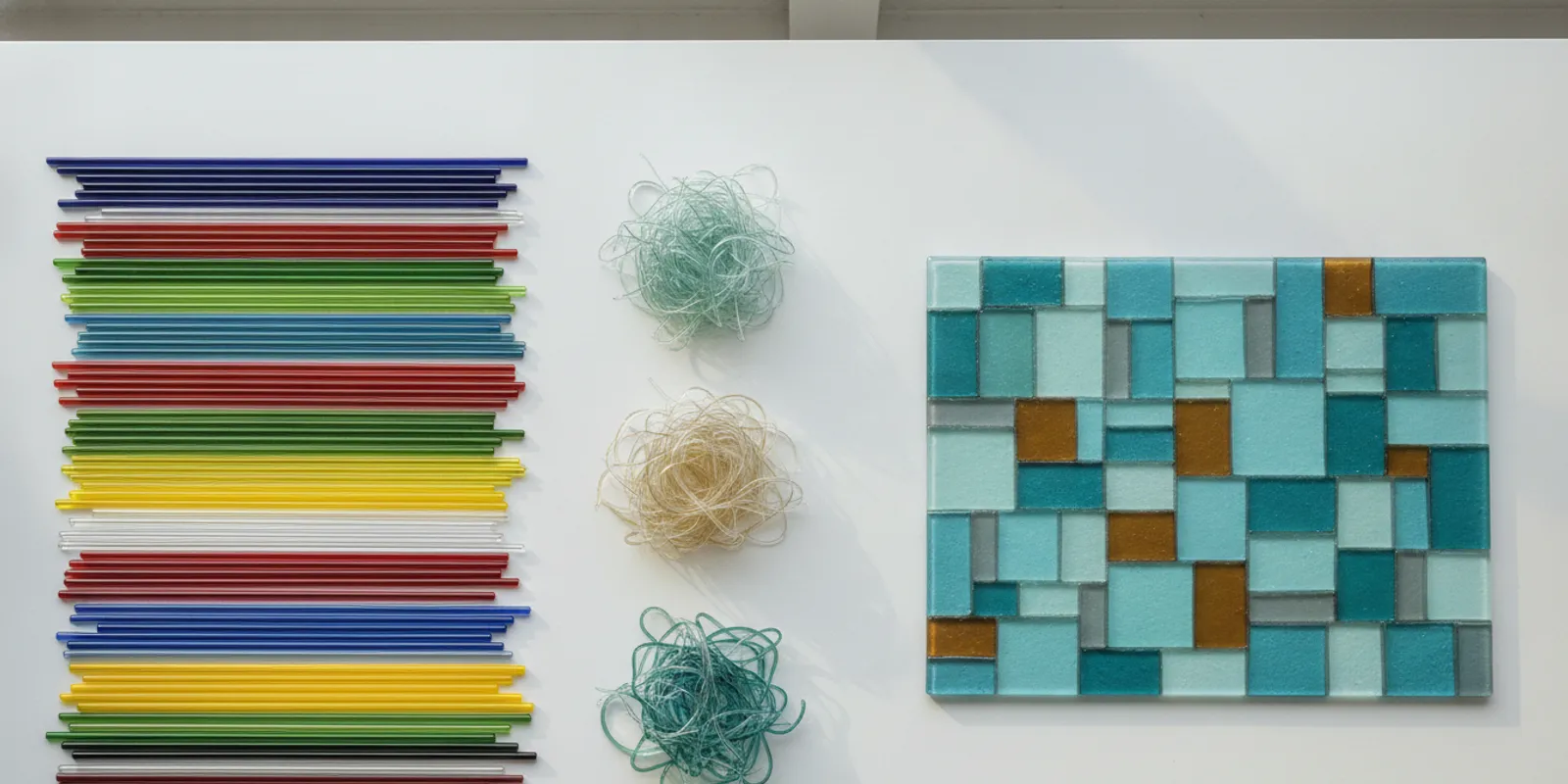
Glass stringers and noodles are both narrow strands of glass used to add lines, details, and texture to fused work. The practical difference is usually shape and handling: stringers tend to be straight and rod-like, while noodles are often thinner or formed with a bend or wave. Product names are not fully standardized, so compare the material description and dimensions before choosing. For a project, first decide what line you want, then confirm that the glass belongs in the same compatible system as the rest of your piece.
Browse glass stringers and noodles
What Are Glass Stringers and Noodles?
Glass stringers are narrow, elongated pieces of glass. They may be straight and fairly uniform, much like fine rods, and they are commonly used to create controlled lines, outlines, veins, and small accents. A stringer gives you a defined path to place on a base sheet or between layers. Depending on thickness and firing, it may remain as a raised line or soften into the design.
Noodles are also narrow strands, but the name often signals a more delicate, irregular, or flexible-looking form. Some are wavy or curled; others are simply very fine strands. Their winding shape can help create movement without requiring every curve to be built from separate straight pieces. Since naming can vary among suppliers, do not assume every product sold as a noodle has the same diameter or shape.
Both terms describe form, not a separate chemistry or a guaranteed firing result. A strand’s appearance after firing depends on its glass formulation, size, placement, and the schedule used for the whole project. If a product description does not state whether it is straight, wavy, thin. Or thick, inspect the available product details or ask the supplier before planning a precise pattern.
How Do Stringers and Noodles Compare?
| Feature | Stringers | Noodles |
|---|---|---|
| Typical form | Straight, rod-like strands | Often finer, wavy, or irregular strands |
| Good fit for | Outlines, veins, borders, and intentional line work | Curves, flowing accents, and less geometric detail |
| Placement | Usually easy to align along a planned path | Can follow a curve or add a naturally uneven path |
| Visual character | Clean, graphic, or precise | Loose, delicate, or energetic |
| What to verify | Diameter, length, color, and COE | Thickness, shape, color, and COE |
| Compatibility | Confirm the glass system and firing compatibility; the name alone does not establish compatibility. | |
This is a practical comparison rather than a strict industry standard. A supplier may use the names differently, and two products with the same label can vary in size or shape. Think of the table as a starting point. The product’s stated COE, material, dimensions, and manufacturer guidance are more useful than the word stringer or noodle by itself.
When Should You Choose Stringers?
Choose a straight stringer when line placement matters. Its rod-like shape can make it easier to follow a border, divide a panel, draw a stem, or create a repeated pattern. It is also a useful option when you want a line to be visibly intentional rather than loose or spontaneous.
- For outlines: A stringer can define a small shape or separate adjoining areas. Dry-fit the pieces first to see whether the strand follows the edge without forcing it into place.
- For botanical details: Straight or gently curved strands can suggest stems, leaf veins, or branches. Combine different lengths to avoid a rigid, diagram-like look.
- For geometry: A straight piece can reinforce grids, rays, stripes, and other designs built around repeated lines. Check spacing from more than one angle before firing.
- For small accents: A short segment can create a dot-like or dash-like mark. Use a sample if a precise final size is important, because the strand may soften during firing.
Stringers are not automatically easier to use just because they are straight. Very fine glass can be fragile during handling, while thicker pieces may create a more prominent ridge or affect the finished surface differently. Match the strand’s scale to the surrounding glass. A heavy line can overpower a small pendant, and a very fine line may disappear into a busy design.
When Are Noodles the Better Fit?
Noodles can be useful when a design needs curved or flowing marks. A wavy strand introduces variation without requiring a series of carefully cut straight sections. That quality works well for water, hair, foliage, decorative flourishes, and abstract compositions where a perfectly even line would feel too formal.
- For organic movement: Let a curve lead the eye across the piece. Place the noodle loosely at first, then adjust its direction before committing to the layout.
- For layered patterns: A curved strand can weave through other shapes or sit above a field of frit. Keep the design readable by leaving open areas around the most delicate detail.
- For soft accents: A thinner strand may add a subtle line rather than a bold outline. Test it on a small sample if visibility after firing matters.
Curved material can also be less predictable to position. A strand may spring out of the intended path or overlap a nearby element. Arrange it on a flat, stable surface and use suitable handling tools if needed. Avoid pushing hard on fragile glass. If the product is supplied as loose, very fine strands, plan for careful transport and storage so it does not become tangled or broken.
How Do You Choose Between Them for a Project?
Start with the visual job, not the product name. Ask whether the design needs a crisp line, a flowing line, or a mixture. Then consider scale: a fine curved accent may suit a small design, while a thicker, straighter strand may read more clearly in a larger panel. Finally, check glass compatibility and test the result if the finished shape or surface is important.
- Sketch the line. Mark the intended path on paper or use a temporary layout guide. Identify where the line must be straight and where a curve would improve the design.
- Compare product details. Check whether the strand is straight or wavy, its thickness or diameter, its length, and its color. Do not rely on a category name alone.
- Match the glass system. Verify the COE and product information against the base glass and any other components that will fuse together.
- Dry-fit the layout. Place the strands without firing. Look for awkward gaps, crossings, sharp corners, or crowded areas that could obscure the design.
- Make a test piece when needed. If you are unsure how much the line will soften or how visible it will remain. Test a small sample using the intended materials and a suitable firing schedule.
A useful layout may combine the two forms. For example, straight stringers can define a border while a noodle provides a curved accent inside it. Keep the roles distinct: if every line competes for attention, neither the straight geometry nor the flowing detail will stand out.
Why Does COE Matter for Glass Strands?
COE means coefficient of expansion. It describes how much a material expands or contracts as its temperature changes. In fused glass, different expansion behavior can leave incompatible pieces under stress after cooling. That stress may lead to cracking or breakage, sometimes immediately and sometimes later. For that reason, use stringers or noodles labeled for the same compatible glass system as the base and other fused components. For additional kilnforming background on working with glass materials, see Go Fusing’s technical resources.
COE is important, but it is not the whole story. Glass compatibility also depends on the specific glass formulation and how the materials behave at fusing temperatures. Viscosity describes how readily glass flows; softening behavior affects when and how the strand changes shape in the kiln. Two glasses with a similar stated COE can still behave differently if their viscosity and softening characteristics differ. Likewise, matching COE numbers alone should not be treated as proof that arbitrary glass products are compatible.
Check manufacturer or supplier information for each component, and keep different glass systems clearly identified and separated in your studio. If you use COE90, select strands designated for that system; if you work in COE96, use strands specified as compatible with it. Product labels and published compatibility information should guide the choice. Do not combine systems based only on color, appearance, or the fact that both items are described as fusible glass.
For a broader material comparison, review COE90 frit blends or the range of COE96 frit before assembling a design. The same habit applies to strands: confirm what system each material belongs to before arranging it on a project.
How Does Thickness Affect the Finished Line?
Thickness influences both handling and appearance. A thin strand may produce a delicate mark, but it can be difficult to pick up and place without breaking. A thicker strand is often easier to see during layout, yet it can produce a stronger visual line and may stand higher or behave differently in the firing. These are tendencies, not guarantees. The final result depends on the exact glass and firing conditions.
Consider contrast as well as size. A strand that closely matches the color of the base may blend in, while a contrasting strand can become the main focal point. Transparent strands can create a different effect from opaque ones, and a line placed over a patterned base may be harder to follow. A quick paper mock-up or unfired dry layout can reveal whether the line is too dominant, too subtle, or too close to another element.
Do not select thickness in isolation from the rest of the design. A small pendant, a broad panel, and a three-dimensional form have different visual scales. If a particular edge height or line width is essential. Make a test tile with the same materials rather than assuming the strand will keep its original profile after firing.
How Should You Handle and Place Strands?
Prepare a clean, uncluttered work area. Keep strands in a container or on a tray where they cannot roll or become mixed with another COE. Handle them gently and avoid dragging them across a rough surface. Very narrow glass pieces can break with little warning, so clear the work area of unrelated fragments before you begin.
Use a layout surface that supports the design. Place longer lines first, then add small accents around them. If a strand must be trimmed, use a method appropriate for the material and protect your eyes and hands from sharp fragments. Do not snap or cut glass toward yourself. Collect small offcuts safely rather than leaving them on the bench.
Check the orientation and spacing from above before firing. A curved strand may cross another line in a way that hides the shape beneath it. A straight strand may look aligned at one end but drift at the other. Make small adjustments before firing instead of trying to correct a crowded layout after the glass has begun to move.
Plan the firing around the whole project and the materials being used. There is no universal schedule for every strand, base glass, thickness, and kiln. Follow the applicable glassmaker guidance and use a schedule appropriate to the assembled piece. When you are trying a new combination or a strongly dimensional result, test first and record the materials and outcome so you can repeat or adjust the process.
Common Mistakes to Avoid
- Assuming the names are universal. One supplier’s noodle may not match another’s. Read the product dimensions and shape description.
- Mixing glass systems by appearance. Similar colors and similar-looking strands do not establish compatibility. Confirm the COE and material guidance.
- Treating COE as the only compatibility check. Expansion is central, but formulation and viscosity or softening behavior also affect how glass interacts during firing and cooling.
- Designing without a dry layout. A strand can cross, crowd, or obscure details. Arrange the pieces before firing.
- Expecting every strand to keep its original profile. Glass may change shape during firing. Test a sample if the final line needs a particular height or width.
- Using too many competing lines. Give the eye a clear path. Combine bold and delicate marks with enough open space.
- Ignoring safe handling. Narrow glass can break into sharp pieces. Keep the workspace orderly and handle fragments with care.
Which Supplies Can Support Your Glass Stringer Project?
Along with compatible strands, gather the base glass, a suitable kiln and shelf setup, and whatever tools you need for a stable layout. If you are adding colored particles, verify their COE as well. COE90 frit blends and COE96 frit give you options for adding granular texture within their respective glass systems. Choose one system for a project unless manufacturer guidance confirms compatibility across the materials you intend to use.
Small accents can also be created with COE96 glass dots or precut COE96 shapes. Treat these as design alternatives, not automatic substitutes: check the material designation and decide whether a raised detail or a strand-like line better suits your plan. For a different kind of embellishment, explore COE90 etched iridescent glass, confirming that it fits the rest of the piece.
If you are choosing equipment as well as glass, compare your project size and firing needs with the details for an Olympic kiln or browse Hot Shot and vitrigraph kilns. Select equipment based on the work you plan to make, not on a single strand project’s appearance. The glass art education resources can also help you explore techniques and supplies as you develop your process.
Compare available stringer and noodle options
Frequently Asked Questions
Are glass stringers and noodles interchangeable?
Sometimes they can serve a similar decorative purpose, but their shape and dimensions may differ. Check the specific product and choose based on the line you want, its thickness, and its glass system.
Can I fuse COE90 stringers with COE96 glass?
Do not assume that they are compatible. COE90 and COE96 identify different glass systems, and combining them without confirmed compatibility can create stress and breakage. Use materials specified for the same compatible system unless the glassmaker provides clear guidance for the combination.
Will a glass stringer stay raised after firing?
It may soften or change shape, and the result depends on the strand, the base, placement, and firing schedule. If a particular raised profile matters, test the same materials in a small sample first.
Which is better for a curved design?
A wavy or curved noodle can make flowing lines easier to lay out. A straight stringer can still work if you build the curve from shorter pieces, but that creates more joints and requires more placement decisions.
How can I tell whether a strand is compatible with my glass?
Read the product’s COE and compatibility details, then compare them with the base glass and other components. When the information is unclear, ask the supplier or glassmaker rather than relying on appearance or a category name.
Choose the Line That Fits Your Design
For clean, deliberate marks, start with straight stringers; for a looser curve or flowing accent, look for noodles with the shape and thickness your layout needs. Either way, verify the glass system, consider how the strand may soften, and test unfamiliar combinations before committing a finished piece. A careful dry layout and a small sample can turn a promising idea into a more predictable project.