
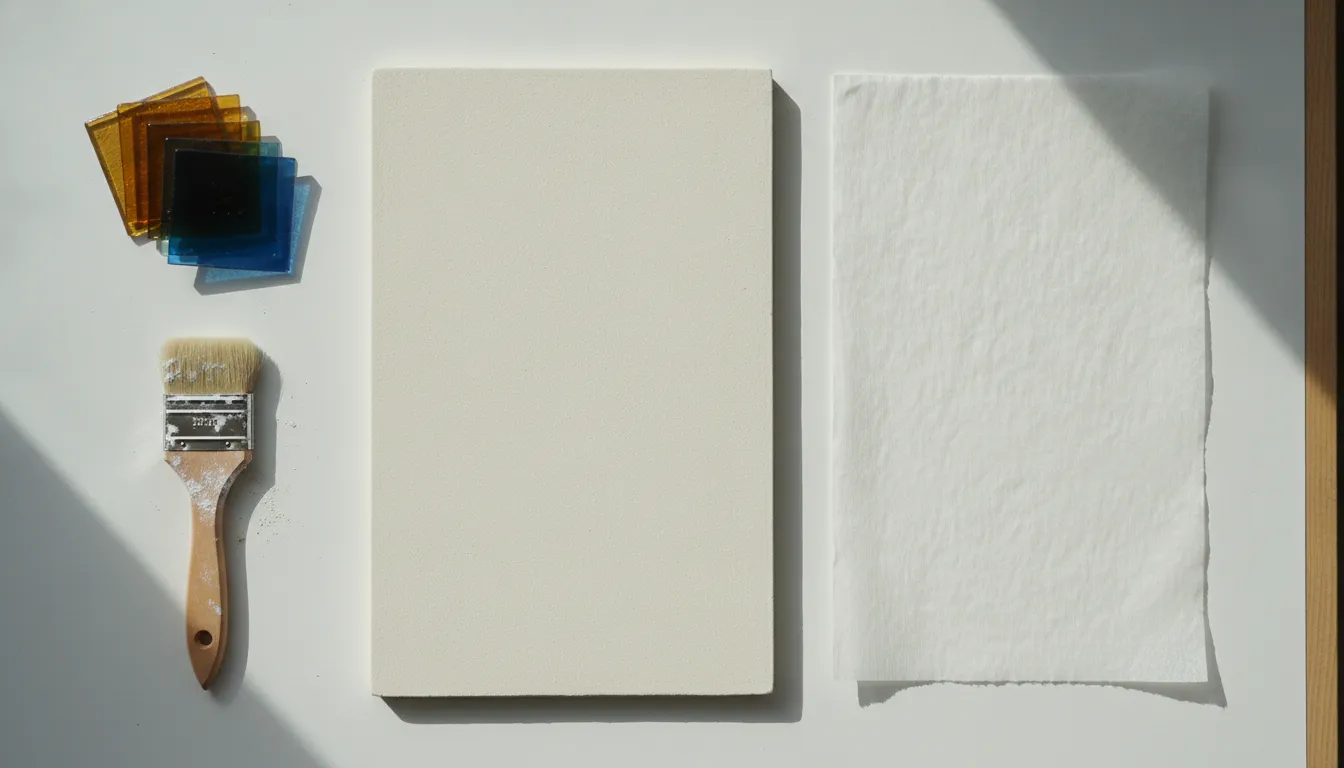
Kiln shelf primer for a first firing is the thin barrier between hot glass and a bare ceramic shelf. Without it, softened glass can stick, chip the shelf, and ruin the piece. You do not need a full studio kit to get this right. You need one clean shelf, one separator that matches the project, and a test piece you can afford to lose.
Choose a kiln shelf primer or shelf paper
What Kiln Shelf Primer Does on a First Firing
A kiln shelf is a hard ceramic slab. At fusing temperature the glass softens, its viscosity drops, and the underside wants to wet whatever it touches. Primer, also called kiln wash, is a sacrificial coating of refractory powders such as alumina, silica, and often zircon. It stays put while the glass moves, then lets the cooled piece release.
That release is the whole job. Primer does not change the glass, and it does not make two glasses compatible. Coefficient of expansion, or COE, describes how much a glass grows and shrinks as it heats and cools. Pieces fused into one object need to be in one tested system, COE90 with COE90 or COE96 with COE96. If the expansion does not match, stress builds on the cool-down even when the shelf lets go cleanly.
On a brand-new kiln, treat the first cycle as a burn-in, not a finished artwork. Binders in the brick can smell, and a little brick dust can fall. Use a simple test piece, leave the vents open, and wait until the kiln is about 60 C before you open the door.
Viscosity is the other half of the story. Cold glass is rigid. As it heats, it softens in stages: first enough to slump, then enough to tack, then enough to flow into a full fuse. Primer has to survive that whole path. A coat that looks fine at a low slump can still fail if the glass gets hot enough to spread and find a pinhole. That is why the first firing should be hot enough to matter, and small enough that a stuck corner teaches you something instead of costing you a commission.
Shelf primer also protects the shelf, which is the expensive part people forget. A stuck sheet can pull a chunk out of the ceramic when you pry it. Patching that divot is harder than brushing three more coats. If you already own a kiln and you are only now buying glass, the shelf is the supply to settle before you order a stack of sheet.
Primer, Shelf Paper, or Fiber for the First Shelf
Three separators cover almost every first firing. Pick by the surface you want and by how much cleanup you will tolerate, not by brand loyalty.
| Separator | Best first use | Underside | After the firing |
|---|---|---|---|
| Brushable shelf primer. | A reusable shelf for flat fusing and simple slumps. | Smooth to lightly textured, depending on the coat. | Inspect, patch thin spots, and recoat when it flakes. |
| Single-fire shelf paper. | A clean shelf when you want no mixing and no scraping. | Even matte finish. | Discard the burned sheet and lay a new one. |
| Ceramic fiber paper. | A thicker barrier, a dam, or a textured base. | Softer texture that can imprint. | Single use. Control the dust when you lift it. |
Hotline Primo Primer is the brushable option stocked for glass shelves and molds. Creative Glass Guild’s product sheet rates that primer to 1550 F (843 C) and higher, and a fired coat brushes or wipes off instead of needing a hard scrape. ThinFire and Papyros are the single-fire papers: lay them flat, fire once, and skip the wash. Fiberfrax at 1/32 inch can line a shelf. The 1/8 inch sheet is thick enough for a dam or a pot melt, which is more than a first flat fuse needs.
For a first full fuse of two or three layers of 2 mm or 3 mm sheet, shelf paper is the lower-risk setup. You avoid a lumpy first coat, and you can see that the glass never touched bare ceramic. Switch to primer once you are firing the same shelf often and want a reusable surface. Keep fiber for texture, dams, and projects that need a real cushion.
When primer is the better first buy
Buy brushable primer first if you expect to fire the same shelf every week. A jar covers many cycles, and a damp sponge resets Hotline-style primer between loads. It is also the right coat for a ceramic slump mold, where a flat sheet of paper will not follow the curve. Spray the mold only if the product is made for molds. A boron nitride spray such as ZYP is for stainless, ceramic, and graphite molds, not a substitute for the shelf coat under a flat fuse.
Buy shelf paper first if this is your first week with the kiln. You will spend more per firing, and you will skip the failure mode that catches new coaters: ridges that print into the glass, and thin spots that grab. Paper also makes a fair test of the kiln itself. If the test piece comes out the wrong size or the wrong texture. You know the schedule or the kiln was the cause, not a bad coat of wash.
Buy fiber first only when the project needs it. A pot melt, a thick dam, or a textured base is a second project, not the burn-in. Fiber dust is finer than primer dust. Cut it on a surface you can wipe, and do not shake the scrap into the room.
The ongoing comparison of wash, paper, and fiber across firing ranges lives in the glass fusing consumables guide. Use that when you are choosing separators for later work. This page stops at the first shelf.
How to Prepare Kiln Shelf Primer Before You Load Glass
If you choose primer, follow the label on that jar. Brands are not interchangeable. A common Hotline-style mix is about one part powder to five parts water, while many traditional kiln washes are mixed thicker, closer to pancake batter. Too much water leaves bare patches. Too little water cracks and flakes in the heat.
- Wipe the shelf with a damp cloth and let it dry. Dust under the coat becomes a stuck spot.
- Stir a small batch. Coat only the top face, and stop short of the edges so flakes do not fall onto the kiln floor or the elements.
- Brush three thin coats rather than one heavy coat. Let each coat dry, about an hour for a traditional wash, before the next.
- If the product label asks for a pre-fire, run that empty cycle before any glass goes on. Hotline-style primer is often pre-fired near 260 C so the water is gone.
- Set the dry shelf on posts, not directly on the kiln floor. The air gap lets heat move evenly.
The longer mixing and disposal notes are in the kiln wash guide. Read them before you scrape an old shelf. Dry primer dust and fiber dust irritate lungs, so mix wet, wipe wet, and do not blow dust around the studio with compressed air.
A coat can look dry and still hide water. If you load glass onto a cool, damp shelf, that water turns to steam under the glass and can push bubbles into the underside. Give the last coat a full dry, then the short empty pre-fire the label asks for. The pre-fire is not the art firing. It drives off water and lets you see cracks before glass hides them.
Store the leftover mix only if the label allows it. Many artists mix a fresh cup each session because a watery jar separates overnight and the next coat goes on thin at the edges. Label the powder jar, keep it closed, and keep it off the same shelf as food containers. The powder is a studio chemical, not a kitchen staple.
Shelf paper skips most of that. Cut it a little smaller than the shelf so edges do not curl into an element. Smooth it flat. One sheet, one firing. Overlap or a wrinkle will print into the glass once the glass softens.
Load a First Project That the Shelf Can Release
Keep the first load small and in one glass system. Two squares of the same COE, stacked, tell you more than a complex design. If you are still choosing that glass, start with the COE90 sheets or the COE96 sheets and stay inside the line you pick. A separator will not save a mix of the two.
Check four things before you close the lid:
- No bare ceramic shows under the glass. Pinholes in primer are future stuck spots.
- The glass sits fully on the separator, with a margin so a full fuse can spread.
- Nothing touches an element, a thermocouple, or the kiln wall.
- Vents are open for a new kiln’s first cycle, and the piece is one you can discard if brick dust falls.
Use the schedule in your kiln manual for a full fuse of that thickness. Do not copy a chart from another studio. Kilns run hot or cool relative to the display, and the first firing is how you learn yours. Annealing, the controlled cool through the range where the glass turns rigid, is what keeps a compatible piece from cracking. Opening early wastes the primer work you just did.
Leave a finger-width of separator around the glass. A full fuse spreads. If the edge of the glass reaches bare shelf, it sticks even though the center released. On a small test, that margin also keeps the piece away from a post or a thermocouple you did not notice while loading.
Write down three numbers before you press start: the glass system, the number of layers, and which separator you used. After the firing, add whether the piece released and whether the underside is matte, ridged, or shiny. That note is worth more than another jar of primer. The next firing should change only one thing, either the coat or the schedule, so you can tell which change fixed a stick.
Planning the glass stack itself is a different job. The first fused glass project guide covers size, layers, and what to record. Pair that with home studio safety before you fire: ventilation, eye protection, and a clear path around a hot kiln.
Read the Shelf After the Kiln Is Cool
Wait until the kiln is near room temperature. Then look at the glass and the shelf as a pair.
- Clean release, even underside: the separator did its job. Note the schedule and the shelf setup.
- Glass stuck in a shiny patch: the coat was thin, scraped off, or missing. Recoat that area before the next firing, or switch to a fresh sheet of paper.
- Flakes stuck to the glass: the coat was too thick, or an edge was painted. Scrape only after you have dust control, then apply thin coats again.
- A bubbled or sandy underside on thin sheet: the base may have been too thin for that separator at a high fuse. A later firing can move to fiber paper. That choice is covered in the consumables guide, not here.
- Needle points or sharp edges: the glass got hot enough to move. Dull them after cooling. They are a handling hazard, not a primer failure.
Do not brush the kiln lid to clean first-firing dust. Brushing the lid knocks more brick loose onto the next shelf. Vacuum or brush the floor of the chamber only, with the shelf already out.
Shop fusing supplies for the next firing
Frequently Asked Questions
Do I have to use kiln shelf primer on a brand-new shelf?
You need a separator on day one, and brushable primer is only one way to get it. Single-fire shelf paper or a sheet of fiber paper also keeps bare ceramic away from the glass. What you cannot do is fire straight on an uncoated shelf. Because hot glass bonds to it and can pull a chip out of the ceramic when it cools.
Can I skip primer and fire on shelf paper instead?
Yes. ThinFire or Papyros is a sound first-firing choice when you would rather not mix a powder. Lay one flat sheet, fire it once, and throw the burned paper away. You will buy a new sheet each cycle, and you will skip both the mixing and the scraping that a kiln-wash shelf needs between firings.
Will shelf primer let me fuse COE90 and COE96 together?
No. Primer only separates the glass from the shelf. It does not change how the glass expands. COE90 and COE96 grow and shrink at different rates, so fusing them in one piece builds stress during the cool-down. The piece can crack after a perfect release.
How do I know the primer coat is thick enough?
After the last coat dries, you should not see the shelf color through it, and the surface should look even rather than ridged. Three thin coats protect better than one heavy coat, which tends to crack. If a later piece sticks in one dull spot, that spot was too thin and needs a patch before the next load.
What should I fire while I test a new kiln and a new shelf?
Fire a small stack of compatible scrap, not a gift or a finished commission. A new kiln can shed a little brick dust, and it can smell while the binders in the brick burn off. Leave the vents open, and open the door only after the kiln has cooled to about 60 C or lower.
Set the Shelf, Then Fire Something Small
Kiln shelf primer for a first firing is a setup choice, not a shopping spree. Coat the shelf in thin layers, or lay one sheet of shelf paper. Keep the glass in one COE system, and spend the first cycle on a test piece. When the shelf releases cleanly, you have a surface you can trust.